Showing posts with label meaning. Show all posts

Saturday, 4 October 2014

Bits of information in 2049

individual
INTERPERSONAL : SCIENCES
humanistic ------------------------------------------- mechanistic
SOCIOLOGY : POLITICAL
group
Who?Kill the Moon
1 0
0 1
Dr

Tuesday, 30 September 2014

Bits of information a-cross the centuries - Bad Tidings & The Love Letter

As noted previously on W2tQ the significance of information practically and as a concept is very obvious in health and social care. Not just the debate about assuring privacy and confidentiality of clinical records and professional disclosure, but the meaning of information to an individual. This is assuming that the person concerned has the mental capacity to recognise what a particular circumstance, event, item of news means; and not just this morning, but tomorrow...

A diagnosis, lab result, a date for this procedure or that operation all can be a major source of anxiety and stress.

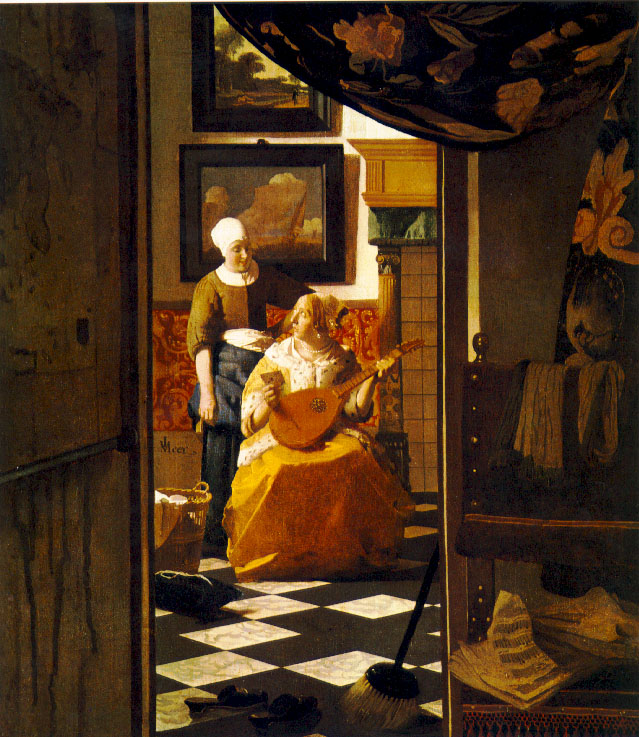
This week's visit to Amsterdam also included a visit to the Stedelijk Museum, where I saw Jobstijding (Bad Tidings), 1932 / Carel Willink (1900-1983). On Saturday I marvelled at Vermeer's The Love Letter and many other great works at the Rijksmuseum. ...

Through art and these works in particular we can contrast the social impact of information, of news - its meaning past and present with our ongoing preoccupation with binary representation and the information age.

Snail mail may be less common and yet the impact of decisions, news, life events ... remains.

individual
INTERPERSONAL : SCIENCES
humanistic ------------------------------------------- mechanistic
SOCIOLOGY : POLITICAL
group

https://www.rijksmuseum.nl/en/collection/SK-A-1595
Vermeer - The Love Letter
1 0
0 1
http://www.stedelijk.nl/en/artwork/3872-de-jobstijding
Carel Willink - Jobstijding (Bad Tidings)

0 1
1 0

Image sources:
The Love Letter, Vermeer
http://www.sai.msu.su/wm/paint/auth/vermeer/vermeer.love-letter.jpg

Jobstijding (Bad Tidings), 1932, Carel Willink (1900-1983)Stedelijk Museum, Amsterdam, The Netherlands

http://www.pinterest.com/pin/567383253025365412/

Monday, 4 August 2014

why - { Ctrl Alt Del } ?

individual
INTERPERSONAL : SCIENCES
humanistic ------------------------------------------- mechanistic
SOCIOLOGY : POLITICAL
group

Alt

Del
Why?

Ctrl


Ctrl provides the power to decide what/who is 'Alt' and What/Who is 'Del' -eted.
The masses are left to ask why?


My source: Peter Kurilecz - RECORDS-MANAGEMENT-UK at JISCMAIL.AC.UK
A Fresh Start: Ctrl + Alt + Delete - Neatorama

One of the programmers’ pet peeves was that whenever the computer encountered a coding glitch, they had to manually restart the entire system. Turning the machine back on automatically initiated a series of memory tests, which stole valuable time. “Some days, you’d be rebooting every five minutes as you searched for the problem,” Bradley says. The tedious tests made the coders want to pull their hair out.

So Bradley created a keyboard shortcut that triggered a system reset without the memory tests. He never dreamed that the simple fix would make him a programming hero, someone who’d someday be hounded to autograph keyboards at conferences. And he didn’t foresee the command becoming such an integral part of the user experience.
http://m.neatorama.com/2014/08/01/A-Fresh-Start-Ctrl-Alt-Delete/#!buNWwY


Additional link: The Holographic Principle
http://apod.nasa.gov/apod/ap090913.html

Monday, 30 June 2014

Two-day symposium ‘Concerning Relations: Sociologies of Conduct, Care and Affect’ 28-29 Nov. 2014

We are pleased to announce a two-day symposium ‘Concerning Relations: Sociologies of Conduct, Care and Affect’, 28/29 Nov. 2014, University of Exeter. The aim of this exciting international workshop is to bring together leading researchers, practitioners and scholars from care studies, sociology of health and illness, science and technology studies, humanities and philosophy to rethink care. We also plan to publish the results of the workshop.

This interdisciplinary symposium, funded by Foundation for the Sociology of Health and Illness (FSHI) and Exeter University, aims to interrogate the implications of shifting the focus of health care away from ‘delivery’ towards care as an ongoing everyday accomplishment. The situatedness of care relations and how situated care relations are practiced and experienced are vital to understanding the impacts care has upon patients, families and healthcare staff. This shift represents a contrasting view on care, from one that is predicated upon a discourse of absence (of care) or lack (of dignity) to the affective interactional relations between social actors. Such shifts of focus are of prime concern as care may be viewed less as a commodity which can be lost, saved, traded or withheld, but as a relation that is deeply embedded within institutional contexts, of individuals and the social worlds they inhabit.

This symposium examines spaces of collisions, elisions or alignments of social worlds, within which the affective dimension of social life in healthcare may be fruitfully examined. Drawing upon relational concerns as a distinct and distinctive mode of sociological inquiry, the symposium seeks to develop an understanding of care and its consequences that help us get beyond the economics of care as a commodified and managed form of engagement with the ‘other’. Making this shift has huge potential for addressing long-standing, global concerns around ‘cultures of poor care’ or ‘care as absence’, the seemingly intractable problems that are not readily amenable to a quick or even a slow fix.

The symposium examines how the fix, the cure, remains an issue of perspective. Central questions include:
  • What if the ‘problem’ of caring in health care settings was viewed differently, how would the issues be seen through an affective, situated relational perspective, how would an affective orientation resolve or heighten long standing and seemingly intractable problems of institutional care?
  • Is the demand for a cure (the fix) a manifestation of a broader political economy at work, is it a question of the mundane interaction order where contemporary modes of conduct reinforces distance, or is the organisational ‘cure’ simply a manifestation of organisational disease?
  • Can materials, economies, institutional practices and modes of accounting contribute to poor clinical and managerial conduct and do such devices legitimate a focus away from the patient?
Rather than provide a critique with no visible solution, or provide a simplification of institutional mores, a more cogent question may be what or who is now being cared for. Once such questions of central importance to a relational sociology have been attended to, the case for re-imagining the organization of care as a situated accomplishment can be made, a case based upon sound sociological reasoning. This symposium challenges what it means to care.

The organizers would appreciate general information about your possible participation before 15.07.2014. Please reply to: m.schillmeier AT exeter.ac.uk

Kind regards

Michael Schillmeier (Exeter)
Joanna Latimer (Cardiff)
Paul White (Swansea)
Alexandra Hillman (Cardiff)
----------------------
Professor Michael Schillmeier
Schumpeter Fellow / VolkswagenStiftung
Department of Sociology, Philosophy and Anthropology
Centre for the Studies of Life Sciences
Byrne House
University of Exeter
Exeter EX4 4PJ

New Nuevo Neu
Eventful Bodies: The Cosmopolitics of Illness. Ashgate (forthcoming)

http://www.nanomedizin.soziologie.uni-muenchen.de

Sunday, 29 June 2014

"ICU" - Technical Haemorrhage & Chlorophyllic Clots

individual
INTERPERSONAL : SCIENCES
humanistic ------------------------------------------- mechanistic
SOCIOLOGY : POLITICAL
group


ICU - Intensive Care Unit
GIS - Geographical Information System

Wednesday, 25 June 2014

For portals, speak patients' language ( c/o Healthcare IT News )

Mike Miliard's 

in Healthcare IT News is a reminder of accessibility and engagement at the level of a communities languages.

This is one of the reasons why I am committed to using Drupal, to try to make use of its Internationalization capabilities amongst others. 

Thanks to Mike's post I'm now familiar with a 'full court press' as a hospital - enterprise wide no less - seeks to achieve defined patient engagement levels by accessing their electronic health record.

This begs the question of what constitutes the patients' language? I don't just mean the purely linguistic forms of Chinese, Korean, Russian and Greek mentioned in the article. The effort is driven by the statutory demands of meaningful use, but what of the patient's general literacy, IT and health literacies? How do patients make sense of their own health (or another in the role of a carer) not just in a given language, but culturally from a medical sociological and public health perspective? What is the community's vocabulary when it comes to health?

How can we assure that meaningfulness? How can we affirm that use and critically translate use into patient benefits and self-efficacy?

You could also entitle Mike's article as

4 portals speak patients' language

individual
INTERPERSONAL : SCIENCES
humanistic ------------------------------------------- mechanistic
SOCIOLOGY : POLITICAL
group
Health Literacy, Accessibility
Measures (health literacy, patient engagement, health and well-being, clinical outcomes)


Cultural Diversity, Languages, Carer

Internationalization
'Meaningful Use', Standards, Legislation, Policy


When we focus on languages we must remember that listening is a great gift. Whether as health and IT professionals, educators, patients and carers, listening to the care domains can help us integrate diverse social, clinical, policy and technical objectives.

What do these portals say to you?

Mike Miliard twitter

Friday, 13 June 2014

Books: The Geometry of Meaning, Gärdenfors & Geometry and Meaning, Widdows

http://mitpress.mit.edu/books/geometry-meaning
http://www.mitpressjournals.org/doi/pdf/10.1162/coli.2006.32.1.155There are two additions to my library. They are technical in parts and beyond my math and technical abilities, but as background this is essential reading.

The module 1 study, still to be marked provided a prompt to install R and obtain some summary statistics. Widdow's Geometry and Meaning includes details of the software used in the text. See the companion website below. While Gärdenfors' book The Geometry of Meaning is new, Widdow's text is a decade old and so demands some checking of software. I notice there are broken links on the companion site. The book, both in fact are great resources even as they increase the permanence of the geometry upon my furrowed brow...

Dominic Widdows, Geometry and Meaning - Companion website

Related posts:
http://hodges-model.blogspot.co.uk/search/label/conceptual%20spaces

Sunday, 25 May 2014

Contextual annealing: Research rolling - hotter, colder, hotter

In conducting research you focus on the question, then the method follows. You may have to go back to the question (in truth) as the methods available to you present their own opportunities and constraints.

Over the past two months this has been a questionnaire within residential care facilities.

Sometimes a confounding factor is to how to describe the study. It's a bit like the figure-ground illusion. One minute you are thinking of the individual, the care worker; the next moment the organisation.

Perspectives shift all the time. This is one of the roles of Hodges' model. The ability to switch from individual to group (population) and various other perspectives and contexts.

I’ve an image of an iceberg. At any one time the questionnaire study’s above the water, the institutional case study under: but then it rolls.


Saturday, 29 March 2014

Amelia: with Human Steps Lalala

INTERPERSONAL : SCIENCES
humanistic ------------------------------------------- mechanistic
SOCIOLOGY : POLITICAL
individual

Just-be


with us


NO!
Be still!
Just-ice
group - population

My source: Sky Arts 1 and Amelia - my grandmother

Tuesday, 25 March 2014

Extraordinary lives: Demographic influences on academic studies - Life Writing, Life Story Work

Recent reading for studies at Lancaster included
Ethics of Internet Research: Contesting the Human Subjects Research Model

Beyond a week's focus on ethics the above refers to Life Writing:
The study of Life Writing spans many disciplines, and represents 'a fast changing terrain' which is concerned with the study of the writing of lives, encompassing auto/biography as well as aspects of life story that originate outside the written form, such as oral history, testimony, and artifacts such as photography and the visual arts (Jolly, 2001, p. ix). The written text is viewed as a vehicle for an individual's construction of identity, the personal narrative that it records being

…a fundamental means by which people comprehend their own lives and present a 'self' to their audience. (Borland, 1991, p. 71)
...
The multiple approaches taken in Life Writing research can arguably be attributed to the multidisciplinary background of its practitioners. Like Internet researchers, those researching Life Writing have been trained in a variety of disciplines including anthropology, sociology, history, linguistics and literary theory. These various disciplines have contributed a range of insights into the collection of oral history and analysis of the resultant texts (Gluck and Patai, 1991, p. 3). Ethical guidelines for the conduct of Life Writing researchers, such as those published by the Oral History Society in the UK, appear to follow a human subjects model, focussing on the undertaking of the interview, and restricting discussion of the resultant text to issues of copyright. Yet practitioners emphasise the need to remember that as:

…the typical product of an interview is a text, not a reproduction of reality …models of textuality [are] therefore needed. (Gluck and Patai, 1991, p. 3)
What chance is there that Life Writing will be - is being influenced by current demographic and societal trends? Trends and challenges that inevitably present new meanings for history within life and with this new ethical issues? While life writing is clearly an established discipline, how might it develop and what other challenges might apply?

In health and social care Life Story Work is an important part in of assessment and interventions. Has it been discussed, is it appropriate, completed and if so, is this work available and accessible? Do we need people beyond the existing establishment with a dedicated set of skills and knowledge to engage with people diagnosed early on, or will treatments soon make this less of an issue? Will dementia and early dementia especially, with the latest technology prompt new perspectives, or reinforce existing life writing practices? What is an archive? In life story work these people, persons, individuals (and their lives?) are more than subjects.

There are many overlaps already in the mental health state of past and present national leaders, while health services continue to bridge the dementia gap in diagnosis. Biography: world leaders, other recognised lives in Life Story Work and seeking to preserve personal identities in dementia care: clearly these are figures that count.

Thursday, 13 March 2014

Is it a Ship, Mars Mission I, a Biscuit, IPO, or Cyber Attack ...?

No!

It's a 3rd year student nurse, 
several in fact
launched 
on their careers.

It is quite a poignant life changing and affirming moment for everyone involved. Of course, there are instances were qualification is problematic, but this is about the +ve.

For the student of course, this represents a great achievement and the realisation of the responsibilities that suddenly apply. This is tempered by preceptorship as mentor and sign-off mentors remind and reassure.

Our students have jobs and this is heartening to hear. They really are off and up-and-running.

There are graduation celebrations and parties to follow for them, but this past week I wondered about another way to signify this literally professional defining event. A way that accompanies and yet transcends the final page 'sign-off' that clearly does carry volumes of meaning and learning.

There was a fleeting thought that I shared: should I form an arch with the student's mentor for the student to pass through? A laugh.

Heaven forbid that this week and day should be for any student an anticlimax. Speaking of heaven there are of course pledges out there. Which also includes:

Nursing is an art;
and if it is to be made an art,
it requires as exclusive a devotion,
as hard a preparation,
as any painter's or sculptor's work;

for what is the having to do with
dead canvas or cold marble,
compared with having to do with the
living body - the temple of God's spirit?

It is one of the Fine Arts;
I had almost said
the finest of the Fine Arts

- Florence Nightingale, 1868.

As I would like to pass on the (twinned-)baton that is Hodges' model, could there be a form of words that can reflect the entry of a new nurse into our midst; an exchange of words that captures the moment for the student, the mentors, nursing and the public we care for and with?

This may seem twee, archaic, a nod to times of formality, the sense of duty, vocation and hierarchy. This wouldn't be about hierarchy, experience yes. It would be reflexive, a dialogue between these 'professionals' that acknowledges the student's rite of passage, the present moment and the collective future of nursing, of caring and their position in time and the professions' values.


Saturday, 11 January 2014

moon, resources and Materialism


INTERPERSONAL : SCIENCES
humanistic ------------------------------------------- mechanistic
SOCIOLOGY : POLITICAL

individual
http://southbanklondon.com/republic-of-the-moon


group - population

Republic of the Moon
http://southbanklondon.com/republic-of-the-moon
(I missed this when it was in Liverpool!)

Additional links:

NASA Releases New Earthrise Simulation Video

UNODA: Treaty on Principles Governing the Activities of States in the Exploration and Use of Outer Space, including the Moon and Other Celestial Bodies
http://disarmament.un.org/treaties/t/outer_space/text

UNOOSA: 34/68. Agreement Governing the Activities of States on the Moon and Other Celestial Bodies
http://www.oosa.unvienna.org/oosa/SpaceLaw/gares/html/gares_34_0068.html

Images:
Leonid Tishkov, Personal Moon - Republic of the Moon
http://www.artscatalyst.org/projects/detail/republic_of_the_moon_Liverpool/

Omega Speedmaster Moonwatch -
http://www.omegawatches.com/collection/speedmaster/moonwatch/anniversary-limited-series/31130423099002


Monday, 30 December 2013

Le Ballet Mécanique (1924, Fernand Leger) & the axes of Hodges' model

INTERPERSONAL : SCIENCES
humanistic ------------------------------------- mechanistic
SOCIOLOGY : POLITICAL

individual
Le Ballet ?


Le Ballet ?


Le Ballet ?

group - population

The Ballet mécanique faq
http://www.antheil.org/faq.html

My source: Budick, A. (2013) Hymn to progress, Life&Arts, FT Weekend, 14-15 December. p.16.

Friday, 1 November 2013

A book chapter: Spatial semantics - definitions...

This book would appear to be an essential reference in respect of h2cm, the following is from chapter 13:
Spatial semantics is the study of the meaning of spatial language, but what is to be regarded as ‘spatial language’? A moment’s reflection suffices to show that the answer to this question is anything but trivial, since SPACE is not a self-contained ‘semantic field’, but rather constitutes an important part of the background for all conceptualization and meaning (Kant [1787] 1964). Furthermore, the term ‘space’ has been used all too often in an extended, metaphorical sense in Cognitive Linguistics and Cognitive Science, e.g., ‘Space Grammar’ (Langacker 1982), ‘Mental Spaces’ (Fauconnier 1985), ‘Conceptual Spaces’ (Gärdenfors 2000). Hence, an unrestricted interpretation of the term ‘space’ might lead us to think that ‘all semantics is spatial semantics’, a conclusion that not even cognitive linguists would find too attractive. Therefore, the scope of spatial semantics needs to be restricted, and this can and has been done in at least three different ways: by form class, by semantic category, and by communicative function. The three definitions based on these restrictions do not coincide, however, and each leaves something to be desired.

Jordan Zlatev (2007) Spatial Semantics, Chapter 13. In. Hubert Cuyckens and Dirk Geeraerts (eds.) Handbook in Cognitive Linguistics. Oxford, Oxford University Press.

Thursday, 24 October 2013

Arts: "Reflection on a sofa" Hodges' model as a 'memory palace' I

Prior to the New Dynamics in Ageing Showcase this Monday (a great event) I travelled down to London on Sunday morning. I wasn't 100% that morning, nothing specific.

I arrived at noon dropped the bags at the B&B and then took the nine stops from Kings Cross to South Kensington. A few minutes walk brought me to the Victoria and Albert Museum. I was early to collect my timed ticket for the Sky Arts Ignition: Memory Palace exhibition.

After queuing for ten minutes (we Brits eh!) at the proper sign to be told I just had to approach the entrance at the allotted time. I went to check the cafe. This was very nice, on the pricey side and rather busy. It's not easy to find a seat, do self-service and be secure. Anyway it was time for a walk, find somewhere else. Before doing so I went to shop and bought the exhibition book, not a huge tome and quite interesting.

Not far away around the corner I found the Brompton cafe. There were seats here. I ordered a cappucinno. There was a large communal table so I sat there. I was ok for about twenty minutes and then came over all hot and increasingly dizzy. I realised I had to move and quickly so took my jumper off and walked around to the right where there was a bookshop.

It was empty and there was sofa with 'LOVE' emblazoned on it - three times - if I registered this correctly. I could hear the cafe and just see one table through the passage way. At that moment I'd had enough of the individual-group axis and the humanistic-mechanistic took over as I went semi-horizontal.

After a couple of minutes I recovered myself and was able to get up - yes the gyro functions - and carry on my way. I am really grateful for that little space and rest. I was still determined to visit the exhibition and attend the showcase. This was fortunate timing with Sunday the 20th the last day of the exhibition and I wanted to keep it that way.
In the post-apocalyptic world of British author Hari Kunzru’s specially commissioned 10,000 word novella, London has been ravaged by a magnetic storm; all memory, art, writing, and recording has been banned. As one man attempts to remember, alone in his cell, the narrative unfolds.
Zoe Pilger, The Independent - Art review.
“misremembered” ambulance by London-based illustration collective Le Gun
“Once there were great palaces called Hospitals.” In contrast to a dystopian future when the NHS and indeed all medical knowledge has been erased, the idea of basic public services appears miraculous. “It was a time of great wonder,” he writes, referring to the present. This fragment of text is accompanied by a fabulous sculpture of a “misremembered” ambulance by London-based illustration collective Le Gun. A ghoulish figure brandishes a whip and pulls a cart filled with potions that promise ad-hoc, alchemical healing.
Zoe Pilger, The Independent - Art review and image
See page 18-19 of Kunzru’s book.
I started in a memory palace, a book shop. I left to visit another, carrying my own memory palace in my mind.

Hodges' model is a memory palace, vacant, awaiting occupancy by patient, client, or carer. The model acts as a great prompt past, future and the here and now.

Monday, 30 September 2013

Time, History, Technology, Institutions, Transparency and Reflective Practice


Despite the passing of time
refactored as
institutional history
 and
 technical solutions,
reflective practice
and
transparency
in care
remain aspirational.


Image: Sculpture at Prague Congress Center

Sunday, 15 September 2013

Book review "Clinical Intuition in Psychotherapy: The Neurobiology of Embodied Response"

Clinical intuition is something that in formal learning terms is intangible, but in practice is earned and relied upon as a gift of experience. When I first received this book from the author Terry Marks-Tarlow, leafing through I thought the emphasis was on the neurobiology presaging a rather technical read. The references to brain structures, neocortex, brain waves ... seemed to suggest a reductive approach, remote from my conception of intuition in clinical practice. I need not have worried, the initial discussion on the brain and evolutionary development is not just a foundation for what follows but as the title suggests underpins and integrates the whole text. Despite the title and as the foreward advises you do not have to be a psychotherapist to read and appreciate this book. The stall is set from the outset in the introduction which explains that chapter one defines clinical intuition:

Clinical intuition is defined from a neurobiological perspective as a right-brain, fully embodied mode of perceiving, relating, and responding to the ongoing flows and changing dynamics of psychotherapy. (p.3)

The introductory material here is essential foundation reading for people starting a career in psychology and mental health related disciplines. The evolutionary development of the brain from reptile through to the mammalian brain is invaluable. Tying this to specific brain functions and circuits - care, fear, panic, play, lust, rage and seeking - helps integrate brain anatomy, perception, emotion, and behaviour. The advances in neurobiology to follow will no doubt demand that we all extend our understanding of this interdisciplinary fusion.

The book itself (hardback edition) is very well produced, the type face easy to read and the book well structured and with a well balanced mix of illustrations and photographs. The reference listing at the end runs over thirteen pages and is well grounded historically and in having regard to ongoing research. The index is comprehensive (fourteen pages) and a resource itself providing a look-up approach. The book's use of case studies, thirteen in total informs the text and provides some continuity through the book. Dialogue between therapist and client is easy to follow and illustrations are provided with ample explanation in situ. The references also utilize web-based resources.

I recall intuition coming up as a thread on several occasions on the psychiatric-nursing list especially between 1998 and 2004. Intuition is a central quality for all personnel working in health and social care. We must also recognise intuition as a human trait as when non-health professionals exercise the judgement that: "Wait a minute, we need a clinical opinion here." Self-care is also discussed. I had a Pythonesque moment - "Is this the right room for an argument?" - considering psychotherapy as a therapeutic modality within therapies as a whole. Here in the UK (and no doubt elsewhere) self, brief and solution based therapies rule economically. Even though the shortage of psychological intervention is recognised in the UK through IAPT improving access to psychological therapies, we need to ask: how does psychotherapy fare in the current (austerity) climate? To what extent can clinicians exercise intuition? Therapy relies on caseness, relationships and narrative, but to what extent can these be acknowledged and delivered within the economical time frames that frequently operate? 

Although there's no specific chapter on training for clinical intuition, Marks-Tarlow provides a list of how researchers have characterized clinical intuition (more recently in the 1980-1990s); five characteristics are proposed:
  • Sudden recognition;
  • Immediate knowledge;
  • Emergent awareness;
  • Non-verbal insight; and 
  • Holistic integrative sensibilities. (pp.42-43).
 Of the first two sudden recognition and immediate knowledge, I thought of the intuitive sense that is applied upon receiving a referral. That is the assumptions (not always helpful) that arise from the information provided (and missing) and where this leads you? But of course, is this clinical intuition? Intuition as the author makes clear (p.3 and) throughout the book is in psychotherapy. Intuition here (and for me) depends on interpersonal - therapeutic - interaction. What precedes is something else (data integration, hypothesizing, reasoning...?). I can however still see explanatory avenues in the above that can help us travel from the conceptual (reduced) to a holistic whole. I did wonder about the role of intuition in suicidal ideation and risk management, but this is also a question of referral criteria and caseness.

I would very much like to write myself about information and complexity and these themes recur in the text, especially the latter. Several 'spaces' are discussed too: social, physical and spatial schemas. The work of Buzsáki on the hippocampus, navigation and maps - landmark navigation - is fascinating in chapter 7 Navigating the Seas. I have likened Hodges' model to a cognitive periplus - an ancient maritime map. Over the next few months I'll post some quotes from the book.

This is an excellent book that I heartily recommend. The discussion of what is implicit in the brain and so in therapy, what is embodied and wisdom in mentoring invites re-reading. Finally but vitally there is much humour and humanity here too.

Many thanks to Terry Marks-Tarlow for the review copy.

Monday, 1 July 2013

Hodges' model - DSM V: the Politics of (Well-being (Health [Mental Health])) salience, books and domains

INTERPERSONAL : SCIENCES
SOCIOLOGY : POLITICAL

individual
Diagnostic and Statistical Manual of Mental Disorders (DSM-5)
'salience' 
‘Salience syndrome’ replaces ‘schizophrenia’ in DSM-V and ICD-11: psychiatry’s evidence-based entry into the 21st century? J. Van Os

bereavement
medical, bio-psycho-social, recovery model
self-efficacy
self-stigma

DSM5 and Ethical Relativism

Ultimate terminology: 
self, person, patient, service user, client, 
Mr, Miss .....
Diagnostic process
'Evidence', objectivity, 
repeatability, validity, treatment, drugs
Credit Heidi Cartwright, Wellcome Images
The history of DSM: APA : Wikipedia
stigma
social services
social network (size, quality)
anti-psychiatry
social norms?

Media: Books review - essay;
Stevenson, T. (2013) Mind field, FT Weekend, May 25-26. p.8.
American Psychiatric Association APA

dx revision watch

Opinion - commentary:

DSM-5: Caught between Mental Illness Stigma and Anti-Psychiatry Prejudice

Is Criticism of DSM-5 'Anti-psychiatry'?

Goldacre: Bad Pharma
.... and much more...!

group - population


Image: http://wellcomeimages.org/