Showing posts with label empathy. Show all posts

Tuesday, 30 September 2014

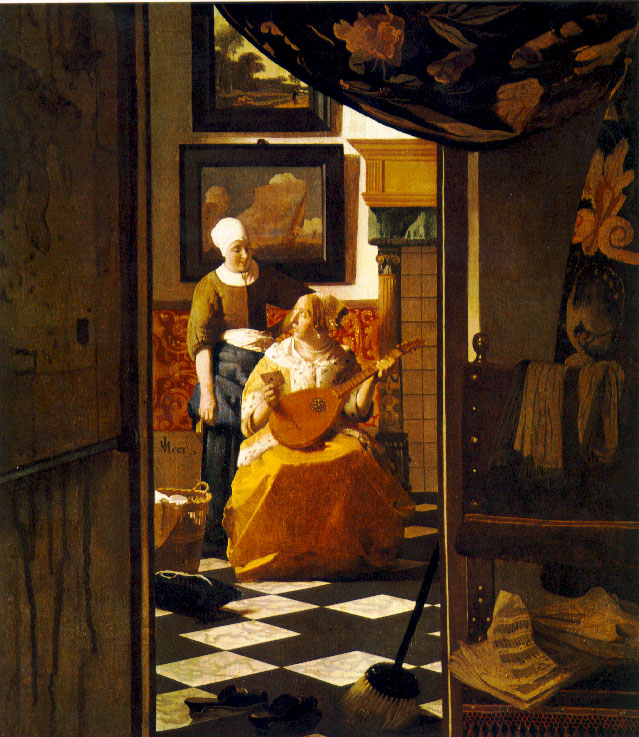
Bits of information a-cross the centuries - Bad Tidings & The Love Letter

As noted previously on W2tQ the significance of information practically and as a concept is very obvious in health and social care. Not just the debate about assuring privacy and confidentiality of clinical records and professional disclosure, but the meaning of information to an individual. This is assuming that the person concerned has the mental capacity to recognise what a particular circumstance, event, item of news means; and not just this morning, but tomorrow...

A diagnosis, lab result, a date for this procedure or that operation all can be a major source of anxiety and stress.

This week's visit to Amsterdam also included a visit to the Stedelijk Museum, where I saw Jobstijding (Bad Tidings), 1932 / Carel Willink (1900-1983). On Saturday I marvelled at Vermeer's The Love Letter and many other great works at the Rijksmuseum. ...

Through art and these works in particular we can contrast the social impact of information, of news - its meaning past and present with our ongoing preoccupation with binary representation and the information age.

Snail mail may be less common and yet the impact of decisions, news, life events ... remains.

individual
INTERPERSONAL : SCIENCES
humanistic ------------------------------------------- mechanistic
SOCIOLOGY : POLITICAL
group

https://www.rijksmuseum.nl/en/collection/SK-A-1595
Vermeer - The Love Letter
1 0
0 1
http://www.stedelijk.nl/en/artwork/3872-de-jobstijding
Carel Willink - Jobstijding (Bad Tidings)

0 1
1 0

Image sources:
The Love Letter, Vermeer
http://www.sai.msu.su/wm/paint/auth/vermeer/vermeer.love-letter.jpg

Jobstijding (Bad Tidings), 1932, Carel Willink (1900-1983)Stedelijk Museum, Amsterdam, The Netherlands

http://www.pinterest.com/pin/567383253025365412/

Saturday, 5 July 2014

i c u

individual
INTERPERSONAL : SCIENCES
humanistic ------------------------------------------- mechanistic
SOCIOLOGY : POLITICAL
group


tears


tears


Avatar image "I see me through your eyes."
te ar s

Wired: Avatar 2, 3 and 4

ICU - Intensive Care Unit
Image: http://i1.ytimg.com/vi/Ek5C0NhnNlA/maxresdefault.jpg

Tuesday, 17 June 2014

Book: The Empathy Exams & Michel Serres Institute

individual
INTERPERSONAL : SCIENCES
humanistic ------------------------------------------- mechanistic
SOCIOLOGY : POLITICAL
group
http://www.lesliejamison.com/
The Natural Sciences
Local, Society & Socio-

-Economic


As recent posts reveal I'm overwhelmed with reading at present. Material that is essential for the TEL course and reading more tangential and yet potentially enjoyable titles. It will be a busy summer as all this is brought together(!?). Especially as I've a literature search in mind as a module submission - progress permitting.

The publication of Jamison's book this (N) spring sits well after the findings last year about the benefits of reading fiction in increasing empathy.

Since 2008-2009 I've lost touch with the work of Michel Serres:

Jones, Peter, Exploring Serres’ Atlas, Hodges’ Knowledge Domains and the Fusion of Informatics and Cultural Horizons (Aug 15, 2007). SOCIAL INFORMATION TECHNOLOGY CONNECTING SOCIETY AND CULTURAL ISSUES. Available at SSRN: http://ssrn.com/abstract=1842504 or http://dx.doi.org/10.2139/ssrn.1842504

- having only just found the Institute. I only scratched the surface of Serres' oeuvre in the above paper and must recharge my reflective capacity.

http://institutmichelserres.ens-lyon.fr/
Book cover image: http://www.ew.com/ew/article/0,,20800427,00.html

My source: The Empathy Exams
FT Weekend, June 7-8, 2014.

Monday, 27 January 2014

'Intellectual brutalisation' and the saving grace and power of poetry

BBC Radio 4 Today: An eminent cardiologist has organised and funded a poetry competition for his medical students to stop them becoming, in his words, intellectually brutalised.
Gabrielle Gascoigne, pictured, is a previous winner.
The BBC’s Jane Dreaper discovers more.

PBS: For these medical students, poetry nurtures the soul

Here's (source: http://www.bbc.co.uk/programmes/b03s6mdp/live ) the full version of Mastectomy - For His Wife, by Gabrielle Ruth Gascoigne:

It will be an honour
to bathe the scars.
Don’t think my tears imply
an ounce of sorrow -
only joy
could fill my eyes.

It will be a pleasure
to hold you close.
Know this – your precious flesh
calls the bluff on gold
and silver -
makes me a king.

It will be a delight
to talk with you
into the night we thought
stolen, clean away -
until day
renews our hope.

It would be too heartless
if all this love,
these sinner’s prayers and more
should fall to nothing
more than rain
on empty streets.

INTERPERSONAL : SCIENCES
humanistic ------------------------------------------- mechanistic
SOCIOLOGY : POLITICAL

individual
subjectivity
insight, rapport, empathy
emotional control, detachment, engagement
risk of burnout
objectivity
anatomy, physiology         
physicality, processes, mechanistic
intellectual brutalisation
humanistic
communication, relationships
(medic) poetry

funding, crowded curricula
hidden curriculum
group - population

Sunday, 16 December 2012

Clusters of empathy

There still is Complexity in Primary Care group but it is now essentially silent. I've met several people through the group over the years.

It might be decades since James Gleick's book Chaos (1987) and yet there is plenty of mileage left in complexity. One of the people I met through the group and hoped to meet in Australia at the ICN Congress is Paul Bennett who informed me of the following paper:

Academic Psychiatry, 33:6, Nov-Dec 2009 p.489
Winseman, J., Malik, A., Morison, J., Balkoski, V. (2009) Students’ Views on Factors Affecting Empathy in Medical Education. Academic Psychiatry. 33:484–491.

In explaining Hodges' model to Paul he was struck by the conceptual clustering in this paper. It isn't that there is a direct match between the paper's figure 2 and the care (knowledge) domains of the model, but multidimensional scaling is a potential tool to explore Hodges' model too.

The influence of political factors in medical education might be another aspect to consider. This is a dimension Hodges' model can encompass.

An acute concern at present in the NHS is the prospect of a seven day service, necessitating changes to the contracts of doctors and other disciplines.

Thanks to:
Paul Bennett, Primary Health Care Education Officer
Broken Hill University Department of Rural Health - Broken Hill
PO Box 457, BROKEN HILL NSW 2880
http://sydney.edu.au/medicine/drh/

Friday, 6 January 2012

Masquerade in health care but on which level?

There is a Drupal module called Masquerade, the project page explains:
The masquerade module is designed as a tool for site designers and site administrators. It allows a user with the right permissions to switch users. While masquerading, a field is set on the $user object, and a menu item appears allowing the user to switch back. Watchdog entries are made any time a user masquerades or stops masquerading.
Life frequently asks more of us and the same applies for employees in whichever employment sector. For teachers and nurses they know the call. As a nurse you adopt the mask of the uniform and the role. You may not actually carry the lamp, but it's there. Sometimes it helps light the way; for the public, for you. If you are a 'bad' nurse - whether your attitude put the lamp out this morning, yesterday, or several years ago -  the darkness that follows you about speaks volumes.

It prompts Prime Ministers to make announcements:

PM announces new focus on quality and nursing care

06 January 2012 12:54
A new drive to free up nurses to provide the care patients and relatives expect has been announced today by Prime Minister David Cameron and Health Secretary Andrew Lansley.

The push will see nurses spending more time on front line care in wards and other services, a senior ward nurse with whom the buck stops, patients leading on inspections and a new 'friends and family test' to show whether nurses and patients had a good overall experience, or would want loved ones needing care to be treated at each hospital.
Prime Minister David Cameron said:
“We know the vast majority of patients are very happy with the care provided by the NHS. And I’ve seen the NHS at its very best. But we have heard recently that in some hospitals patients are not provided with the level care or respect they deserve and I am absolutely appalled by this.
“If we want dignity and respect, we need to focus on nurses and the care they deliver. The whole approach to caring in this country needs to be reset. And it needs to start with this simple fact. Caring for patients is what nurses do. Everything else comes second."
<->

While we all play masquerade there are many levels. As a 'nurse' it's difficult (but never impossible) to play the caring, skilled, knowledgeable, patient, warm, efficient ... representative AND ensure all records are maintained, letters written, all communications logged, targets achieved, electronic records and data gathering requirements met. ... If you need a steer-clear from the stereotypical image of Angels, then you should see the faces nurses pull behind the mask trying to satisfy the audience.

That audience does not just include managers, patient representatives, inspection agencies but policy makers and politicians. Of course the latter are expert proponents of masquerade (they practice through a 4-5 year cycle).

Closer to home and the Drupal module? Well, I can't see a role for masquerade on a new h2cm website, but the thought crosses my mind of general nurses masquerading as mental health nurses; social workers masquerading as nurses. ... Although I'm playing games :-) it makes you think about what we mean by 'multidisciplinary'. To what extent, for example, is care of people living with dementia being missed because these disciplinary distinctions - silos really do still prevail? Surely the nursing issue isn't just a lack of light?

This announcement is not exactly news given what has gone before in the UK media through 2011.

What is strange is that this policy should emerge in 2012: The Alan Turing Year.

Yes, nurses DO need time to care, but perhaps we also need a test for empathy and rapport and not just intelligence?

Monday, 12 December 2011

Student placements and public engagement - over the years

Mentoring student nurses has always been and remains a non-trivial professional obligation. It is something that I have always enjoyed. I make a point of not wittering on and on about h2cm - well maybe a little :) . To save the student's patience and assure my time it is good to ensure a well-rounded placement.

Over the years I've engaged in community service and research projects so looking to the humanistic domains comes naturally. It's been quite interesting watching the various efforts the health sector has made to engage the public. There's no imperative, but I make a point of highlighting the possible learning to be had in contacting the local public involvement and engagement people. Students have found this to be quite enlightening. Encounters with the Community Health Council [CHC] especially so, although that seems a long time ago now.

The Health Service Journal (still catching up) reminded me of all this in the summer, c/o Calkin & West, 4 August 2011 pp. 4-5. This news item spanned my whole career outlining the history of such bodies:
I even remember the demise of the CHC being reported. Actually no, correct that: I remember the report of the CHC's teeth being taken out before their end. As you look at the timeline represented above it seems to suggest either less stability, or less significance has set in; maybe both. The title of the above piece reads: Plans for engagement are 'insulting'.

Whether or not the CHC ever had sharp canines (with an extra full-moon glisten) and a bite force like a croc is something for the archaeologists to check. One thing for sure, it seems subsequent bodies have no need of dental check-ups, being sans teeth.

Working in the community it was heartening to see the CHC doing its work locally. I also read recently (HSJ I'm sure) how public involvement was finally enshrined in the The National Health Service Act 2006. So you see how progressive the CHC was. It is a great shame this momentum cannot be maintained - for reasons we'll return to in 2012.

For now, as students enter their third year I think it helps to bring life to the POLITICAL care domain. It matters. This ongoing issue is central to health services provision, planning, innovation and the commons ...