Showing posts with label love. Show all posts

Tuesday, 30 September 2014

Bits of information a-cross the centuries - Bad Tidings & The Love Letter

As noted previously on W2tQ the significance of information practically and as a concept is very obvious in health and social care. Not just the debate about assuring privacy and confidentiality of clinical records and professional disclosure, but the meaning of information to an individual. This is assuming that the person concerned has the mental capacity to recognise what a particular circumstance, event, item of news means; and not just this morning, but tomorrow...

A diagnosis, lab result, a date for this procedure or that operation all can be a major source of anxiety and stress.

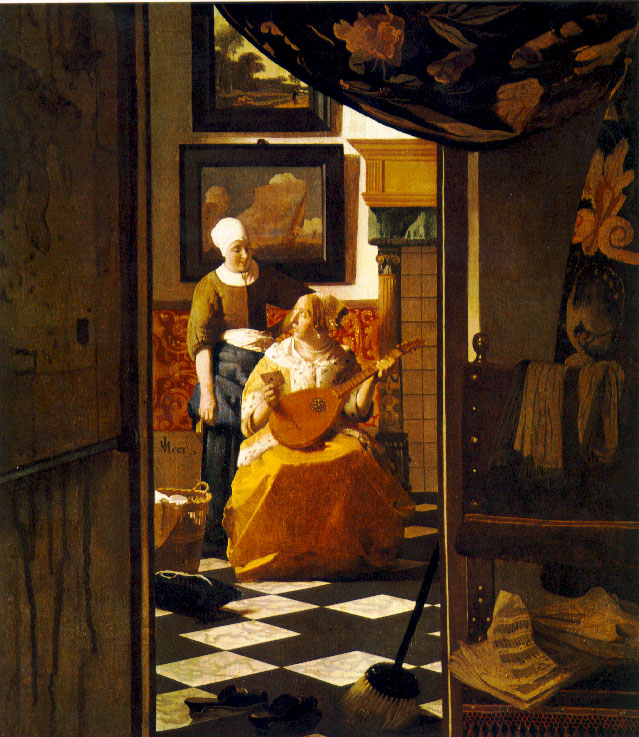
This week's visit to Amsterdam also included a visit to the Stedelijk Museum, where I saw Jobstijding (Bad Tidings), 1932 / Carel Willink (1900-1983). On Saturday I marvelled at Vermeer's The Love Letter and many other great works at the Rijksmuseum. ...

Through art and these works in particular we can contrast the social impact of information, of news - its meaning past and present with our ongoing preoccupation with binary representation and the information age.

Snail mail may be less common and yet the impact of decisions, news, life events ... remains.

individual
INTERPERSONAL : SCIENCES
humanistic ------------------------------------------- mechanistic
SOCIOLOGY : POLITICAL
group

https://www.rijksmuseum.nl/en/collection/SK-A-1595
Vermeer - The Love Letter
1 0
0 1
http://www.stedelijk.nl/en/artwork/3872-de-jobstijding
Carel Willink - Jobstijding (Bad Tidings)

0 1
1 0

Image sources:
The Love Letter, Vermeer
http://www.sai.msu.su/wm/paint/auth/vermeer/vermeer.love-letter.jpg

Jobstijding (Bad Tidings), 1932, Carel Willink (1900-1983)Stedelijk Museum, Amsterdam, The Netherlands

http://www.pinterest.com/pin/567383253025365412/

Saturday, 7 December 2013

Reading and writing the minutia of locked doors and windows (still a draught)

Couples, married or not, partners are the cards that frequently, if not by definition, lean on each other beyond the pale, to the n-th degree. Witness so many lessons of what love really is.

They bend and flex. Tested by history, timelines entwined, ties-that-bind, trying to persist in the hear and how.

Their psychological union is challenged as memories become eroded and physically frailty takes hold. Usually; mostly, on the one.

Eventually things, established relationships break and one or the other - should we say: finds themselves in - residential care.

Courtship enables us to become socialised to and with each other and respective families and in some instances other cultures and beliefs.

In this crucial transition sometimes there is learning through experience as respite care is sought.

In other cases health services wonder how this relationship has survived for so long. A crisis is a precipice for change. A chaotic invitation. Radical.

A sudden shift from what was home to a new world of corridors, r, ro, roo, room, rooms; my room? New noises and smells and altered routines and jumbled faces, touches, days and nights

The dolls of childhood are left behind, but may be picked up again literally as an emotional comforter. If not this then perhaps a ‘paper clad dol’ that is bound to be - ‘deprivation of liberty’.

In this new home, this person walks the corridor and inspects the minutia of the doors and windows. Staff pass by(e) waving by their walk - "so-busy-look-no-hands" while trying to be butterflies.

Butterflies that cannot say which way is ‘out’.

They are they. Difficult to follow with eye, head and a hand to catch. The individual recognises the whole of the comings and goings, the main thoroughfare. The strategic point, the nexus of comings and goings.

Something's not right though! I need to be somewhere else.

Sadly (or Usually), there is no going back.

Is there a pattern to this confused-coming-to-terms-with?

From asking repeatedly about being elsewhere, especially with the setting of the sun is there a shift in attempted reasoning? So correct, so responsible all those decades ago. Perhaps even months ago...

If no one will listen to me then perhaps if I have my wife/husband with me then they will see the importance of my cause, my mission.

See look - I have my wife, husband, partner with me now: we really need to go!

Can the residential care home support this person? Can they meet their care needs? They say they are ‘struggling’. Will they need to move – again?

How do they work through this transition? What do we know of how individuals negotiate this transition in their lives? How can we try to understand?

How do they make sense of what has happened, and where they now find themselves? Will their level of distress, agitation gradually extinguish as with their efforts to leave?

As they look to the windows, seek to traverse the doorway, cross the foreign threshold and venture to that somewhere that is not here, we know one thing.

Person centredness lies in the minutia of the life once lived through those locked doors and windows.

We can ‘open’ the doors and windows by travelling with them, together, sharing that journey, the sense of those times and upon returning help them adjust to this new listen and how. Clearly, deprivation of liberty is not a punishment here, yet it demands compensation by provision of high quality personalised care.

Sunday, 24 March 2013

Society (global trends?) that diminishes the greatest gifts

Last December 15th -16th Harry Eyres' column The Slow Lane in the FT Weekend (p.24) pointed me to the New Economic Forum's pamphlet entitled The New Materialism. Mr Eyres wrote about the The most precious gifts and the fact that things do not last like they used to. Quality lies in things that last, things that are worth repairing and repairable.

The piece prompted me to think back about some of the children's toys. Very gratefully received as gifts, guilt sprung when more of an impulse (impelled) buy: what about the amount of plastic, the oil, the probable lack of longevity in use, the longevity in decay and the some-other-where of waste and disposal?

Recall then the joys of the wooden train set, with non-toxic paint... The toy flung aside as the cardboard box is tossed, turned and crawled into and puzzled about. The reflection took me around a few towns too, the pound shops. It's good when you really can afford to make a choice about what you buy, about quality. The hammer, clearly not ready for hand: unbalanced once home. I'm not saying all 'cheap' screwdrivers are the same, but the slightest amount of torque and the handle is undone. Probably the one cheap find and sometimes free are the watchmaker's screwdriver sets. Eye-saving when the screw on the side of my glasses comes loose and the lens falls out on something soft thus far.

All the mass production and lack of love and care invested in making things - the loss of true craft, as Mr Eyres points out, makes me wonder whether this also pollutes the way we value our health.

Like so much advertising - conditioning - we recognize the true significance of what is happening only when forced to and we ourselves suffer a failure and 'break' in some way, to some degree.

This issue is provoking various responses. An example being Beck's Song Reader, an album released solely as sheet music.

http://www.ft.com/cms/s/2/0b4a2066-06f8-11e2-92b5-00144feabdc0.html#axzz2NyOTAcgA