Showing posts with label news. Show all posts

Tuesday, 30 September 2014

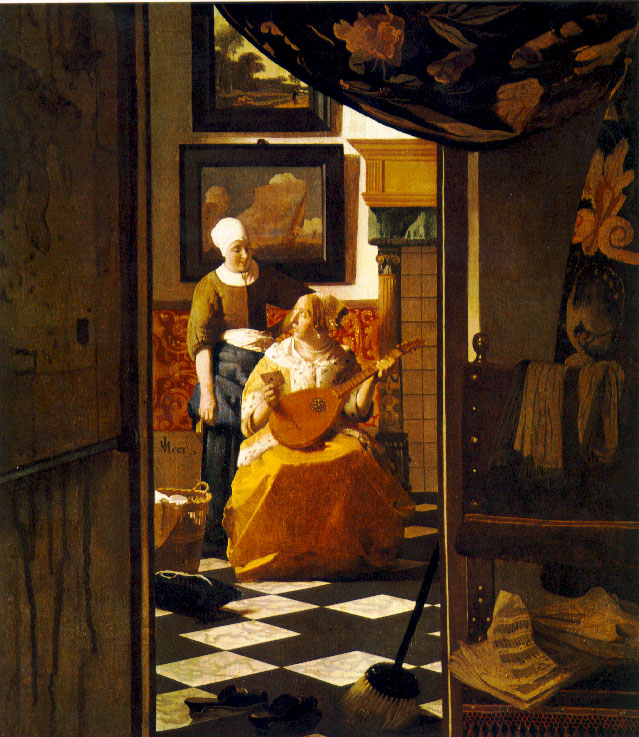
Bits of information a-cross the centuries - Bad Tidings & The Love Letter

As noted previously on W2tQ the significance of information practically and as a concept is very obvious in health and social care. Not just the debate about assuring privacy and confidentiality of clinical records and professional disclosure, but the meaning of information to an individual. This is assuming that the person concerned has the mental capacity to recognise what a particular circumstance, event, item of news means; and not just this morning, but tomorrow...

A diagnosis, lab result, a date for this procedure or that operation all can be a major source of anxiety and stress.

This week's visit to Amsterdam also included a visit to the Stedelijk Museum, where I saw Jobstijding (Bad Tidings), 1932 / Carel Willink (1900-1983). On Saturday I marvelled at Vermeer's The Love Letter and many other great works at the Rijksmuseum. ...

Through art and these works in particular we can contrast the social impact of information, of news - its meaning past and present with our ongoing preoccupation with binary representation and the information age.

Snail mail may be less common and yet the impact of decisions, news, life events ... remains.

individual
INTERPERSONAL : SCIENCES
humanistic ------------------------------------------- mechanistic
SOCIOLOGY : POLITICAL
group

https://www.rijksmuseum.nl/en/collection/SK-A-1595
Vermeer - The Love Letter
1 0
0 1
http://www.stedelijk.nl/en/artwork/3872-de-jobstijding
Carel Willink - Jobstijding (Bad Tidings)

0 1
1 0

Image sources:
The Love Letter, Vermeer
http://www.sai.msu.su/wm/paint/auth/vermeer/vermeer.love-letter.jpg

Jobstijding (Bad Tidings), 1932, Carel Willink (1900-1983)Stedelijk Museum, Amsterdam, The Netherlands

http://www.pinterest.com/pin/567383253025365412/

Sunday, 13 October 2013

Health, Art and The Reith Lectures 2013 (and the search for the perpetual umbilicus)

This week sees the start of The Reith Lectures on BBC Radio 4 by Grayson Perry.

The question is: who decides on what makes art good?

Perry writes in the Financial Times Weekend:
Clement Greenberg, a famous art critic in the 1950s, said that art will always be tied to money by an umbilical cord of gold, either state money or market money. I'm pragmatic about it: one of my favourite quotes is you'll never have a good art career unless your work fits into the elevator of a New York apartment block.
Once born into the world, the umbilical cord that transfers and imbues life and sustenance no longer matters physically. It is the social ties that bind, according to the lyrics and life experience.

In health and social care we need to find a perpetual umbilical cord that makes well-being and health not just something to take for granted. Not some thing that is only noticed when the piece of art won't fit into the elevator any longer.

This is the challenge in health care. A challenge that will see art movements and markets come and go. The solutions will rely on science, technology and art.

@science @technology @art 
each brings its own engineering.

We need tools that facilitate self-care when needed. Cognitive engineering that people can call upon by virtue of the combined literacies they possess. Self-care that is delayed due to self-knowledge.

Cognitive tools people can take anywhere; from elevators in New York and doors to apartments, yurts in Mongolia, the multitude of tents in Jordan to the terraced houses near Wigan Pier ...


Financial Times, Grayson Perry’s Reith Lectures: Who decides what makes art good? October 11, 2013 7:16 pm

Thursday, 6 June 2013

Government steps in to settle medical dispute over digital patient records - Canada

REGINA - The Saskatchewan government has stepped in to help three Regina doctors who were having problems getting their patients' digital medical records from the clinic where they used to work.

The office manager at the Gateway Alliance Medical Clinic says efforts to get the electronic records from the Midway Walk-in Healthcare Centre had been ongoing for two months.
Robin Anderson says Midway transferred paper files as required by Saskatchewan law, but not the digital records.

http://bit.ly/14xRYgS

My source: Peter Kurilecz - Records Management List

Information and Records Management Society