Showing posts with label mechanistic. Show all posts

Tuesday, 30 September 2014

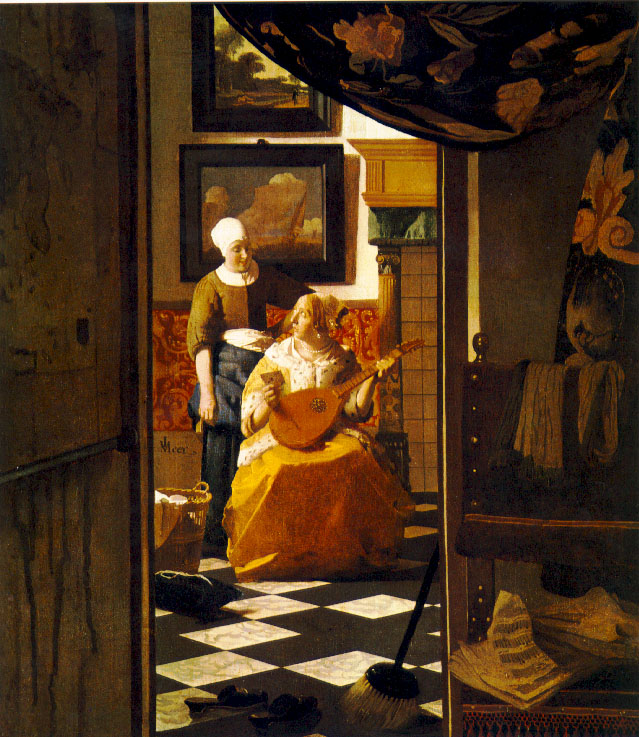
Bits of information a-cross the centuries - Bad Tidings & The Love Letter

As noted previously on W2tQ the significance of information practically and as a concept is very obvious in health and social care. Not just the debate about assuring privacy and confidentiality of clinical records and professional disclosure, but the meaning of information to an individual. This is assuming that the person concerned has the mental capacity to recognise what a particular circumstance, event, item of news means; and not just this morning, but tomorrow...

A diagnosis, lab result, a date for this procedure or that operation all can be a major source of anxiety and stress.

This week's visit to Amsterdam also included a visit to the Stedelijk Museum, where I saw Jobstijding (Bad Tidings), 1932 / Carel Willink (1900-1983). On Saturday I marvelled at Vermeer's The Love Letter and many other great works at the Rijksmuseum. ...

Through art and these works in particular we can contrast the social impact of information, of news - its meaning past and present with our ongoing preoccupation with binary representation and the information age.

Snail mail may be less common and yet the impact of decisions, news, life events ... remains.

individual
INTERPERSONAL : SCIENCES
humanistic ------------------------------------------- mechanistic
SOCIOLOGY : POLITICAL
group

https://www.rijksmuseum.nl/en/collection/SK-A-1595
Vermeer - The Love Letter
1 0
0 1
http://www.stedelijk.nl/en/artwork/3872-de-jobstijding
Carel Willink - Jobstijding (Bad Tidings)

0 1
1 0

Image sources:
The Love Letter, Vermeer
http://www.sai.msu.su/wm/paint/auth/vermeer/vermeer.love-letter.jpg

Jobstijding (Bad Tidings), 1932, Carel Willink (1900-1983)Stedelijk Museum, Amsterdam, The Netherlands

http://www.pinterest.com/pin/567383253025365412/

Wednesday, 4 June 2014

Would you let a robot take your blood?

A Robot With A Hypodermic Needle 

Written by Lucy Black
27 July 2013

Would you let a robot take your blood? The answer to this question illuminates our real relationship to machines that aspire to rise above the robot vac. Is there another sort of uncanny valley?

Veebot is a very clever use of some basic image processing plus some very accurate positioning mechanisms. It first locates a good vein using infrared. Once it has a target it switches to ultrasound to make sure that there is enough blood flow to make it worth inserting the needle.

More...


My source:
International Society for Presence Research: June
http://ispr.info/


individual
INTERPERSONAL : SCIENCES
humanistic ------------------------------------------- mechanistic
SOCIOLOGY : POLITICAL
group
trust, confidence, anxiety, expectations, 'needles' - phobia, previous experiences, model of the 'other', intelligence, physical tests to differentiate mental health problems, subjective feelings - 'creepiness'
human
pa
safety, measurement, imaging, mechanics, technology, electromagnetic spectrum, infra red, ultrasound, motion, accuracy, research, trials, evidence, logic, blood sample,  appearance, (surgical robots R-here)
factors
in             RFT - 'right first time'
public awareness, interaction, relationships, community of practice - acceptance, publicity, media, dissemination
investment, policy, certification, law, standards, testing, supervision, labour relations

Saturday, 12 April 2014

ERCIM News No. 97 Special theme: "Cyber-Physical Systems"

Dear ERCIM News Reader,

ERCIM News No. 97 has just been published at http://ercim-news.ercim.eu/en97

Special theme: "Cyber-Physical Systems"
http://ercim-news.ercim.eu/en97/special/

Guest editors
:
- Maria Domenica Di Benedetto, University of L’Aquila, Center of Excellence DEWS
- Françoise Lamnabhi-Lagarrigue, CNRS, Laboratoire des Signaux et Systèmes
- Erwin Schoitsch, AIT Austrian Institute of Technology/AARIT.

http://ercim-news.ercim.eu/en97Keynote: "The Importance of Cyber-Physical Systems for Industry" by Clas Jacobson, Chief Scientist for United Technologies Systems & Controls Engineering, USA

This issue is also available for download as:
pdf
:  http://ercim-news.ercim.eu/images/stories/EN97/EN97-web.pdf
epub: http://ercim-news.ercim.eu/images/stories/EN97/EN97.epub

Next issue: No. 98, July 2014 - Special Theme: "Smart Cities"
(the call will be published shortly at http://ercim-news.ercim.eu/call)

Thank you for your interest in ERCIM News.
Feel free to forward this message to others who might be interested.

Best regards,
Peter Kunz
ERCIM News central editor

Includes:
Optogenetics to Unravel the Mechanisms of Parkinsonian Symptoms
Big Data in Healthcare: Intensive Care Units as a Case Study
SEMEOTICONS: Face Reading to Help People stay Healthy


--------------------------------------------------------------------------------------
Cor Baayen Award 2014: Nominate a promising young researcher. Deadline: 30 April
http://www.ercim.eu/activity/cor-baayen-award
-------------------------------------------------------------------
ERCIM "Alain Bensoussan" Fellowship Programme
ERCIM offers fellowships for PhD holders from all over the world. The next round is open. Application deadline: 30 April 2014 http://fellowship.ercim.eu/

Follow us on twitter http://twitter.com/#!/ercim_news
and join the open ERCIM LinkedIn Group http://www.linkedin.com/groups/ERCIM-81390

Sunday, 23 February 2014

18th Annual International Philosophy of Nursing Conference

in association with the International Philosophy of Nursing Society
(IPONS)

September 8th, 9th and 10th, 2014

Hosted by the School of Health Sciences, University of Nottingham, England, UK

Brave new world?
Health, technology and evidence based practice

Nurses have seen some fundamental changes in the way that healthcare is delivered. Body care is at the centre of nursing practice but the nature of that care has been extended beyond the personal, human-to-human contact, and is increasingly refracted through the medium of technological/scientific interventions. The way that these technologies interact with the human dimension does, and should, require critical analysis.This is particularly the case for nurses who are increasingly expected to adopt methods and approaches that change the nature of the nurse patient relationship.  Added to this is the way that clinicians/academics/researchers interact with health care issues, locally as well as globally.

There is an established debate and tension within the evidence based practice literature that illustrates a deep ambivalence about how a holistic approach to clinical practice relates to, enhances, or is undermined by the new health technologies. These include care pathways, systematic reviews of knowledge, the enabling/disabling effects of technology and the putative implication that there is an empiricist and dehumanising process involved in these developments. For example, what happens to the complexity of ethical debates when they are shaped in the form of arguments based on literature reviews? These may wittingly or unwittingly serve as a means of translating complex moral issues into usable clinical regimes that partially mimic meta-analyses. Furthermore we may ask what place narrative knowledge and qualitative experiences may have in this new world of implementation technologies? And how do the new interventions of telemedicine and other policy drivers that emphasise the “hospital-at-home” impact on the ways that nurses carry out health care?

This conference intends to examine these and other issues related to ‘Health, technology, and evidence-based practice’.


CONFERENCE DETAILS

Details of the Conference can now be found at the following link:
http://www.nottingham.ac.uk/conference/fac-mhs/healthsciences/aipnursingconference/index.aspx

These details include the list of Keynote speakers; the venue; a Call for Abstracts; conference registration and accommodation, and transportation. Abstracts of the Keynote speakers and the full Conference Programme will be available soon on the above link.

Any specific queries should be addressed to Dr Stuart Nairn
stuart.nairn AT nottingham.ac.uk


other IPONS posts on W2tQ

Man Runs a Loop-the-Loop (in Hodges' model - discuss?)

INTERPERSONAL : SCIENCES
humanistic ------------------------------------------- mechanistic
SOCIOLOGY : POLITICAL
individual


group - population

Monday, 27 January 2014

'Intellectual brutalisation' and the saving grace and power of poetry

BBC Radio 4 Today: An eminent cardiologist has organised and funded a poetry competition for his medical students to stop them becoming, in his words, intellectually brutalised.
Gabrielle Gascoigne, pictured, is a previous winner.
The BBC’s Jane Dreaper discovers more.

PBS: For these medical students, poetry nurtures the soul

Here's (source: http://www.bbc.co.uk/programmes/b03s6mdp/live ) the full version of Mastectomy - For His Wife, by Gabrielle Ruth Gascoigne:

It will be an honour
to bathe the scars.
Don’t think my tears imply
an ounce of sorrow -
only joy
could fill my eyes.

It will be a pleasure
to hold you close.
Know this – your precious flesh
calls the bluff on gold
and silver -
makes me a king.

It will be a delight
to talk with you
into the night we thought
stolen, clean away -
until day
renews our hope.

It would be too heartless
if all this love,
these sinner’s prayers and more
should fall to nothing
more than rain
on empty streets.

INTERPERSONAL : SCIENCES
humanistic ------------------------------------------- mechanistic
SOCIOLOGY : POLITICAL

individual
subjectivity
insight, rapport, empathy
emotional control, detachment, engagement
risk of burnout
objectivity
anatomy, physiology         
physicality, processes, mechanistic
intellectual brutalisation
humanistic
communication, relationships
(medic) poetry

funding, crowded curricula
hidden curriculum
group - population

Sunday, 19 January 2014

FOUR QUARTETS T.S. Eliot from EAST COKER - IV


FOUR QUARTETS

T.S. Eliot


EAST COKER
(No. 2 of 'Four Quartets')


IV
The wounded surgeon plies the steel
That questions the distempered part;
Beneath the bleeding hands we feel
The sharp compassion of the healer's art
Resolving the enigma of the fever chart.

    Our only health is the disease
If we obey the dying nurse
Whose constant care is not to please
But to remind of our, and Adam's curse,
And that, to be restored, our sickness must grow worse.

    The whole earth is our hospital
Endowed by the ruined millionaire,
Wherein, if we do well, we shall
Die of the absolute paternal care
That will not leave us, but prevents us everywhere.

    The chill ascends from feet to knees,
The fever sings in mental wires.
If to be warmed, then I must freeze
And quake in frigid purgatorial fires
Of which the flame is roses, and the smoke is briars.

    The dripping blood our only drink,
The bloody flesh our only food:
In spite of which we like to think
That we are sound, substantial flesh and blood—
Again, in spite of that, we call this Friday good.


T.S. Eliot Nobel Prizes biography
http://www.nobelprize.org/nobel_prizes/literature/laureates/1948/eliot-bio.html

Source copy:
http://www.davidgorman.com/4Quartets/notes.htm

http://www.davidgorman.com/4Quartets/2-coker.htm

Monday, 30 December 2013

Le Ballet Mécanique (1924, Fernand Leger) & the axes of Hodges' model

INTERPERSONAL : SCIENCES
humanistic ------------------------------------- mechanistic
SOCIOLOGY : POLITICAL

individual
Le Ballet ?


Le Ballet ?


Le Ballet ?

group - population

The Ballet mécanique faq
http://www.antheil.org/faq.html

My source: Budick, A. (2013) Hymn to progress, Life&Arts, FT Weekend, 14-15 December. p.16.

Saturday, 30 November 2013

The Resurgence of - Soul Soil Society - in h2cm

On my travels into Manchester for Drupal NW and other monthly meetings I sometimes have time to call at the Cornerhouse. It's an independent cinema and visual arts venue. The shop is open until about 7pm and amongst many interesting publications I discovered Resurgence which is now Resurgence & ECOLOGIST. It is a great read - as per its banner - on the environment, activism, social justice, arts and ethical living. The great read lies not just in the content, but the fact that it challenges your way of life.

The welcome in the latest issue Nov/Dec 2013 by Satish Kumar the editor-in-chief includes mention of two books, one by Satish Kumar himself: Soul Soil Society.

As technology races ahead and governments chase economic growth through capitalist-based socio-economic systems what stands out is the failure of political systems to keep up.

The question is not how soil is created through a natural process that takes time and is itself a vital variable in a complex ecosystem. The question is how hard can we push soil?

What are the global effects of giant excavators that can move mountains, cut swathes of tarmac through rain forests? What is the natural value of soil, of land for individual farmers against synthetic fertilisers, genetically modified seed, land grabs ...? Why do we call the rainforests - rainforests#? The impacts are local, global and glocal as this issue of Resurgence and others highlights.

Below I've transposed the book's title on to Hodges' model:
INTERPERSONAL : SCIENCES
SOCIOLOGY : POLITICAL

individual
Soul


Soil

Society


What is missing?
group - population

# See also: PHYSICS & THE RAINFOREST, Peter Bunyard, pp.12-14.

Additional book:
Jonathon Porritt, The World We Made

Tuesday, 12 November 2013

TO: EU -omics research community; if you are seeking a holistic approach for personalised medicine...

The relevance of Hodges' model as a resource in 21st century health care and research can be found within personalised medicine.

This is in addition to the need to assure holistic bandwidth within existing health care delivery, when it is person centered care that is the concern. Personalised medicine brings with it further challenges as it emphasizes the scientific, the inevitable reductionist work can potentially increase the distance between the humanistic and the mechanistic. The working document from the European Commission -

Brussels, 25.10.2013 SWD(2013) 436 final COMMISSION STAFF WORKING DOCUMENT. Use of '-omics' technologies in the development of personalised medicine
http://ec.europa.eu/health/files/latest_news/2013-10_personalised_medicine_en.pdf

on page 7 we read:
The figure is instructive as it shows that a holistic approach is needed to fully appreciate the challenges and opportunities presented by personalised medicine. 
'Holistic' is a much maligned word, with its fuzzy, new age connotations. Especially when the word count = '1'. Another related document also picks up the holistic call:
IMI2 will deliver tools, methods and prevention and treatment options (directly or indirectly) that will progress the vision of personalised medicine and prevention. Through providing the framework required to support collaboration between scientists, regulators, HTAs, patients and healthcare providers, IMI2 will ensure that research is translated into implementable solutions to current healthcare challenges. Solutions that are not purely focussed on the development of new medicines, but that provide a holistic personalised healthcare package as well as maintain people healthy and productive through out their lifetime. Reclassification of diseases based on their root cause and not symptoms will help addressing unmet needs even in areas where a range of options exist but patients do not respond, because their symptoms are misleading therapy choices.
[ IMI - Innovative Medicines Initiative ]

Outline Strategic Research Agenda for a biomedical research public private partnership under Horizon 2020: (draft) The right prevention and treatment for the right patient at the right time. 08 July 2013http://www.efpia.eu/uploads/Modules/MCMedias/1373296554546/IMI2%20Strategic_Research_Agenda_v%208%20July%202013.pdf

On page 10:
A sustainable healthcare system is a holistic one in which the patients are responsible for their wellness and quality of life; physicians, therapists, nutritionists, community carers, and all other actors in the value chain are motivated to this goal; delivery of care takes into account patient beliefs, values and both rational and irrational behaviors; the care is affordable to both public and private payers and promotes health; sustainable businesses can thrive; and the education, prevention and management of chronic conditions are aligned to achieve this goal.
The focus of these documents is -omics and the development of new medicines. By its very nature this research, data and knowledge lies deep within many sciences: new sciences no less. This recognition of the need for holistic approaches and perspectives is still very encouraging. As the first document on personalised medicine notes, future treatments must be from "bench to bedside". We can equate this as "mechanistic to humanistic", but only as long as the patient in that bed is a person and not just viewed as a diagnosis with an associated -omic profile.

Have a look also at the figure on page 7, the medical innovation cycle. As discussed previously on W2tQ patient safety needs situated awareness and holistic perspectives.

My original (and seemingly incomplete) source:
http://www.researchresearch.com/index.php?option=com_news&template=rr_2col&view=article&articleId=1339313

Thursday, 29 November 2012

(Extreme) sensitivity to initial conditions: Employment - Sickness

There was an item today on BBC Radio 4's You and Yours on the government's Fit for Work tests.

The new fitness for work assessments have been under review. The discussion featured Professor Malcolm Harrington and his final report on the Work Capability Assessment Review and highlighted the humanistic and mechanistic dimensions of this very complex issue (see also the back-to-work programme?). Points raised include:
  • the impact of certain medications and treatments on an individual's ability to partake in an interview;
  • the meaningfulness of an appeals process that once won, then sees subsequent recalls;
  • 4/10 appeals are won;
  • the need to balance decision making and the computer based process, with the former utilising documentary evidence;
  • people with mental health and cognitive problems may be less able to advocate for themselves.
What troubled me is (the admittedly) single example were a client attending a review was advised not to bring documentary evidence. What this does is to effectively switch OFF three of four care domains: SOCIAL, INTERPERSONAL and (remarkably) the SCIENTIFIC.

What are the purposes to which clinical assessments, tests, reviews can be put? Why do clinicians and the social care team create records?

Relying primarily upon, or being driven by a computer based algorithm makes this a POLITICAL 'exercise'.

As such it will be seen SPIRITUALLY as cold and uncaring.
POLITICAL neglect reinforcing similar neglect and disinterest in the CITIZENRY.

Thursday, 31 May 2012

Book for Review: Risjord's - Nursing Knowledge - Science, Practice, and Philosophy

In order to put Hodges' model on a more theoretical and practical footing (especially as part of an extended project) I approached the publishers of Mark Risjord's Nursing Knowledge: Science, Practice, and Philosophy. Wiley-Blackwell have kindly forwarded me a review copy of this book.

My preoccupation with nursing theory, practice and informatics could form the basis of a multiple choice question:

Having an earnest interest in nursing theory, practice and informatics is:

a) a grand academic and intellectual enterprise (you're a historian, journalist and futurologist).
b) a sign of our times for ALL nurses (doh!) this is the 21st century after all.
c) a contradiction in terms.
d) a sign you are informationally overloaded, trapped in the gap.

Seriously, the effort to understand nursing, informatics and retrofit theory (conceptual spaces, threshold concepts...?) to support Hodges' model needs to be philosophically sound - rigorous. This book will help.

Sunday, 15 April 2012

What really makes us human?

Remembering is fundamentally recursive,
because it involves inserting a past mental state
into the present one.

Michael Corballis
New Scientist, 1st September 2007 p.48-49.

Tuesday, 6 December 2011

The astrolabe, programming and big pictures


The astrolabe was a
mechanical implementation of
an object-orientation
model of the sky. p.47.


Eric Evans, (2009). Domain-Driven Design: Tackling Complexity in the Heart of Software, Model-Driven Design. Addison-Wesley.


Image source: http://planetariubm.wordpress.com/2011/03/01/femei-celebre-in-istoria-astronomiei-1/