Showing posts with label knowledge. Show all posts

Saturday, 27 September 2014

Rijksmuseum Amsterdam - health in art : art in health

I arrived in Amsterdam last night and spent today, 8 hours in the Rijksmuseum. It is an amazing experience, even to just scratch the surface. Early on it was not busy! Entering the building, is as publicised, to discover a remarkable series of spaces.

There are so many highlights of a rewarding day. One must be within the final hour 1610 finding one of Van Gogh's self portraits. Van Gogh finds himself placed in the interpersonal domain not just by virtue of this self portrait, but his struggle with mental health and  hospitalisations.
individual
INTERPERSONAL : SCIENCES
humanistic ------------------------------------------- mechanistic
SOCIOLOGY : POLITICAL
group
http://www.vangoghmuseum.nl/en


The Anemic Woman
Samuel Dirksz van Hoogstraten [Public domain], via Wikimedia Commons
There were many other (ill-)health related examples (and many that are also bright and humorous).

The sick child. The Sick Woman....

When initially viewing Visiting the Sick you have some searching to do. The sick individual themselves and the doctor are rather lost in the background. The painting stresses the sociological, domestic aspects of health past and present.

In Visiting the Sick and The Anemic Woman we get a view of the way outside (possibly of spiritual significance?) and another room through doorways. From TV, reading and my visit today, this is a common device within Dutch genre painting. If we have a diagnosis now in the 21st century, we still need to look through the windows and doors that relate to the individual and their social situation. In the age of the interface and partitions we still need to negotiate themDoorways, windows and portals as changes in knowledge content, can in the form of care domains illuminate the boundary of what is objective and subjective. This is central in health and social care.


Van Gogh self portrait source:
http://historiek.net/chinezen-zeer-geinteresseerd-in-van-gogh/13217/#.VCb5mRbivTo

The Anemic Woman image source:
http://commons.wikimedia.org/wiki/File:Samuel_van_Hoogstraten_-_The_Anaemic_Lady_-_WGA11719.jpg

Sunday, 31 August 2014

Four domain link pages updated

The four links pages are still out there and recent interest prompted a review. Given the total number of links included, it is no surprise how url domains are taken over - vape, fitness... It felt good using a links checker and finding and deleting these 'broken' sites and some that are plain dead-ends: the 'domain for sale'. There may be a few more to sort in there...

The pages are archaic in terms of approach - they are not responsive but the format is fine on a desktop and should work on a tablet. The pages started in 1997-98, you don't do this now! People search in real-time for what they need. Besides not everyone may agree with the subjects I have included and the domain in which I have placed them? What is missing?

The intention is to indicate as with another resource the potential scope of Hodges' model in the knowledge and subjects that can be encompassed. I'm not sure of the longer term future of these pages, as I look to new hosting for Drupal.

Over the coming months I will emphasise research, TEL - technology enhanced learning, e-learning and Drupal resources.

Keen to reduce the maintenance overhead, two rows have been removed and categories moved about. As a result there are a couple of 'vacant' columns in there.

In the future I need to investigate the full ramifications of SEO search engine optimization. I receive many requests offering SEO services, and to add links. Given the demanding update task if I can add a few paid links this will help me fund conference travels and studies. ...

As I return to revising my latest essay I'll let you grab a drink and browse, enjoy...(?)

Saturday, 12 April 2014

Making learning visible dodging bullet points

Since January and the start of the course in Technology Enhanced Education there's been - and still is - a lot of reading to do. I've gained new and renewed insights into possible research methods and I'll share some of this in the next few weeks. The figure below is from:

Hay, D., Kinchin, I., Lygo‐Baker, S., 2008. Making learning visible: the role of concept mapping in higher education. Studies in Higher Education. 33, 295–311. doi:10.1080/03075070802049251

Figure 4 from Hay.
Over the years I've noticed and been rewarded when after a session on the care domains model some audience members have commented that the exercise made them think. There's nothing special in that of course, simple maths makes me think. Perhaps, people felt relief for a change from the passive absorption of facts, images, acting as static targets for a slew of bullet points. What comes across though is that there was some effort involved. In the figure above we can imagine the energy needed to not only create new and maintain existing concepts, but reject others. This might also constitute one front of the theory - practice gap?

This in a way reflects my thinking that although we refer to person-centred care in theory, practice and policy, this does not automatically follow. Person-centredness should take effort, work and energy. If that is the case, it also needs time.

Tuesday, 25 February 2014

NW England: Pathways to Health and Wealth 31st March 2014 (4-7pm)

Dear all

As discussed in our meeting, here is the website for the LU Cross Faculty KE event Pathways to Health and Wealth taking place on 31st March 2014 (4-7pm):

http://www.lancaster.ac.uk/healthandwealth/

Please let me or Becky Gordon b.gordon AT lancaster.ac.uk know if you have any queries and please pass on to any of your industry connections who you think might be interested to find out what we do, how we do it and how we can help them do it too!

Thanks, Karen

Dr Karen L Wright
Peel Trust Lecturer in Biomedicine
Faculty of Health and Medicine
Division of Biomedical and Life Sciences
Furness College
Lancaster University
Lancaster LA1 4YG
Email: karen.wright AT lancaster.ac.uk

[ Just to note I have not attended these meetings, the post is copied here to help in a small way with local publicity. PJ ]

Tuesday, 21 January 2014

ICN and IHTSDO partner to provide a new Informatics Resources for nurses

International Council of Nurses (ICN) and International Health Terminology Standards Development Organization (IHTSDO)
partner to provide a new Informatics Resources for nurses

Geneva, Switzerland, Copenhagen, Denmark, 20 January 2014 - The International Council of Nurses (ICN) and the International Health Terminology Standards Development Organisation (IHTSDO) are pleased to announce an equivalency table between the International Classification for Nursing Practice (ICNP) concepts and SNOMED CT concepts. The table contains ICNP Diagnosis and Outcomes Statements that have semantic equivalencies with SNOMED CT concepts.

ICNP is an international standard that facilitates the description and comparison of nursing practice locally, regionally, nationally and internationally. The ICNP terminology serves a critical role for ICN in facilitating representation of the domain of nursing practice worldwide to promote evidenced based quality care. ICNP provides nurses with content solutions for electronic health records (EHRs) at all levels to support data-based information for use in practice, administration, education and research. SNOMED CT, a multidisciplinary international healthcare terminology, is designed to support the entry and retrieval of clinical concepts in electronic record systems and the safe, accurate, and effective exchange of health information.

“This equivalency table between ICNP and SNOMED CT is a tangible demonstration of how collaboration among standards development organisations can contribute to improved and standardized documentation of healthcare delivery,” noted ICN CEO David Benton. “Greater standardization supports the larger goal of interoperability of systems as well as better understanding of the contributions that each discipline makes to health outcomes and the effective and efficient use of health resources.“

“The IHTSDO is pleased to see this work being made available to users internationally and hopes that there will be feedback on its usage over time in supporting the care of individuals on a multidisciplinary basis. Continued collaboration with ICN is important to the IHTSDO going forward, providing a key link to the nursing profession internationally” said Jane Millar, Head of Collaboration at IHTSDO.

This new product advances the collaboration on terminology development agreed between ICN and IHTSDO in their 2010 harmonization agreement by allowing ICN to make the equivalency table available through its website at the ICNP Download page ( http://www.icn.ch/pillarsprograms/icnp-download/ ). Although this table is not formally endorsed by IHTSDO, persons interested in using it should review the terms of the SNOMED CT Affiliate License before downloading ( www.ihtsdo.org/licence.pdf ).

The product can be a useful resource to nurses and healthcare facilities interested in using SNOMED CT for documentation in EHRs and using ICNP to help identify clinically relevant content for use in documentation of nursing care.

An additional product from ICN, the ICNP Technical Implementation Guide, was also recently released with the intent of supporting ICNP users, from vendors to nurses in care delivery settings. When used alongside documentation available on the IHTSDO website ( http://ihtsdo.org/fileadmin/user_upload/doc/ ), the Implementation Guide will be of particular use to those who choose to access and use the ICNP-SNOMED CT Equivalency Table in that it gives details about applications that use ICNP, approaches to implementation, structure and content of ICNP, and technical overview. The ICNP Implementation Guide is available on the ICN website ( www.icn.ch/pillarsprograms/implementing-icnpr/ ).

My source: Amy L Amherdt, icn-ehealth

Monday, 20 January 2014

ERCIM News No. 96 Special theme: "Linked Open Data"

Dear ERCIM News Reader,

ERCIM News No. 96 has just been published at
http://ercim-news.ercim.eu/en96

Special Theme: "Linked Open Data"
http://ercim-news.ercim.eu/en96/special/
Guest editors
: Irini Fundulaki (Institute of Computer Science, FORTH) and Sören Auer (University of Bonn and Fraunhofer IAIS)

http://ercim-news.ercim.eu/en96
Keynote: "Linked Data: The Quiet Revolution" by Wendy Hall

This issue for download
pdf
http://ercim-news.ercim.eu/images/stories/EN96/EN96-web.pdf
epub: http://ercim-news.ercim.eu/images/stories/EN96/EN96.epub

Next issue: No. 97, April 2014 - Special Theme: "Cyber-Physical Systems"
(see the call at http://ercim-news.ercim.eu/call)

Thank you for your interest in ERCIM News.
Feel free to forward this message to others who might be interested.

Best regards,
Peter Kunz
ERCIM News central editor

--------------------------------------------------
An initiative for the ERCIM members: Call for Participation - identifying the emerging grand challenges in ICST http://kwz.me/74

Wednesday, 1 January 2014

Book review: "Nursing Informatics and the Foundation of Knowledge" (long book - long review)

Happy New Year to everyone!

Last spring I requested a book for review and received three c/o and with thanks to Jones & Bartlett Learning Nursing. Finally, I've picked up the second - and about time it seems - as on this first day of 2014 the publishers are planning the 3rd edition. This book provided a break from virtual matters being a door-stop of a book; 538 pages, excluding abbreviations, glossary and index. In addition to this physical rendering the publishers emphasize an online presence for this and other books. Inside the cover there is a card with an access code to unlock the companion website for online resources for readers, students and lecturers. The account setup is straightforward and there are additional student exercises beyond those in the book.

Informatics is by definition a challenge for authors and publishers. Even though published in 2011 - 2012 time is at work. From the outset then the team involved in this text are to be congratulated on what is a monumental task in scale and time.

The foundation of knowledge in the title refers to the adopted conceptual framework - the foundation of knowledge model, which is illustrated at the start of the book's sections and especially section I on the building blocks of nursing informatics.

http://www.jblearning.com/catalog/9781449631741/
The foundation of knowledge model was itself quite a hook for me.
The model includes bits, bytes, data and information and from this arise:
  • knowledge acquisition
  • knowledge processing
  • knowledge generation
  • and knowledge dissemination
- with all of these influenced by and influencing feedback (there is an illustration in the sample chapter). The model describes people as information systems. Although the diagram presents a structure for the model, and it fits this informatics context very well and provides a link throughout the book it is not convincing in terms of subjects, agents, and knowledge disciplines. Admittedly the foundation of knowledge model is high level like Hodges’ model. Similarly, it is not prescriptive in terms of how events, phenomena are characterised. Data, information, knowledge and wisdom are however, the most fuzzy of concepts and subject to ongoing philosophical debate. I'll reflect a little more on this later. As already noted the model works here and I see online that a couple of students (and no doubt a great many more) have utilised the model in e-portfolios.

Each chapter has a listing of key terms, which are highlighted in the text. There are reflective questions at the end of each chapters. Chapters are concise, well referenced across various media and are all accessible and evident of a great editorship. There are a couple of longer treatments of certain and well chosen topics. Within chapters there are brief diversions in boxes on a related theme, for example in chapter 3, box 3.2 on ‘storage capacities’. I’d almost forgotten about EPROM and RAM, even though I used to purchase computer programs on EPROMS and ROMS in the 90s. Although abbreviations still abound, these abbreviations have become rather transparent now - and may say more about the generational scope of the authors - including this one? If these are going to be included then where is ‘GPU’, ‘SSD’ …? This is a difficult balance to strike, but mention of these struck me as antiquated and date the text. ('GPU' is hardly new - 1998 c/o Nvidia)

With two major companies referred to early on, open source is explained on page 43 and in the examples of software programs that are listed. The book is courageous in several respects introducing the model, listing software and specific technology examples, some of which can be brief in terms of market longevity. The emergence of the cloud is discussed and provides a current flavour, as with usability (‘UX’). Although the authors are clearly leaders and advocates for nursing informatics and the technologic, the enthusiasm is tempered.

The limits and complexity of AI artificial intelligence are raised in addition to the revolutionary progress. Chapter 4 on cognitive informatics I found personally fascinating, as it reassures me about my interest in the potential of combining conceptual spaces, threshold concepts with Hodges’ model. As a result I previously posted items from the book about cognitive informatics and another relating Beauchamp and Childress’s four principles of health care ethics to Hodges’ model.

Chapter 5 continues the consideration of the limits and challenges posed by technology in exploring the theoretical approaches to health care ethics. The standards for e-health ethics will now be tested with the fate of the .health domain (deliberated online at HIFA2015 to follow...). I wonder if this debate will figure in the 3rd edition? Clearly there are implications for the governance of such a domain. As the chapter points out many ethical e-health standards are voluntary.

As an individual and a reviewer of book with international scope and a discipline with international global aspirations you are acutely aware of your parochial situation. When I look at the UK (Northwest England!) and nursing informatics it seems, with some exceptions to have failed to make a mark in nursing. Yes, colleagues and I use an electronic health record, but there is so much more that could be provided in terms of purposes, functionality and reports. The majority of student nurses I speak to do not seem to be primed let alone tutored for the wider informatics world they will enter as practitioners. So much more that could be done with mobile technology, caseload management tools, research tools. Perhaps this is why as I read of - the use of decision support systems and expert systems (p.77) – I thought “Get real!”. How accessible are such tools to the majority of nurses? Speaking from Wigan Pier at least, if it is 'nursing informatics' you seek then you must be westward bound. It appears there is quite a difference in the esteem of nursing informatics in the USA and UK? - and my review reflects this. Jocularity aside there are two serious points here.

1. The book is clearly USA centric, but it really is relevant to readers elsewhere (I thought there might be a problem registering on the website, but there was no .
2. The other point concerns activism.

When there is an opportunity should we advocate for nursing? Is there scope for this within a nursing informatics text? Even in ‘developed’ nations we should take nothing for granted be that the UK - rickets, TB, sexually transmitted diseases in older adults, obesity; or the United States with the potential impact of climate change and health inequality (MacKenzie, 2013, America's hidden epidemic of tropical diseases). The complexity of nursing and health is also apparent while reading that informatics can serve to check compliance with antibiotic regimes, you simultaneously reflect on the need to reduce the general prescribing of antibiotics and the correct administration and management when they are utilized.

My interest in and exposure to informatics and the humanistic-mechanistic axis within Hodges’ model brought me to the socio-technical literature. Even though socio-technical aspects of nursing and nursing informatics abound implicitly in the book (chapter 6, page 100 and elsewhere – chapter 16) ‘sociotechnical’ or ‘socio-technical’ does not have a place in the index. Although they rarely come across it – hence my thoughts above – I explain something of classification and coding to the student nurses who visit our team. Chapter 7 is a very informative contribution on this subject by one of several international contributors (all listed at the book’s start). How can nursing informatics make an impact if nursing students are not aware of the existence of nursing terminologies and approaches – enumerative and ontological - to the same? Nurses should be aware of the international standards associated with their profession - nursing terminologies included. Chapter 8 on nursing roles, competencies and skills prompted me to wonder about other forms of informatics and to what extent there can (should) be dialogue between these other disciplines?

In, Information and Knowledge needs of nurses in the 21st century (chapter 9), as an individual practitioner you are always situated (p.531) in a local nursing experience. I think this is where the model needs to be extended to facilitate the incorporation of local, global and glocal perspectives. Surely informatic's role as the latest technical means to communicate across a diaspora and it seems create a reverse diaspora through online communities and virtual worlds is worthy of a political stance? Global initiatives such as Health Information for All 2015 (what year is it next and still so much to do...) and other groups (maternal and infant care) need nursing's support and this extended information-informatics awareness (wisdom!) might also pay local and national dividends?

Chapter 10 is lengthy as befits legislative matters which nevertheless maintain the readable tone, clearly there is an ongoing evaluation by systems suppliers and users on the potential of the Cloud (Chapter 17). Chapter 11 was a nice surprise and the impact of which I have already referred to in e-portfolios. Individuals act as their own portal – p.187. This is a subject that (I hope) will occupy me for the next couple of years. The use of e-media by nurses for reflective commentary using web publishing tools is addressed very well. Having just ordered a second hand copy of Etienne Wenger’s book on communities of practice I find this discussed here:
In the future it is hoped that the use of communities of practice in nursing will grow beyond knowledge sharing and promote more knowledge discovery and sense making. p.189.
I’m not sure if e-portfolios have affected the EU populace with the rapidity and extent expected (by 2010), but there is a series of ongoing conferences dedicated to the cause. In the 1990s and early 2000s you could not miss the emphasis on benefits realization. If this concept has had its day what exactly happened? (There is no longer a need to prove the worth, potential of the computer at the bedside, nurses station.) We should still focus on outcomes as noted in several  chapters.

The sections also take on a practical – application focus across administration and nursing functions. Open source is further examined p.212. If SQL is mentioned would it help to acknowledge the development of noSQL approaches? Memory and processing power (for indexing) are less of a constraint on systems now. There is another challenge presented to editors: is 2004 really a ‘recent’ study? ‘Recent’ and its synonyms ‘currently’ need to be checked throughout the book and revised accordingly. The same applies to references to demographics and changes in nursing numbers (p.320-321). The trends in the numbers are established and remain, but perhaps there are more up-to-date sources? Throughout the book there are also case studies and pointers to research that provide practical and personal insights to the subject at hand.

While the context is nursing and informatics I think the discussion on ‘health literacy’ requires a critical review. It seems that health literacy may be being construed as synonymous with health technology literacy, computer and information literacy which are also noted in the text. There is admittedly a great deal of overlap.

‘Health literacy’ needs to be considered before a specific health problem arises – it is too late then. Health literacy does not mean, should not be equated with the deployment and use of e-tech applied to people with diabetes, coronary heart disease. Is this specific health education aimed at self-care, relapse prevention, staying well? Is health literacy concerned with positive health?

http://www.healthliteracy.org.uk/why-it-is-important

I’m sure the authors – editors are only too aware of this but this understanding of the wider context of ‘health literacy’ as a field of research and practice is not conveyed at present. I also don't necessarily see a wiki as a search tool, yes you can search a wiki but it is a type of repository and as such the effectiveness of a search must depend on the contributions made and the preceding searches. Perhaps a dedicated wiki could become a form e-grey literature?

A highpoint for this reviewer was to read: Learning is a multispatial function, … (p.406). It certainly is. The discussion on creating learning resources is an excellent introduction, especially on using the electronic health record as the learning resource.

In considering the future chapter 29 does not explicitly utilize the framework of knowledge. This may provide an opportunity to extend the framework to more readily integrate bio-psychosocial-political and spiritual perspectives through time. The framework of knowledge within informatics is a great resource. As mentioned this drew my interest to the book, in 1996 I sought to relate informatics concepts to nursing and mental health (redundancy, entropy.... see bibliography). Whatever the differences between the USA and UK nursing informatics the framework might benefit from a way to integrate context, specific concepts and practices, self-care, interprofessional education and wisdom.

This is a great book, one that is also courageous in its scope and execution. The third edition will be very well worth not just purchasing, but applying. Thanks again to Jones & Bartlett Learning for this copy.

MacKenzie, D. (2013). America's hidden epidemic of tropical diseases, New Scientist. 11 December 2013, 2947.
http://www.newscientist.com/article/mg22029473.200-americas-hidden-epidemic-of-tropical-diseases.html?full=true
 
McGonigle, D., Mastrian, K.G. (2012) Nursing Informatics and the Foundation of Knowledge, Second Edition. Jones & Bartlett Learning, Burlington, MA.

Tuesday, 19 November 2013

Immortality, the matrix and Hodges' model

The 5th care - knowledge - domain is the Spiritual

INTERPERSONAL : SCIENCES
SOCIOLOGY : POLITICAL
individual

floating off as souls
not dying


coming back to life
living on through legacy


group - population


My source: FT Weekend March 31 - April 1 2012, Memento mori, Book review by Julian Baggani of Stephen Cave's Immortality: The Quest to Live Forever and How It Drives Civilization.

Saturday, 5 October 2013

Tuesday, 27 August 2013

Wednesday, 29 May 2013

Author's copy: Humans, Information and Science - now on Academia.edu

Humans, Information and Science

This evening I went through some old directories from two PCs ago and added the two figures missing from a paper published in 1996. This is now available on Academia.edu:

http://www.academia.edu/3555654/Humans_information_and_science

I've mentioned this paper before on W2tQ. I thought I would upload a copy as the basic details seems to have prompted some interest. At some point I would like to return to this subject:
ABSTRACT

The use of information forms the basis of nursing policies, standards and professional codes of conduct. Although used intuitively, nurses must now also grapple empirically with information needs often defined by others, and with the technology used to capture and process it. Even the briefest contemplation of 'information' reveals a truly pervasive concept. Information is ubiquitous. In order to care effectively in the so-called "information age" health care professionals need to understand information. This paper is a small contribution to that effort, attempting to conjoin the disparate fields of health and the information sciences; and the basic sciences upon which they are based.

This paper explores how definitions of 'information' formulated in computing and communication theory relate to health and other aspects of human experience. The strategy adopted to achieve this is threefold. First, there is the vexed question of defining data, information and knowledge. Second, I consider how communication - that essential nursing activity - relates to information, meaning and the messages people seek to convey to each other. Thirdly, clinical situations are described in an information oriented manner, using the concepts of 'redundancy' and 'entropy'. The conclusion provides an historical perspective.
Jones, P. (1996) Humans, Information, and Science, Journal of Advanced Nursing, 24(3),591-598.

In the meantime a draft paper on Hodges' model, case formulation (conceptualization) and diagrams is at a reduced 4,000 words ready for a meeting with my co-author later in June.

Early next month I'll post a book review and crack on with other reading for reviews.

Sunday, 26 May 2013

Dementia Awareness Week - journal papers (still available 26th)

Definition: 
Awareness - something that must last beyond a week. For some people - carers and families - awareness is a living constant.

Dear list members 
(these papers appear to be still accessible - PJ).

In support of Dementia Awareness Week we are giving away free access to a selection of content from Emerald’s Health & Social Care Collection of journals on dementia and related conditions.

These papers help to raise awareness of the available research and practice issues involved in working with people with dementia. 

Bob Woods

Promoting self-directed support for people living with dementia: overcoming the challenges

David Moore, Kirsty Jones


Daniel L. Herron, Helena M. Priest


Best wishes
Laura

Laura Wilson
Editorial Assistant | Emerald Group Publishing Limited

My source: MHHE list

Sunday, 7 April 2013

3rd Int. Conference on Integrated Information: IC-ININFO, Prague Sept

Hi everyone!

I have been invited to Chair a session at the IC-ININFO 2013 conference in Prague in September and am now looking for abstracts by people interested in attending.

I am particularly interested in papers around sociotechnology or knowledge management. At this stage an abstract is required of around 250 words to me in the first instance and if I accept it, then it will go through the online review system. After acceptance of their abstract the authors have to prepare their Conference paper of up to 8 pages.

The paper submission will initiate a further single blind peer review process and the final paper will be published in the Conference Proceedings Book. More over, each author can submit a full paper to one of the supporting journals.

Please get in touch if you have an idea for this conference.

Elayne Coakes (Dr)
Senior Lecturer, Information and Knowledge Management
Room M112
The University of Westminster
coakese at WESTMINSTER.AC.UK

My source: SOCIOTECH at JISCMAIL.AC.UK

Saturday, 23 March 2013

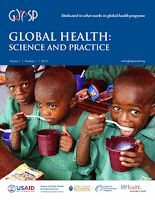
Inaugural issue open-access journal: Global Health - Science and Practice

Dear HIFA members,

The inaugural issue of the open-access journal Global Health: Science and Practice, is now available here:
http://www.ghspjournal.org/content/current

Below are extracts from the editorials:
'USAID and the Schools of Public Health at JHU and GWU welcome you to the inaugural issue of GHSP­an open-access, peer-reviewed journal for the global health community, particularly program implementers, to contribute to and benefit from a dialogue based on science and practical programmatic experience...'
'We foresee that public health practitioners, university colleagues, donors, and other development partners will be able to contribute to and benefit from a dialogue based on science and experience of what works for field programs.... GHSP will take a multidisciplinary approach to the science and practice of global health... We look forward to your engagement and feedback.'
Ariel Pablos-Méndez, Michael Klag, Lynn Goldman
Glob Health Sci Pract 2013;1(1):1-2
http://dx.doi.org/10.9745/GHSP-D-13-00012
'Formal research definitely helps. But it is not enough. We also need programmatic know-how, including experience-based knowledge and 'lessons learned.'.
James D Shelton, Ronald J Waldman
Glob Health Sci Pract 2013;1(1):3-4
http://dx.doi.org/10.9745/GHSP-D-13-00001

Best wishes,
Neil

My source: HIFA2015

Thursday, 24 January 2013

Two new books ... to review and a new IPONS website

There are two books in the post for review here which I look forward to receiving. Originally I only enquired about the following:

Philosophical and Theoretical Perspectives for Advanced Nursing Practice, Fifth Edition 

The book will continue to address a need to identify philosophical and a theoretical basis for h2cm.

A phone call from the publisher's rep. Clare McMillan had noted the informatics content here on Welcome to the QUAD W2tQ and would I also be interested in another book?

Yes please, certainly... I appreciate the recognition too.


Nursing Informatics and the Foundation of Knowledge, Second Edition is also to follow and not without a challenge as Clare pointed out. This foundation on informatics is focused on the North American experience. So it is a perspective from Wigan Pier to follow.

Of related interest and with further refinements to follow apparently, the International Philosophy of Nursing Society has a new website.

Monday, 14 January 2013

'Holistic confrontation' Gadgil et al. - a useful construct for H2CM

The possible explanatory utility of what I've termed holistic bandwidth is an ongoing prompt for me to study Hodges' model as a conceptual space, or series of spaces. In the literature recently I discovered Gadgil et al. who explain what they term holistic confrontation in their paper:
Chi (2008) has characterized three kinds of student misconceptions that increase in their representational complexity from false beliefs to flawed mental models to incorrect ontological categories. This framework suggests that different kinds of cognitive processes and instruction may be differentially effective in facilitating conceptual change for a given level of representational complexity. We hypothesize that as the representational complexity of the misconception increases, so does the amount of transformation needed to rectify it. Specifically, we hypothesize that conceptual change at the mental model level requires knowledge revision to the interrelations between the features of the prior knowledge, which is different from revising individual false beliefs or reassignment of a concept to an ontological category. Furthermore, we propose that instruction that focuses the learner on revising systems of relations of the misconception, what we call “holistic confrontation”, should be more effective in facilitating change of a flawed mental model than instruction that focuses on revising false beliefs or the type of ontological category. p.47.
One of the more specific applications for Hodges' model I see and in need of demonstration is case formulation, or case conceptualization. This could extend from a general counselling, long-term medical condition self-care management level through to collaborative case formulation in formal psychological therapies, such as cognitive behavioural therapy and cognitive analytic therapy.

Gadgil et al. use a diagram test of the circulatory system with two instructional conditions for subjects: compare or explain-diagram. The introduction, method, design and six hypotheses in this paper comprise an interesting approach for due consideration here.

Gadgil, S., Nokes-Malach, T. J., & Chi, M. T. H. (2011). Effectiveness of holistic mental model confrontation in driving conceptual change. Learning and Instruction: 22, 1, 47–61.

Friday, 21 December 2012

KT-EQUAL events: inc. Food and Nutrition in Later Life; Meeting the Needs of People Living with Dementia and their Carers ...

Dear KT-EQUAL supporters,

Hello. Here's an update about some of our activities and other news that may be of interest to you.

-----------------------------------------
Upcoming events programme
You are warmly invited to join our upcoming events:

------------------------------------------
Food and Nutrition in Later Life
------------------------------------------
When:    8 January 2013
Time:     9.30am - 16.15pm
Where:   University of Reading

The day features talks from experts, as well as an interactive "hands-on" showcase.  The event should be informative and fun, and provide an opportunity to meet and network with others who have personal or professional interests in food and nutrition for older people. The programme has been designed to appeal to a wide audience, including older adults, practitioners from health and social care, academic researchers, industry and charities.

Free to attend with lunch and refreshments included.

For further details and to book: http://kt-equal.org.uk/calendar/96/60-Nutrition-in-Older-Age

------------------------------------------
Thinking outside the box - meeting the needs of people living with dementia and their carers
------------------------------------------
When:    24 January 2013
Time:     9.00am - 16.45pm
Where:   The Forum, St James Parade, Bath, BA1 1UG

Dementia is a major challenge facing our health and social services over the next 20 years.  This has now been recognised by the government and significant resources are being directed towards early diagnosis, new treatments and management of people with dementia.

This funding will only be effective if we can develop news ways of supporting and managing people with dementia and there carers.  This will require a multidisciplinary team approach to problem solving and service delivery.  Health and Social Care Practitioners are familiar with the concept of multidisciplinary team working but often lack insights into dynamics of group working. We need to ensure that the interventions are effective and consider outcome measures that are appropriate for a long term neurodegenerative condition that are appropriate for patients and carers.

This event aims:

- to help researchers, health and social care professionals to think differently about meeting the needs of people who are living with dementia
- to consider the range of outcome measures that might be used to assess the benefit of an intervention
- to make researchers aware of the challenges and opportunities of multidisciplinary working
- to inform new researchers of the needs of people with dementia
- to trigger ideas for new research and provide a forum where participants can develop potential proposals

Please note that this event has limited places to ensure that representatives from several disciplines have the opportunity to participate.

Free to attend with lunch and refreshments included.

For further details and to register interest: http://kt-equal.org.uk/calendar/96/61-Thinking-outside-the-box-meeting-the-needs-of-people-living-with-dementia-and-their-carers

------------------------------------------
Design for Living in Later Life
------------------------------------------
When:    31 January 2013
Time:     10.00am - 16.30pm
Where:   The Open University, Milton Keynes

This event brings together the latest research ideas and developments about creating lifetime environments for people of all ages.

Free to attend with lunch and refreshments included.

For further details and to book: http://kt-equal.org.uk/calendar/96/54-Design-for-Living-in-Later-Life

------------------------------------------
Keeping safe and maintaining independence: older people and sight loss
------------------------------------------
When:    7 February 2013
Time:     9.30am - 15.45pm
Where:   Weetwood Hall Conference Centre and Hotel, Otley Road, Leeds, LS16 5PS

This workshop event is concerned with sight loss in later life and how we can enable people to live a quality life despite the difficulties that arise from diminished vision.

This event aims to raise awareness of sight loss and its impact and to increase knowledge and understanding of how to support people with sight loss. The programme will showcase new developments in research and practice that have the potential to inform practitioners.

Free to attend with lunch and refreshments included.

For further details and to book: http://kt-equal.org.uk/calendar/96/62-Keeping-safe-and-maintaining-independence-older-people-and-sight-loss

------------------------------------------

New posts on the KT-EQUAL blog which may be of interest to you:

Housing LIN newsletter – Housing with Care Matters, December 2012

This reflects back on some of the successes the Housing Learning and Improvement Network (LIN) had in 2012, including the recent 2nd annual conference attended by over 300 people.

The conference also saw Norman Lamb, Minister for Care and Support Services, announce an additional £40m in this financial year for Disabled Facilities Grants. Details of this and a number of other recent policy and funding announcements to do with housing, care and support are featured in this end of year newsletter along with information on new learning resources from the Housing LIN, important new publications such as HAPPI2, calls for information, and details of Housing LIN forthcoming regional meetings and events.

New dementia website launched: dementiakt.ca

The Canadian Dementia Knowledge Translation Network (CDKTN) and the National Core for Neuroethics are pleased to announce the launch of the online Dementia Knowledge Translation (KT) Learning Centre. This website is targeted towards new and established dementia researchers engaged in KT.

------------------------------------------

Invitation to take part in a study

I am sending some details passed onto us by one of our members, based at TRL:

We are currently undertaking a European study regarding older road users and what different countries do about supporting mobility. The aim of our project is to investigate travel patterns and road safety amongst older road users across Europe, see how they are changing and look at what work is being undertaken to support improving mobility. As part of this we are looking to undertake interviews with possible major players as to what they are doing. Would anyone be interested in taking part in a telephone interview with one of our researchers on this topic?

If you are interested please contact Jenny Stannard, Principal Project Manager and Road Risk Consultant.
email: jstannard@trl.co.uk

It would be helpful if you would contact Jenny by 18 January 2013 if you would like to take part.

------------------------------------------

Recent Highlights

A new BBC film highlights the work of our i-design team in Cambridge: how do older people use technology? http://www.bbc.co.uk/news/technology-20664470

Falling off the Bandwagon: Sustaining digital engagement by older people - a series of consultation events have recently been undertaken exploring potential solutions to the challenges faced by older IT users. A major consultation event took place at St Georges House, Windsor focusing on solutions and how to implement them.  http://www.stgeorgeshouse.org/consultations/social-and-ethical-consultations/recent-consultations/

We were delighted that The Princess Royal presented a keynote address at our recent 'Showcase world class occupational therapy research to meet the needs of an ageing population' event. This event took place at the College of Occupational Therapists where The Princess Royal is Patron. It was a unique opportunity to bring together leading experts to discuss ways of meeting the challenges of an ageing population. http://blog.kt-equal.org.uk/

------------------------------------------

I hope that this is helpful. It's been a pleasure to meet with some of you over the course of this year - look forward to further developments in 2013. If you have any queries and or comments/suggestions please do not hesitate to contact me.

As this eventful year draws to a close, we would like to thank you for all your continued support and extend seasons greetings.  All the very best for 2013.

Bangar
--------
S Bangar
KT-EQUAL Research Co-ordinator
School of Health and Related Research (ScHARR)
University of Sheffield
Regent Court, 30 Regent Street
Sheffield  S1 4DA

http://www.equal.ac.uk/

*Please note: I work 4 days each week.
_______________________________________________
Sparc-network mailing list <Sparc-network@lists.reading.ac.uk> (... and my source)
http://www.lists.rdg.ac.uk/mailman/listinfo/sparc-network

Thursday, 8 November 2012

Evidence Bibliography 4 - Public Involvement in NHS, Public Health and Social Care Research

October 2012. References on public involvement in NHS, public health and social care research.
Author: Kristina Staley, TwoCan Associates

invoNET is a network of people working to build evidence, knowledge and learning about public involvement in NHS, public health and social care research.
The invoNET library is an electronic library of references that is available on the invoNET section of the INVOLVE website. The library includes references (reports and articles) that cover:
  • the nature and extent of public involvement in research, for example mapping public involvement
  • the impact of public involvement on research
  • reflections on public involvement in research
It also includes other pieces of work that shed new light or provide a new perspective on public involvement in research.

Source from the link above - my source INVOLVE email.

Sunday, 28 October 2012

Open access: everyone has the right to knowledge

SOURCE: The Conversation

By Alessandro Demaio, University of Copenhagen; Bertil Dorch, University of Copenhagen, and Fred Hersch, University of Sydney

This week, we celebrate open access week – an event aimed at bringing attention to this rapidly emerging form of scientific publication and its ethical imperatives.

Traditionally, knowledge breakthroughs and scientific discoveries are shared through publication in academic journals. Peer-reviewed and highly competitive, careers are made and broken on the number and impact of these publications.

With the complex, long-standing hierarchy of journal ranking, scientific publishing is big business. From a distance, one might assume that scientific publications aim to maximise the dissemination of ideas, break down barriers to science and make knowledge accessible to the masses – but this is not actually the case.

The publication process

When a scientist, whether in the field, the laboratory or the hospital, makes a discovery, she puts her ideas into an academic paper and submits it to a journal. The journal’s editors decide whether it’s relevant to the scope of the publication, and if it is, they (usually) send it on to a small group of the researcher’s peers.

These are other specialists in the field who will read and give feedback on the paper. If they think the work is worthwhile, and they have no changes to suggest (which is seldom), then the paper will be published in a future issue of that journal.

At this point, no one has paid for anything. The authors don’t pay to submit the article, the journal doesn’t pay for the scientists’ work and the peer reviewers are voluntary. Even the editors are often unpaid, unless they can integrate this service into their professional work.

Journals seek remuneration through subscriptions or once-off access fees by the user – often in the order of US$30 per paper. Those of us lucky enough to have an affiliation to a university, or live in Denmark where the government spends many millions on subscriptions for the entire population can access scientific knowledge free of charge.

Open access

Open access publication differs in one very important way from “traditional” academic publishing. Instead of the individual paying to access an article, or buying a subscription, researchers pay for the publication of their work, often out of their research funds.

In the order of US$1,000-$2,500 per publication, this article processing fee is payable when and if the paper is accepted – and it’s routinely waived for researchers from low and middle-income nations.
This means that while the editorial and peer review process are the same as above, access to the published work is free forever and available openly (hence, open access) online.

The traditional publishing paradigm can be regressive and exclusive. Think for a moment how it works: I am a researcher, I do research in developing countries. What if I was to go there; take the time, resources, ideas or even blood samples from thousands of local people; take the information back to my university; access all the scientific knowledge I need in order to develop the work; and then publish my findings in journals for which there’s an access fee of one week’s wages for the people involved in my study.

Sure I might be able to send them a copy, but for the vast majority of people in that community, science remains out of reach. Now, these study participants may also have no internet access for open access sourcing, but many now do and at least the barrier to knowledge is not put up by the scientific community itself.

Similarly, in high-income nations, it’s still the wealthy, the highly educated or those at higher-education institutions who have greatest access to the vast majority of published science. How is this just?

And what happens when we add an additional layer of ethical consideration: that these researchers and their work is often is paid for by society, by taxpayers, through public funding. How can we then justify publishing it in academic media inaccessible to the vast majority who paid for it?

We can’t just blame researchers or the research community for this – and we’re not saying that because we’re researchers. Academic performance and assessment, in the large part, is determined by the amount and impact of one’s publications. The older “traditional” journals have greater histories and so researchers are almost coerced into publishing with these journals.

Some good news

The good news is that things are changing. In the first decade of the 21st century, we have seen an explosion in open access publications. During this time, we’ve observed a ten-fold increase in publications (almost 200,000 at 2011) and more than a six-fold increase in the number of open access journals, to almost 5,000.

Things are clearly moving in the right direction, but this impressive number still accounts for only around 20% of all publishing.

Simultaneously, global leaders have acknowledged the ethical dilemmas of our current system and backed open access. The European Union, for example, is currently piloting a project to encourage all EU-funded research to place their results in an open-access repository or publish them in open access journals.

And some nations, including the United Kingdom, Denmark and Australia, are either planning or implementing policies making publication of publicly-funded research in open access journals mandatory.

The call for change is being echoed by the academic community, which is asking for greater open access and the removal of economic barriers to science.

Research should be about furthering knowledge for all. And there’s no reason why open access publication shouldn’t be routine.

There are also strong economic arguments for investing in a knowledge economy. We are confident that with enough support, we will see more nations, companies and organisations mandating open access publication – a move that’s likely to bring social and economic benefits.

And who knows, maybe we’ll also begin to see the “traditional” academic journals change their business model and one day make knowledge open to all.

Dr Alessandro Demaio is PhD Fellow in Global Health with the Copenhagen School of Global Health at the University of Copenhagen. In addition, he is a Director of the Global Steering Committee for the Young Professional Chronic Disease Network and NCD Action. For The Conversation, Alessandro expresses his own views only.
Bertil F. Dorch is currently senior executive adviser to the university librarian at Copenhagen University Library Services (part of The Royal Library, Denmark), and have previously been Head of Center for Research Support Services as well as a research scientist at University of Copenhagen (The Niels Bohr Institute), within the field of astrophysics.
Fred Hersch does not work for, consult to, own shares in or receive funding from any company or organisation that would benefit from this article, and has no relevant affiliations.

The Conversation
This article was originally published at The Conversation. Read the original article.

Monday, 8 October 2012

The Information Centre: October bulletin

Welcome to the October edition of IC Knowledge

Welcome back to IC Knowledge, the online bulletin that keeps you up-to-date with new data releases, service news and forthcoming events.

In our first edition we look at:

  • New data linkage service now available
  • GPES to provide data for QOF payments from April 2013
  • Data workshop set to inspire innovation in use of information
  • National Diabetes Audit set for busy autumn of activity
  • First ever Social Care Outcomes Framework published
  • Updated commissioning data sets due next month
  • Improved mental health report among new statistics due out soon

Read the latest edition now

My source: IC subscription

Copyright © 2012, Re-used with the permission of the Health and Social Care Information Centre. All rights reserved.