Showing posts with label children. Show all posts

Thursday, 31 July 2014

Research Initiative: Test the Impact of a Radio Campaign Addressing Child Mortality

Source:

DEVELOPMENT NETWORKS - The Communication Initiative's Social Networking Space


Introduction and comments:
http://networks.comminit.com/healthcommunication/node/200774


Development Media International (DMI) is conducting a 3-year randomised controlled trial to test the hypothesis that a radio campaign can reduce the large number of children dying before their fifth birthday in Burkina Faso. As detailed at the link below (see Related Summaries), the research involves the broadcast, beginning in March 2012, of health messages using radio spots (60-second adverts) and radio phone-in programmes. With the goal of engaging the public with health issues in order to change behaviours, this is a research initiative to evaluate a public health intervention delivered to 7 randomised geographic areas (clusters) across Burkina Faso with 7 additional clusters being used as controls.

Methodologies: 
 
Supervised by 2 people affiliated with the London School of Hygiene and Tropical Medicine (LSHTM), this independent survey is based on interviews with 5,000 mothers in the 7 intervention zones and 7 control zones halfway into the research intervention period (midline data).

Practices:

....

"For a full summary of the midline results please go to this link where there is also a link to the DMI summary paper."

Thursday, 1 May 2014

Wellbeing: A Complete Reference Guide

Several years ago well-being was everywhere so it seemed. I even blogged about this wondering about the professional side of caring and the care professions:

Well-being and the dilution of 'caring'

What triggered the reflections above in 2010 was the appearance of the British Journal of Wellbeing (BJW). I subsequently learned that the journal launched in April 2010 was published until the end of 2011; the publisher (MA Healthcare) then launched a new journal the British Journal of Mental Health Nursing (BJMHN). I was also advised that although BJMHN has some similarities to BJW, it has more of a nursing focus. 

So, perhaps there was some merit in my thoughts back in 2010 and yet well-being (or wellbeing) is a central discussion point. It has to be if we are to conjoin:

health education : health care 
'being' - 'well' (physically, mentally, ....)
self care : care services
health literate - health 'expert' / professional
.....

I now wonder if the scope of the volumes in a complete reference guide on wellbeing as indicated below, might benefit from an overarching conceptual framework?
This reference set comprises six volumes that focus on the ways wellbeing has been studied and can be applied across different aspects of the life course.
  • The first multi-volume examination of all elements of wellbeing.
  • Volumes cover children and families; the workplace; the environment; aging and later life; economics; and policies of wellbeing
  • Each volume brings together leaders of their respective fields in an edited volume of original articles
  • Presents a synthesis of the latest research on this growing and interdisciplinary area of study
Wellbeing: A Complete Reference Guide
Edited by Cary L. Cooper, CBE
Distinguished Professor of Organizational Psychology and Health at Lancaster University, UK
Now available in print and online
6 volumes • 3,000 pages • Hardcover
Print Edition ISBN: 978-1-118-53882-1


* 
Personal communication: Sam Gournay
Sent: Wednesday, 20 March 2013, 11:30
Subject: FW: Message from MA Healthcare website

Thursday, 27 February 2014

Rare Disease Day 28 February 2014


INTERPERSONAL : SCIENCES
humanistic ------------------------------------------- mechanistic
SOCIOLOGY : POLITICAL
I am honored to stand, in her graceful place, and shine a light on a delicate group of individuals who, nevertheless, in sheer numbers are a force to be reckoned with.
Thank you,

Sean Hepburn Ferrer
A disease or disorder is defined as rare in Europe when it affects fewer than 1 in 2000.
A disease or disorder is defined as rare in the USA when it affects fewer than 200,000 Americans at any given time. One rare disease may affect only a handful of patients in the EU (European Union), and another touch as many as 245,000. In the EU, as many as 30 million people alone may be affected by one of over 6000 rare diseases existing.
  • 80% of rare diseases have identified genetic origins whilst others are the result of infections (bacterial or viral), allergies and environmental causes, or are degenerative and proliferative.
  • 50% of rare diseases touch children.
In the words of Audrey Hepburn,

“We cannot save everyone… but the knowledge that someone is coming to their rescue… that we care as a society is ultimately as important…”.

It is in this spirit that we invite you, alongside Sean Hepburn Ferrer, to Join Together for Better Care.
group - population

Winwick Hospital remembered

Image source: Metro

Tuesday, 15 October 2013

Blog Action Day 2013: Human Rights - Health and Disability

HUMANistic -------- RIGHTS


INTERPERSONAL : SCIENCES
SOCIOLOGY : POLITICAL
individual
Reflecting on Human Rights with Hodges' model
Educating health professionals about disability: A review of interventions
Tom Shakespeare and Ira Kleine suggest health professionals need a better understanding of the health needs and human rights of disabled people. Read the first comprehensive review of educational interventions. (HEA)
Physical (and cognitive) access to info:

Governments are legally obliged to ensure adequate access to health information
The Lancet Global Health, Volume 1, Issue 3, Pages e129 - e130, September 2013
doi:10.1016/S2214-109X(13)70043-3
(HIFA2015)
-ismsDear All, I would like to congratulate the initiative HIFA-Watch about access to health information as universal human right and use this opportunity to share with you an excellent illustration, presentation by video on the Declaration of Human Right, source of inspiration for all. http://www.youtube.com/watch?v=O9chQdZw7Bc
And I use also this opportunity to share with you the Medicus Mundis International discussion paper published today which compares key elements of the concept of Universal Health Coverage as promoted by the World Health Organization http://www.medicusmundi.org/en/contributions/news/2013/mmi-uhc-discussion-paper/uhc-mmi-discussion-paper-august-2013.pdf
With my warmest regards.
Isabelle WACHSMUTH
World Health Organization, Knowledge Management and Sharing
 (HIFA2015)
group - population

Additional links:
Law in Action BBC Radio 4 (see - Interview with Attorney General Dominic Grieve 15 Oct 2013 download available for 28 days)

Conference: Human Rights in Scotland: understanding the challenges and embracing the opportunities 2014

Health and Human Rights: journal

http://hodges-model.blogspot.co.uk/2013/08/an-international-bill-of-rights-of-man.html

Political domain: links

Thursday, 10 October 2013

Recent Advances in Research on Housing Transitions and the Life Course - a one-day symposium

Meeting of the Royal Statistical Society Social Statistics section.
DATE: Tuesday 10 December 2013
TIME: 10am-5pm (followed by a drinks reception)
LOCATION: Royal Statistical Society, 12 Errol Street, London EC1Y 8LX

We are pleased to announce a one-day symposium on recent developments in research on housing transitions through the life course.  The event will feature presentations from leading international demographers, geographers and economists on different aspects of housing careers. Topics include:

  • the interrelationship between housing and fertility: childbearing patterns by housing conditions and housing changes after the birth of a child
  • wage, employment and house-price effects on migration
  • intergenerational transmission of home ownership and neighbourhood poverty
  • residential mobility, neighbourhood poverty dynamics and neighbourhood choice among families
The symposium is sponsored by the ESRC-funded project “Interrelationships between housing transitions and fertility” (see http://www.bristol.ac.uk/cmm/research/housing for further details). 

SPEAKERS:
William A.V. Clark (University of California, Los Angeles) Clara Mulder (University of Groningen), Heather Joshi (Institute of Education) Hill Kulu (University of Liverpool) David Manley (University of Bristol) Birgitta Rabe (University of Essex) Elizabeth Washbrook (University of Bristol)

A programme and abstracts are at http://www.bristol.ac.uk/cmm/research/housing/symposium/index.html

REGISTRATION AND QUERIES: All are welcome and attendance is free.  Refreshments will be provided, including lunch and a drinks reception.  However, advance registration is essential.  Please complete the online registration form at http://www.cmm.bris.ac.uk/clients/booking/91/ to reserve your place.


[ I mentioned to the organisers about the ongoing transitions I have posted about before; that of older adults moving house (home) often in response to a bereavement to be nearer other family members. This is not the symposium's focus, but remains a question in terms of the potential impact on the individuals concerned and health and social services. pj ]

Friday, 5 July 2013

Part I: Pensioners, 'Health students' and Children NHS@75?

As the NHS celebrated its 65th birthday its mobility is clearly challenged.

There are signs of furniture-walking now. Admittedly, there are no asylums now to step from to the cottage hospital, oops nearly! Phew - made it - to the fever hospital. Thankfully, those mobility aids are no more - a great sign of progress.

The pressure for ongoing change is relentless. This week's HSJ is highlighting the true fact on its cover:

NOT READY FOR RETIREMENT


There's also a six month exercise by PWC - NHS@75

There are many strands one of which has the following graphic:


If the public is to be informed and proactive about their health then we had better start now....


Medikidz is absolutely great - depression is in there - but as PWC's initiative shows the NHS@75... is going to need much more than explaining illnesses.

Medikidz image: http://www.themarysue.com/medikidz-comic/

Saturday, 27 April 2013

'Holistic reform of education' in Jordan (an eastern dose of serendipity)

View from The Citadel, Amman 23 April 2013

Yesterday morning I arrived back safe and sound from Amman in Jordan, via Istanbul through to Manchester and full of new experiences and learning. I say 'safe and sound' because travel to the region is clearly not a matter of routine given ongoing events. Checking governmental advice in the UK it becomes a question of personal evaluation as was the unexpected trip to Colombia in 2011. Once the non-trivial decision is out of the way ... Jordan's nursing and educational communities provide a truly remarkable welcome and experience. Not only that, but the kingdom of Jordan and the people have so much to offer in their culture, history, hospitality and engagement.

Returning on Thursday from a full day's trip to Petra - amazing! - I asked for an English language paper to read at the hotel before leaving for the airport. I was provided with a copy of The Jordan Times to accompany a cappuccino*. On page nine Mona Smadi,# Asst. Professor, Al Balqa Applied University) wrote an opinion piece on Holistic reform of education. The opening sentence enabled my brain to reconnect with my legs (although I would have gladly walked back through the valley):
A holistic perception of reality means having a vision of the context of the constituent fragments and thereby gaining a clearer perception of the reality in its totality.
Prof. Smadi's focus is children's education and curriculum reform. The overlap between children's education, the professor's concerns and nursing is not limited to how curricula are designed and who owns them. Is, for example, the curriculum centered on the student as an individual nurse, or child? If nurses are to be able to integrate their learning and effectively negotiate the emotional and ethical spaces they find themselves in then when is this deeper thinking to start?

Petra 25 April 2013

Not surprisingly there was a lot of talk about this at the JNC conference. The theory - practice gap is not just alive and kicking there is an echo off the seemingly disparate walls. Given too the debate in the UK about student nurses spending time as a health care assistant before starting their formal nurse education. The word applied in the title of Prof. Smadi's university's is interesting. We are accustomed to applied mathematics, ethics, energy and of course applied nursing research and many other examples?

What of applied nursing - does that make sense? Or is there a circularity of sorts in nursing applied? I will check my notes as this point was raised in conference regards to evidence based care and evidence based practice.

Prof. Smadi's referring to a 'clearer perception' can also be extended to recognition of patterns, contexts and situations that are 'hot' in how they relate to values.

(There are a couple of points to add here which I will get too).


There was another serving of serendipity to add to that at Le Meridien, soon after rejoining the land of the virtual I came across the UK Department of Education's Preparing for Adulthood initiative on twitter. If you read the brief article by Prof. Smadi you will see how the two are closely related. Do lifestyles and family life today for many compromise the ability of families to teach moral values to children? As noted in the text this then becomes a critical role for education. In westernized cultures is this one of the qualities referred to in the saying of 'spending quality time' with the family? An acknowledgement of a deficit?

Source: http://www.preparingforadulthood.org.uk/
Vital and complex work in two senses. On the one hand cultures try to understand themselves; and on the other, they seek to understand the other others out there: now not so far away. The patterns that are realised be they mosaic, prayers, celtic knot, tartan, languages, landscapes - rock cut architecture - sculpture; these patterns work, that is 'make a difference' by virtue of both the detail and the whole.

"Petra is half-built, half-carved into the rock ..." UNESCO.

#If I have not used the proper name and title I will edit this accordingly asap upon advice.
 
*Why not an Arabic coffee? Well I had one the day before. What can I say... It was different in the preparation, being an observation as in so many cultural patterns (tea). I would like to think I will have another one day. The key thing is I did not necessarily want to have the capability to run to the airport at 11pm, or back to Petra for that matter.


Saturday, 23 March 2013

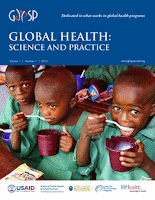
Inaugural issue open-access journal: Global Health - Science and Practice

Dear HIFA members,

The inaugural issue of the open-access journal Global Health: Science and Practice, is now available here:
http://www.ghspjournal.org/content/current

Below are extracts from the editorials:
'USAID and the Schools of Public Health at JHU and GWU welcome you to the inaugural issue of GHSP­an open-access, peer-reviewed journal for the global health community, particularly program implementers, to contribute to and benefit from a dialogue based on science and practical programmatic experience...'
'We foresee that public health practitioners, university colleagues, donors, and other development partners will be able to contribute to and benefit from a dialogue based on science and experience of what works for field programs.... GHSP will take a multidisciplinary approach to the science and practice of global health... We look forward to your engagement and feedback.'
Ariel Pablos-Méndez, Michael Klag, Lynn Goldman
Glob Health Sci Pract 2013;1(1):1-2
http://dx.doi.org/10.9745/GHSP-D-13-00012
'Formal research definitely helps. But it is not enough. We also need programmatic know-how, including experience-based knowledge and 'lessons learned.'.
James D Shelton, Ronald J Waldman
Glob Health Sci Pract 2013;1(1):3-4
http://dx.doi.org/10.9745/GHSP-D-13-00001

Best wishes,
Neil

My source: HIFA2015

Friday, 11 January 2013

Thanks Gerry for pulling some strings

http://www.bbc.co.uk/news/entertainment-arts-20847151
Today it was Gerry Anderson's funeral. I am a child of that generation Thunderbirds, Joe 90, UFO - great TV.

In 2008 I found myself back in my old home town and an old friend from junior school got in touch. One of John's memories regards my dad who passed away in 2003 was the fact that when John came around in the very early 70s my dad would watch Thunderbirds with us too.

It really was family entertainment. Visionary, innovative, humane in its messages and delivery; and like the web today the stories counted. There was humour and human frailty on display too, a great primer for a future mental health nurse.

http://gerryanderson.wikia.com/wiki/Thunderbirds_Are_Go
There are favourite episodes - that featuring Fireflash, the Sidewinder, Sunprobe and Zero X from the film Thunderbirds Are Go that I saw on first release at the cinema.

I acquired a love of film soundtracks from the marriage of music and the action in Thunderbirds. Fusion existed in the 60s. Even before Star Trek arrived in the UK there was hope and optimism for the future.

Thanks Gerry!

Thursday, 1 November 2012

SCIE Research briefing 43: Effective supervision in social work and social care

This research briefing provides an overview of the evidence concerning the value of supervision in supporting the practice of social care and social work. It is relevant to both children’s and adult social care services and includes a consideration of supervision in integrated, multi-professional teams. While the focus is on social work and social care, some of the research reviewed includes participants from other professions such as nursing and psychology.

The briefing covers evidence on the use of different models of supervision and outcomes for workers, employers, service users and carers. It considers evidence on the costs of supervision and concludes with implications for policy-makers, practitioners, organisations, service users, carers and researchers.

Download here: 
http://www.scie.org.uk/publications/briefings/briefing43/

My source: Jill Anderson via MHHE list

Monday, 5 March 2012

RCN nursing journals are now available through HINARI

Dear All,

I am pleased to share that, as of last month, the journals published by the Royal College of Nursing (UK) are now available through HINARI, which means that HINARI users can now access the following journals:-

- Cancer Nursing Practice
- Emergency Nurse
- Learning Disability Practice
- Mental Health Practice
- Nurse Researcher
- Nursing Children and Young People Nursing Management
- Nursing Older People
- Nursing Standard
- Primary Health Care

This brings the total number of nursing journals available via HINARI to 172, including journals from BMJ Publishing, Cambridge University Press, Elsevier, Informa Healthcare, John Wiley, Lippincott Williams & Wilkins, Mary Ann Liebert, Sage, SLACK, and Thieme.

Best wishes to all.

Richard Gedye
Publisher Co-ordinator
Research4Life

My source:
HIFA2015 Health Information For All by 2015 

Wednesday, 28 December 2011

[HIFA2015] Women and Children First

As we draw towards the end of the year, Ros Davies, executive director of
Women and Children First (www.wcf-uk.org) reminds us:

'This Christmas Day, 1000 women will die in childbirth.
1000 women will die this way on Boxing Day too.
In fact 1000 women die every day whilst pregnant or giving birth.

... the vast majority of these deaths could be prevented by the provision of simple information and equipment which many of us take for granted.'

http://hosted.verticalresponse.com/786283/74890f4030/1470640645/8fd055e22b/
Click here to read online.
My source:
HIFA2015: Healthcare Information For All by 2015: www.hifa2015.org