Showing posts with label geography. Show all posts

Monday, 25 August 2014

Heat maps and hotbeds in Hodges' model

individual
INTERPERSONAL : SCIENCES
humanistic ------------------------------------------- mechanistic
SOCIOLOGY : POLITICAL
group


"Out of area placements are a good indicator of heat within the system and how over-stretched it is." p.5

Prof. Paul McCrone,
Lintern (2014).


Sources:
Image: http://www.usability.gov/sites/default/files/images/eye-tracking-full-option1.jpg

Lintern, S. (2014) Analysis reveals mental health trust funding cuts, Health Service Journal. 124, 6411, 4-5.

Monday, 7 July 2014

Book: The social atlas of Europe

www.europemapper.orgSee Europe as never before!

The social atlas of Europe
Dimitris Ballas, University of Sheffield
Danny Dorling, University of Oxford
Benjamin Hennig, University of Oxford

"An insightful look at today's Europe - through the underlying realities that Europeans live every day, all brought to life in charts and maps that reveal the human geography of this vitally important area of the world." Robert B. Reich, University of California at Berkeley.

The social atlas of Europe is the first human geography atlas to consider the European economy, culture, history, human and physical geography as a single land mass and a more unified European people. It provides an accessible overview of Europe and a human geography contribution to debates about a wide range of topics. It includes:

- Maps on over 80 topics ranging from life expectancy, greenhouse gas emissions to Eurovision Song Contest voting patterns
- Uses innovative full colour visualisation methods
- Explores Europe's society, culture, economy, politics and the environment
- State-of-the-art Geographical Information Systems (GIS) and new human cartography techniques

More information about the book is available on its website www.europemapper.org

Available at the special price of £19.99 (plus p&p) at www.policypress.co.uk/display.asp?K=9781447313533
Kathryn King
Marketing Manager
Policy Press, University of Bristol
6th Floor, Howard House, Queen's Avenue, Clifton, Bristol BS8 1SD
Tel: +44 (0) 117 331 5369
Email: kathryn.king AT bristol.ac.uk

My source: EUROPEAN-SOCIOLOGIST list at JISCMAIL.AC.UK

Thursday, 10 October 2013

Recent Advances in Research on Housing Transitions and the Life Course - a one-day symposium

Meeting of the Royal Statistical Society Social Statistics section.
DATE: Tuesday 10 December 2013
TIME: 10am-5pm (followed by a drinks reception)
LOCATION: Royal Statistical Society, 12 Errol Street, London EC1Y 8LX

We are pleased to announce a one-day symposium on recent developments in research on housing transitions through the life course.  The event will feature presentations from leading international demographers, geographers and economists on different aspects of housing careers. Topics include:

  • the interrelationship between housing and fertility: childbearing patterns by housing conditions and housing changes after the birth of a child
  • wage, employment and house-price effects on migration
  • intergenerational transmission of home ownership and neighbourhood poverty
  • residential mobility, neighbourhood poverty dynamics and neighbourhood choice among families
The symposium is sponsored by the ESRC-funded project “Interrelationships between housing transitions and fertility” (see http://www.bristol.ac.uk/cmm/research/housing for further details). 

SPEAKERS:
William A.V. Clark (University of California, Los Angeles) Clara Mulder (University of Groningen), Heather Joshi (Institute of Education) Hill Kulu (University of Liverpool) David Manley (University of Bristol) Birgitta Rabe (University of Essex) Elizabeth Washbrook (University of Bristol)

A programme and abstracts are at http://www.bristol.ac.uk/cmm/research/housing/symposium/index.html

REGISTRATION AND QUERIES: All are welcome and attendance is free.  Refreshments will be provided, including lunch and a drinks reception.  However, advance registration is essential.  Please complete the online registration form at http://www.cmm.bris.ac.uk/clients/booking/91/ to reserve your place.


[ I mentioned to the organisers about the ongoing transitions I have posted about before; that of older adults moving house (home) often in response to a bereavement to be nearer other family members. This is not the symposium's focus, but remains a question in terms of the potential impact on the individuals concerned and health and social services. pj ]

Tuesday, 8 October 2013

Zero, One, Fifteen, (Thirty, Sixty...?)

SOCIETY
care-S S-cares
context: UK news media 15 minute carer visits to elderly clients

INTERPERSONAL : SCIENCES
SOCIOLOGY : POLITICAL
individual
Reflecting on Social Care with Hodges' model
The one, self, me, a person. Carers: ethics (and common sense? when is 15 minutes of 'fame' enough?), demonstration of rapport, empathy, dignity, loneliness, independence. Carer stress. Job satisfaction. Staff knowledge and skills. Observation. Mental state. Mood. Choices - personal preferences. Personal - carer's values. Cognition - Re-cognition. Case review. Individualized care? Expressed concerns (wither...?) theory: task vs. person-centered care
mechanistic aspects of care, travel, geography, arrival, tasks, plan, recording, constraints - esp. time, practical problems encountered. Number of carers involved. Safety. Protective clothing. Seasonal factors. Evidence base? Best practice? Relapse rates? Telecare role? Physical mobility - movement. Systems, processes, logistics and scheduling. Degrees of freedom - flexibility. Data, information, datasets. Admissions - depth of data?
practice: task vs. person-centered care
Caring relationship building, trust - very personal - intimate care, subjective: time with someone I like / don't like? Relatives experience. Social care infrastructure - community centers. Ability to go out shopping with a carer. Media: BBC 2 Newsnight 7/10/13; The Times; C4 News. Social contact. Social mores (time?)
Policy, professionalism, recording, outcome measures. Agreement - care plan. Care reviews. Ban on 15 minute visits? Management. Standards. Supervision. Zero hour contracts. Pay and conditions. Staff turnover. Vulnerable adults. Personal development, training. Risk of organization's reputations being damaged. Corporate responsibility, values. 'Value for money'. New commissioning systems. Advocacy (position significant). Whistleblowing. 'Francis effect' increase in nursing posts. HSJ, 25 Oct 2013, p.6. 'Funded establishment'.

group - population

Discount the contract, you can then 'discount' the individual worker and the client.
Care Relationship = Care Transaction

Wikipedia: "15 minutes of fame"

Sunday, 14 July 2013

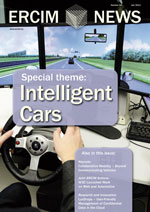
ERCIM News No. 94 Special theme: "Intelligent Cars" (memory and driving - PJ)


Dear ERCIM News Reader,

ERCIM News No. 94 has just been published at
http://ercim-news.ercim.eu/en94

Special Theme: "Intelligent Cars"
Guest editors: Jaroslav Machan (Å KODA AUTO a.s., Czech Republic) and Christian Laugier (Inria, France)
http://ercim-news.ercim.eu/en94/special/


Keynote: "Collaborative Mobility – Beyond Communicating Vehicles"
by Ilja Radusch, Ilja Radusch, head of department “Automotive Services and Communication Technologies” at Fraunhofer FOKUS and head of the Daimler Center for Automotive IT Innovations

This issue for download
pdf
: http://ercim-news.ercim.eu/images/stories/EN94/EN94-web.pdf
epub format: http://ercim-news.ercim.eu/images/stories/EN94/EN94.epub

Next issue: No. 95, October 2013 - Special Theme: "Image Understanding" (see Call at http://ercim-news.ercim.eu/call)

Thank you for your interest in ERCIM News.
Feel free to forward this message to others who might be interested.

Peter Kunz
ERCIM News central editor
------------------------------------------------------------------------
About ERCIM
ERCIM - the European Research Consortium for Informatics and Mathematics - aims to foster collaborative work within the European research community and to increase co-operation with European industry. Leading European research institutes are members of ERCIM. ERCIM is the European host of W3C.
http://www.ercim.eu/
<>

Each issue of ERCIM NEWS is a gift and for me it does not have to be a special theme that speaks directly to the health care, informatics or education communities. I have followed this publication and posted on W2tQ about many fascinating new issues. I'm sure it is over a decade ago since I also subscribed to Technicity, a magazine from Daimler. I bring the two publications together for two reasons (not due to sponsorship - how I wish):

Firstly, this is such a difficult time socio-economically in the EU, evinced in the proportions of younger adults who are unemployed. Publications like this show the opportunities for young people who aspire, but to do so they need the support and opportunities. Safety, design, materials science, energy systems and storage, city transport infrastructure and planning, security, nanotechnology, communications, vehicular informatics ... the possibilities for youths are amazing. In turn, however we need to recognize and respond to the employment potential of those whose path is not primarily academic and research based.

Secondly, in community mental health nursing services for older adults we often come across people who are still driving when their competency is most likely compromised. They should report an admission to hospital, prescribed medication or a specific diagnosis to the DVLA. ERCIM and Technicity both presage the arrival of autonomous vehicles. At present of course an 'intelligent car' depends on the intelligence of the driver. Which is why we get so annoyed when someone drives like an *^%$£!

Driving is a great responsibility and privilege. It is central to who we are, how we define ourselves, our independence, sustaining real social networks and - in my case livelihood. I recognised decades ago there will come a time to hand over the keys. Doing so gracefully, informed by insight and self-awareness is the trick. I don't envy family doctors who have to deal with this when a patient  insists that they are safe behind the wheel. Sometimes we are ageist, hoping that a meeting with their doctor of some 20-30 years might carry some gravitas that their generation will still respond to. Add to this though that the person concerned is not always elderly. It can be very difficult for the driver (person, patient) concerned and their families too. Amid all this, as a community nurse you are trying to establish trust, empathy and rapport. Each time this issue is encountered: it is novel.

I don't want to suggest that suddenly the person behind the wheel is 'unintelligent', far from it. Evidence shows that a diagnosis of dementia does not immediately mean surrender of a driver's license. Behind dementia, however lie altered faculties that add up to more than synonyms: cognitive impairment, impaired perception, recall, and decision making, reduced concentration and attention. I thought there might be something in this issue of ERCIM related to dementia; monitoring the physiological state of the driver, reactions, attention, stress levels, eye movement. Is there a signature for health in driving behaviours?
Unlike other methods of detecting tiredness, the Mercedes-Benz system evaluates a series of indicators in order to assess the alertness of the driver and to recognise the gradual transition between being awake and being tired. AME.info
Our sense of being, of personhood is heightened by movement. When do we feel most alive? What is the most important factor in health and well-being? There are moments when we are stationary and time passes us by. There are other occasions when we move through time. We literally project our ego through time. We enjoy sharing with friends where will be in the future and when we can also suspend time. Cars and air travel extend these abilities, AND mobilities.

The danger is when we pass through not only time but distance at speed without a reliable sense of judgement, without a wholly coherent sense of self and responsibility.

In the not too distant future all this of course could lead us to a new definition of self-care at least in this context?

"Self-care - put your trust in a self-driving vehicle"

 SOME PAPERS via Athens: (other suggestions welcome)

Title: Driving and dementia: what nurses need to know.
Citation: Journal of Gerontological Nursing, Aug 2011, vol. 37, no. 8, p. 10-13, 0098-9134 (August 2011)
Author(s): Flanagan, Nina M.
Source: BNI

Title: Driving with dementia.
Citation: Nursing in the Community, Jan 2005, vol. 6, no. 1, p. 27., 1649-0657 (Jan-Feb 2005)
Source: BNI

Title: Transitions in dementia care: theoretical support for nursing roles.
Citation: Online Journal of Issues in Nursing, May 2012, vol. 17, no. 2, p. 14 unnumbered pages, 1091-3734 (May 2012)
Author(s): Rose, Karen M*, Lopez, Ruth Palan
Source: BNI

Title: Dementia and driving: screening, assessment and advice.
Citation: Lancet, Oct 1996, vol. 348, no. 9035, p. 1114., 0140-6736 (October 26, 1996)
Author(s): O'Neill, D
Source: BNI

Title: Imposed versus involved: different strategies to effect driving cessation in cognitively impaired older adults.
Citation: Geriatric Nursing, Mar 2005, vol. 26, no. 2, p. 111-116, 0197-4572 (Mar-Apr 2005)
Author(s): Jett, K, Tappen, R, Rosselli, M
Source: BNI

Title: A prospective study of cognitive tests to predict performance on a standardised road test in people with dementia.
Citation: International Journal of Geriatric Psychiatry, May 2010, vol. 25, no. 5, p. 489-496, 0885-6230 (May 2010)
Author(s): Lincoln, N, Taylor, J, Vella, K
Source: BNI

Title: Effects of Alzheimer's disease and mild cognitive impairment on driving ability: a controlled clinical study by simulated driving test.
Citation: International Journal of Geriatric Psychiatry, 01 March 2009, vol./is. 24/3(232-238), 08856230
Author(s): Frittelli C, Borghetti D, Iudice G, Bonanni E, Maestri M, Tognoni G, Pasquali L, Iudice A
Source: CINAHL

Title: A community based survey of cognitive functioning, highway-code performance and traffic accidents in a cohort of older drivers.
Citation: International Journal of Geriatric Psychiatry, 01 March 2009, vol./is. 24/3(247-253), 08856230
Author(s): Ingley S, Chinnaswamy S, Devakumar M, Bell D, Tranter R
Source: CINAHL


Additional links:
Alzheimer’s Society - Driving and dementia
DVLA, UK Guide to the current medical standards of fitness to drive
The University of Nottingham - Predicting fitness to drive speed = (total distance traveled)/(total time taken)

Friday, 21 June 2013

Opaque

INTERPERSONAL : SCIENCES
SOCIOLOGY : POLITICAL

individual
anxiety, mood, anger, frustration, coping abilities, vulnerability, personal communication - masks, poor sleep, helplessness, apathy, personal memory, personal ethics 'Blaze season' - June to September, Smog - duration?, geography, fires, public health, asthma, respiration, bronchitis, conjunctivitis, vision, eye care, cardiovascular system, weather, create rain, environment, daily physical activities of living, ecosystem impact, elderly, young, measures, monitoring,
pollution standard index: 400 1100hrs, stay indoors, building workers, Loss of Habitat
public opinion, quality of life, media, social media, public perception, communication - advice to population, 
(public anger in China over that country's appalling environmental record)
Illegal forest fires, Indonesia, Singapore, Politics,
Commerce, Globalization, Governments, Governance, Diplomacy, Corporations, Regulation, Law, Enforcement, Tourism, Employment, Economic impact, Health Care System Burden, Political Tension, Accountability, Trust, Companies involved? Ecocide (not in Europe)
group - population

Additional source: The Independent Friday 21 June 2013

Wednesday, 24 April 2013

2013 Year of Piri Reis & Navigating the world of nursing care - in Jordan

The conference in Jordan is over it has been an intense and excellent two days, with a free day tomorrow. It has been a brilliant opportunity to share and learn not just about nursing, but travel, culture and some of the people that make up the global nursing community.

I am truly grateful to the Jordanian Nursing Council for accepting my abstract. The welcome and hospitality has been truly amazing.

In the flight magazine on the way here there was an article about Piri Reis, which reminded me of Paul Cunliffe's book about Pytheas.

From the UNESCO website:
The United Nations Educational, Scientific and Cultural Organization (UNESCO) has agreed to declare 2013 the year of Piri Reis on the occasion of the 500th anniversary of a map he drew up that included seven continents, reported the Anatolia news agency. 
“This map marks a significant event in the history of the country and has enabled its collective knowledge to be transmitted through generations. As a rare world map from the 15th and 16th centuries, Piri Reis World Map is an invaluable piece of the world's documentary heritage as it provides insight on the history of its time. It is therefore part of the Memory of the World and should be made better known,” stated UNESCO.

The world-renowned Ottoman captain and cartographer Reis is best known for world maps and charts collected in his “Kitab-ı Bahriye” (Book of Navigation).
Source: http://www.todayszaman.com/newsDetail_getNewsById.action?newsId=294065

Source: http://en.wikipedia.org/wiki/Piri_Reis_map


I have written before about Hodges' model as a map -

a cognitive periplus 

- for navigation through the complex world(s) of health and social care.

Would a new mariner take to the sea without a clear sky, a compass, map, or satnav? What then of our students?


Additional link: Please see the entry for Iran -

http://www.unesco.org/new/en/unesco/events/prizes-and-celebrations/celebrations/anniversaries-celebrated-by-member-states/2013/

Monday, 3 December 2012

The Difference that Makes a Difference 2013 - Information: Space, Time, and Identity


You are invited to The Difference that Makes a Difference 2013, An interdisciplinary workshop on Information: Space, Time, and Identity.

Location: The Open University and the MK Gallery, Milton Keynes , UK
Dates: 8-10 April 2013
Website: http://www.dtmd.org.uk

Deadline for one page abstracts - 3rd January 2013.

Information has been conceptualised in many different ways in different disciplines, and the DTMD series of workshops is a forum for sharing of those insights . We are keen to involve as many different people, from as many different disciplines, as possible in presenting and participating in the workshop. We invite a wide range of participants to give short (10 minute) presentations on their work as it relates to an understanding of information.

There will be six sessions:

Over days 1 and 2 the first four sessions consist of a keynote speaker followed by six or seven short presentations (which will have been selected by referees from submitted abstracts) then a panel discussion.
  1. Information and Space. The relationship between information and space, 'meaning' in our physical environment, and the information landscapes that go beyond physical space.
  2. Information and Time. Both the historic framework of the notion of information, and time as a 'dimension' in information – physics, entropy, information and ‘the arrow of time’.
  3. Information and Identity. Identity (race, gender, nationality, class and sexual orientation, for example) as information and, conversely, information as identity.
  4. What is information? Why are so many disciplines using informational concepts in their narratives? Is a Universal Theory of Information (UTI) possible?
Sessions 5 and 6 on day 3 draw together the insights from the first two days in two ways. First, through art, when the results of the work of the Workshop artist’s collaboration with delegates is presented and discussed. Second, a final keynote speech from Luciano Floridi, Professor of the Philosophy of Information will lead in to a panel discussion with the keynote speakers from the earlier sessions.

For more details see the workshop programme: http://www.dtmd.org.uk/programme and the Call for Papers: http://www.dtmd.org.uk/call-for-papers

Accepted abstracts will be published in a Workshop Digest which will be made available online prior to the event, and, following the workshop, delegates will be invited to submit papers for special issue of Kybernetes, based on papers presented at the workshop.

We hope to see you in Milton Keynes in April.
Best wishes,
Magnus Ramage and David Chapman on behalf of the Programme Committee: http://www.dtmd.org.uk/committee
-- 
Dr. David A. Chapman CEng, FIET, FHEA
Senior Lecturer
Department of Communication and Systems
The Open University http://cands.open.ac.uk/
Intropy blog: http://www.intropy.co.uk/
T. +44 1908 652919 Twitter @dachapman

Sunday, 25 November 2012

CASA - Centre for Advanced Spatial Analysis: Working Papers

Date: Sat, 24 Nov 2012 10:24:30 +0000
From: Willard McCarty
Subject: CASA Working Papers

Many here will find something of interest, I suspect, in the Working Papers series of the Bartlett Centre for Advanced Spatial Analysis, University College London,
http://www.bartlett.ucl.ac.uk/casa/latest/publications/working-papers.
In particular my eye was caught by Martin Dodge and Rob Kitchin, "The ethics of forgetting in an age of pervasive computing", CASA Working Paper 92.

Undoubtedly those with GIS-related concerns will find much more than that.
Yours,
WM
--
Willard McCarty, FRAI / Professor of Humanities Computing & Director of the Doctoral Programme, Department of Digital Humanities, King's College London; Professor, School of Computing, Engineering and Mathematics, University of Western Sydney; Editor, Interdisciplinary Science Reviews
(www.isr-journal.org); Editor, Humanist
(www.digitalhumanities.org/humanist/); www.mccarty.org.uk/


My source:  Humanist Discussion Group, Vol. 26, No. 520. www.dhhumanist.org/
With CASA logo added here. 
                

Saturday, 1 September 2012

April 8-10 2013 The Difference That Makes a Difference: Information - People and Places

To: DTMD2011 contacts
Dear colleague,

We are sending you this message because either you attended The Difference That Makes a Difference 2011 workshop (www.dtmd2011.info) last September, or we have previously had some other contact with you in association with the workshop, and we think this information will be of interest to you.

 DTMD 2013

Plans for "The Difference That Makes a Difference 2013" are taking shape. It will run from 8th to 10th April 2013 and will either be on the Open University campus or, if we can get the funding, at Bletchley Park. There will be an overall theme to the workshop of 'Information: People and Places', with the sessions provisionally planned as follows:
Session 1: The philosophy of information and the search for a UTI. This does not specifically address the people and places theme, but addresses the underlying theoretical basis running through all discussions of Information.

Session 2: Information and Identity: How does thinking in terms of information inform our understanding of human identity? How do our concepts of identity inform our understanding of information? What do we learn if we address race, gender, nationality, class, sexual orientation as information issues?

Session 3: Information and the built environment. In what sense is architecture an information discipline? What is the relationship between information and cities.

Session 4: Information and Geography. This opens the themes of sessions 2 and 3 to a broader consideration of information in the context of physical and human geography. As with DTMD 2011, these sessions will be followed by a synthesis session to maximise the opportunity for discussion. 
An additional exciting plan for DTMD 2013 is the involvement of artists. We have been in discussion with the MK Gallery and are seeking funding to allow three artists to participate in the workshop, and at the end of the workshop for one them to be commissioned to produce a work which reflects, interprets and communicates ideas emerging from the workshop. The commissioned work would be unveiled/launched/performed six months after the workshop.

We are very pleased that Professor Luciano Floridi (http://www.philosophyofinformation.net/Welcome.html) has agreed to participate in the workshop.

Please get in touch if you have any proposals or suggestions for DTMD 2013 - and put it in your diary.

TripleC Special Issue. We've had a good set of papers submitted for the special issue of TripleC arising from DTMD 2011, which we are currently reviewing. The Special Issue is planned for August this year - keep an eye on the website: www.triple-c.at.  

Kybernetes. We (Magnus and David) together with Chris Bissell (Professor of Telematics at the OU, and one of the Keynote Speakers at DTMD 2011) are to take up the editorship of Kybernetes (http://www.emeraldinsight.com/journals.htm?issn=0368-492X ) from later this year, with Magnus as lead editor and David and Chris as co-editors. Among our plans for the journal are to increase the focus on Information. Again: keep an eye on the website.

Best wishes,
David Chapman and Magnus Ramage

Dr. David A. Chapman CEng, FIET, FHEA
Senior Lecturer
Department of Communication and Systems
The Open University
http://cands.open.ac.uk/
Intropy blog: http://www.intropy.co.uk/
Twitter @dachapman

http://www.dtmd2011.info/announcements/newsapril2012

Sunday, 5 August 2012

Integrated Health and Social Care Data: GIS torch

Last month the HSJ announced plans to integrated health and social care data (July 5th, pp. 6-7). The purpose is specific to support care commissioning, but ...

The related topic of integrated care is a round-robin element of policy debate. It may go quiet for a time, but it is there, needing to be fed in successive governmental and policy turns.

You might reasonably expect that integrated health and social care data, would be a by-product of integrated care. So the fact that data integration remains a 'to-do' demonstrates the patchwork nature of care integration and the many levels by which it can be defined: commissioning, practice (within domain) across care domains, budget, teams - disciplines, service organisations, care and education, public involvement and data. 

I hope the integration of health and social care data at the commissioning level might also put data into the hands of clinicians and social care teams - integrated of course!

The local insights that could flow would represent a real, tangible benefit. The news item stresses the potential value for commissioners. There are as ever several caveats:
  • To what extent can health and social care staff influence the shape of the dataset?
  • Is it crystallized (centralised) already?
  • Can the new role for councils in public health finally ignite the GIS torch to illuminate what is really happening in the local community?
It happens that:

data 'integration' 
also = data 'orientating'

So - come on policy people, commissioners and managers, don't leave the workforce out of the loop. Staff on the ground are disoriented enough by the relentless pace of change. They need a sat-nav for care. Give them the torch they need.

What is that you say? They don't have the time to critique their (integrated) practice, to formulate their questions. And anyway - they don't have the access or the skills to use the informatics resources, let alone the nous to interpret the data! Well, if that is the case then shame on you.