Showing posts with label maths. Show all posts

Tuesday, 30 September 2014

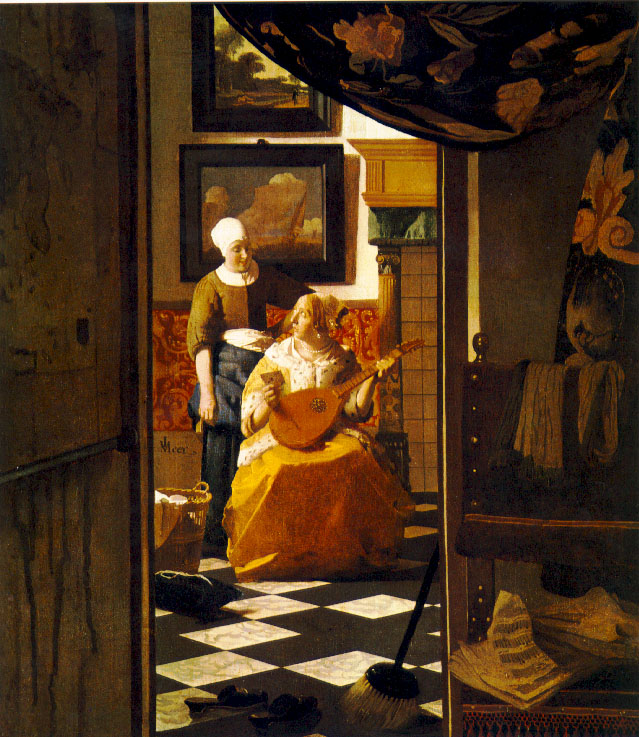
Bits of information a-cross the centuries - Bad Tidings & The Love Letter

As noted previously on W2tQ the significance of information practically and as a concept is very obvious in health and social care. Not just the debate about assuring privacy and confidentiality of clinical records and professional disclosure, but the meaning of information to an individual. This is assuming that the person concerned has the mental capacity to recognise what a particular circumstance, event, item of news means; and not just this morning, but tomorrow...

A diagnosis, lab result, a date for this procedure or that operation all can be a major source of anxiety and stress.

This week's visit to Amsterdam also included a visit to the Stedelijk Museum, where I saw Jobstijding (Bad Tidings), 1932 / Carel Willink (1900-1983). On Saturday I marvelled at Vermeer's The Love Letter and many other great works at the Rijksmuseum. ...

Through art and these works in particular we can contrast the social impact of information, of news - its meaning past and present with our ongoing preoccupation with binary representation and the information age.

Snail mail may be less common and yet the impact of decisions, news, life events ... remains.

individual
INTERPERSONAL : SCIENCES
humanistic ------------------------------------------- mechanistic
SOCIOLOGY : POLITICAL
group

https://www.rijksmuseum.nl/en/collection/SK-A-1595
Vermeer - The Love Letter
1 0
0 1
http://www.stedelijk.nl/en/artwork/3872-de-jobstijding
Carel Willink - Jobstijding (Bad Tidings)

0 1
1 0

Image sources:
The Love Letter, Vermeer
http://www.sai.msu.su/wm/paint/auth/vermeer/vermeer.love-letter.jpg

Jobstijding (Bad Tidings), 1932, Carel Willink (1900-1983)Stedelijk Museum, Amsterdam, The Netherlands

http://www.pinterest.com/pin/567383253025365412/

Friday, 13 June 2014

Books: The Geometry of Meaning, Gärdenfors & Geometry and Meaning, Widdows

http://mitpress.mit.edu/books/geometry-meaning
http://www.mitpressjournals.org/doi/pdf/10.1162/coli.2006.32.1.155There are two additions to my library. They are technical in parts and beyond my math and technical abilities, but as background this is essential reading.

The module 1 study, still to be marked provided a prompt to install R and obtain some summary statistics. Widdow's Geometry and Meaning includes details of the software used in the text. See the companion website below. While Gärdenfors' book The Geometry of Meaning is new, Widdow's text is a decade old and so demands some checking of software. I notice there are broken links on the companion site. The book, both in fact are great resources even as they increase the permanence of the geometry upon my furrowed brow...

Dominic Widdows, Geometry and Meaning - Companion website

Related posts:
http://hodges-model.blogspot.co.uk/search/label/conceptual%20spaces

Saturday, 26 April 2014

Alex through the Looking-Glass: How Life Reflects Numbers and Numbers Reflect Life

Alex through the Looking-Glass: How...

individual
INTERPERSONAL : SCIENCES
humanistic ------------------------------------------- mechanistic
SOCIOLOGY : POLITICAL
group


...Numbers Reflect Life
Life Reflects Numbers...


Image source:
http://pages.bloomsbury.com/favouritenumber/2

Monday, 20 January 2014

ERCIM News No. 96 Special theme: "Linked Open Data"

Dear ERCIM News Reader,

ERCIM News No. 96 has just been published at
http://ercim-news.ercim.eu/en96

Special Theme: "Linked Open Data"
http://ercim-news.ercim.eu/en96/special/
Guest editors
: Irini Fundulaki (Institute of Computer Science, FORTH) and Sören Auer (University of Bonn and Fraunhofer IAIS)

http://ercim-news.ercim.eu/en96
Keynote: "Linked Data: The Quiet Revolution" by Wendy Hall

This issue for download
pdf
: http://ercim-news.ercim.eu/images/stories/EN96/EN96-web.pdf
epub: http://ercim-news.ercim.eu/images/stories/EN96/EN96.epub

Next issue: No. 97, April 2014 - Special Theme: "Cyber-Physical Systems"
(see the call at http://ercim-news.ercim.eu/call)

Thank you for your interest in ERCIM News.
Feel free to forward this message to others who might be interested.

Best regards,
Peter Kunz
ERCIM News central editor

--------------------------------------------------
An initiative for the ERCIM members: Call for Participation - identifying the emerging grand challenges in ICST http://kwz.me/74

Sunday, 12 January 2014

Book: Thinking as Communicating - Sfard (the intra- interpersonal domain)

Previously I wondered about a term that might combine thinking and the formation and process of mental mapping, the creation of a conceptual map - a mental conceptual geography - cogneography?

Thinking as Communicating
Finding Anna Sfard's 1998 paper this past week led me to her book. The following is from the introduction:
I define thinking as individualized form of interpersonal communication. The disappearance of the time-honored dichotomy is epitomized in the term commognition, which combines communication with cognition. The commognitive tenet implies that verbal communication, with its distinctive property of recursive self-reference, may be the primary source of humans’ unique ability to accumulate the complexity of their action from one generation to another.

Sfard's work will have to go on the 'to read' pile (part-time studies begin tomorrow), but it may help provide ways to understand and unravel the intra- and interpersonal domain within Hodges' model. The mathematical emphasis (even though I may struggle with this) is an added bonus.

Sfard, A. Thinking as communicating: Human development, the growth of discourses, and mathematizing. Cambridge, UK: Cambridge University Press.

Sfard, A. (1998). On two metaphors for learning and the dangers of choosing just one. Educational Researcher, 27(2), pp. 4-13.
http://www.colorado.edu/physics/phys4810/phys4810_fa08/4810_readings/Sfard.pdf

Wednesday, 26 December 2012

The Enormous Theorem meets The Enormous Conceptual Framework

with Best Wishes for the Season and 2013...

Hodges' Health Career - Care Domains - Model is not a theory of health and social care.

It can however encompass the conceptual space that comprises not only health and social care, but the lived experience of individuals, and the existence of corporate and political entities (notably policy).

So while mathematicians have The Enormous Theorem, in Hodges' model we can at least reflect on what might be the enormous conceptual framework.


Prize awarded for largest mathematical proof. New Scientist, Sept 10 2011, 211, 2829. p.5.

Sunday, 2 December 2012

FatFonts - fonts with real weight: Giving space and data form

How it works (from fatfonts.org):

Fatfonts are designed so that the amount of dark pixels in a numeral character is proportional to the number it represents. For example, “2″ has twice the ink than “1″, “8″ has two times the amount of dark ink than “4″ etc. You can see this easily in the set of characters below:


Source for the above and animated: http://visual.ly/fatfonts-player?view=true

My source: Jacob Aron, Making numbers punch their weight, New Scientist, 5 May 2012, 214, 2863, p.12.

Sunday, 25 November 2012

CASA - Centre for Advanced Spatial Analysis: Working Papers

Date: Sat, 24 Nov 2012 10:24:30 +0000
From: Willard McCarty
Subject: CASA Working Papers

Many here will find something of interest, I suspect, in the Working Papers series of the Bartlett Centre for Advanced Spatial Analysis, University College London,
http://www.bartlett.ucl.ac.uk/casa/latest/publications/working-papers.
In particular my eye was caught by Martin Dodge and Rob Kitchin, "The ethics of forgetting in an age of pervasive computing", CASA Working Paper 92.

Undoubtedly those with GIS-related concerns will find much more than that.
Yours,
WM
--
Willard McCarty, FRAI / Professor of Humanities Computing & Director of the Doctoral Programme, Department of Digital Humanities, King's College London; Professor, School of Computing, Engineering and Mathematics, University of Western Sydney; Editor, Interdisciplinary Science Reviews
(www.isr-journal.org); Editor, Humanist
(www.digitalhumanities.org/humanist/); www.mccarty.org.uk/


My source:  Humanist Discussion Group, Vol. 26, No. 520. www.dhhumanist.org/
With CASA logo added here. 
                

Saturday, 4 August 2012

IdN Extra 07: Infographics — Designing Data

Visiting Manchester twice this past fortnight I'd noticed this IdN special issue on infographics in the Cornerhouse shop. The shop's only small but there is lots to dive into - arts, media, design and philosophy.

When a database becomes a thing of beauty

Infographics or information graphics are visual representations of information, data or knowledge. They are often used when complex information needs to be presented as quickly and effectively as possible, such as signs and maps. Infographics can be as simple as a bar chart or a pie graph to represent percentages in business information; or as elaborative as some of the examples in this book to communicate stories in newspapers and magazine.

Infographics can be entertaining when the information they represent is of personal interest; but it is especially fun and challenging when the topic may be as dry as representing concepts in technical manuals or scientific statics.

 <->

I don't know if it's the reduced scale, or my right eye talking but some of the text descriptions are difficult to read. The graphics and ideas are stunning, both in themselves and the questions they provoke.

Tuesday, 17 July 2012

ERCIM News No. 90 Special Theme: "Cybercrime and Privacy Issues"

Dear ERCIM News Reader,

ERCIM News No. 90 has just been published at http://ercim-news.ercim.eu/

Special Theme: "Cybercrime and Privacy Issues"

Guest editors: Jean-Jacques Quisquater (Université catholique de Louvain), Solange Ghernaouti-Hélie (University of Lausanne), Jens Tölle and Peter Martini (Fraunhofer Institute for Communication, Information Processing and Ergonomics FKIE)
http://ercim-news.ercim.eu/en90/special

Keynote: "Current Cybersecurity Best Practices – a Clear and Present Danger to Privacy" by Roger R. Schell
http://ercim-news.ercim.eu/en90/keynote

ERCIM News 90 issue for download in pdf:
http://ercim-news.ercim.eu/EN90/EN90-web.pdf

Next issue: No. 91, October 2012 - Special Theme: "What is Computation? Alan Turing's Legacy"
(see call at http://ercim-news.ercim.eu/call)

Thank you for your interest in ERCIM News.

Feel free to forward this message to others who might be interested.
Peter Kunz
ERCIM News central editor

Thursday, 5 April 2012

ERCIM News No. 89 Special Theme: "Big Data"

Dear ERCIM News Reader,

ERCIM News No. 89 has just been published at http://ercim-news.ercim.eu/

Special Theme: "Big Data"

Guest editors: Stefan Manegold, Martin Kersten, CWI, The Netherlands, and Costantino Thanos, ISTI-CNR, Italy
http://ercim-news.ercim.eu/en89/special

Keynote: "E-Infrastructures for Big Data: Opportunities and Challenges" by Kostas Glinos, European Commission
http://ercim-news.ercim.eu/en89/keynote/e-infrastructures-for-big-data-opportunities-and-challenges

Next issue: No. 90, July 2012 - Special Theme: "Cybercrime and Privacy Issues"
(see preliminary call at http://ercim-news.ercim.eu/call)

Thank you for your interest in ERCIM News. Feel free to forward this message to others who might be interested.
Peter Kunz
ERCIM News central editor

ERCIM "Alain Bensoussan" Fellowship Programme
ERCIM offers fellowships for PhD holders from all over the world. The next round is now open!
Deadline for applications: 30 April
http://fellowship.ercim.eu/

Issue 89 includes:
Performance Analysis of Healthcare Processes through Process Mining
by Diogo R. Ferreira
A-Brain: Using the Cloud to Understand the Impact of Genetic Variability on the Brain
by Gabriel Antoniu, Alexandru Costan, Benoit Da Mota, Bertrand Thirion and Radu Tudoran

Sunday, 11 March 2012

Use and ab-use of knowledge

The effective ‘use’ of knowledge is constantly espoused in health care both informally with patients and formally in evidence based research. Knowledge is the key to improving patient safety and delivering efficient, high quality care interventions and effective outcomes. Things become complicated in health and social with the number of potential knowledge sources and the disciplines intent on seeing, gathering, recording and utilizing knowledge that is theirs. From that adopted vantage point they are bound to have a certain perspective.

There are still vestiges of C.P. Snow’s The Two Cultures (1959) when we view the use and ab-use of knowledge, particularly the way knowledge is sliced, diced, partitioned and housed into disciplines. In the Introduction to Michel Serres' Parasite, Cary Wolfe notes that:
... the Latin prefix ab- meaning, the Oxford English Dictionary tells us, “off, or away from”: "abuse" value at a tangent to use and exchange value, at a distance from it: a different vector, a different type of value (Wolfe, 2007). p. xx.

Literally looking at the model we see that whilst there is increasing interdisciplinarity and collaboration between disciplines, practitioners and managers, academics and policy makers … there remains much ab-use between the domains of (care) knowledge.

If by definition abuse brings individuals, agencies and whoever falls in-between into disagreement, dispute and possibly much worse then clearly a tool that can help furnish a common understanding and insight should be welcomed.


For all that Hodges’s model can offer as a common foundation and bridge for the disciplines, we must ask where is the patient, the carer and the public? Is there a new discipline emerging?
 
What is needed to help gauge the potentials of use and ab-use in health and social care ...?

Additional links - for the image:
Coxeters Loxodromic Sequence of Tangent Circles
http://mathworld.wolfram.com/CoxetersLoxodromicSequenceofTangentCircles.html

Donald Coexeter
http://www.geometry.net/detail/scientists/coxeter_donald.html

Snow, C.P. (2001 [1959]). The Two Cultures. London: Cambridge University Press.

Wolfe, C. (2007). Introduction to the New Edition. Bring the Noise: The Parasite and the Multiple Genealogies of Posthumanism. In Serres, M. (1980). The Parasite. University of Minnesota Press.

Image source:
http://en.wikipedia.org/wiki/File:Coxeter_circles.png

Tuesday, 3 January 2012

ERCIM News No. 88 Special Theme: "Evolving Software"

Dear ERCIM News Reader,

ERCIM News No. 88 has just been published at http://ercim-news.ercim.eu/

Guest editors: Tom Mens (University of Mons, Belgium) and Jacques Klein (University of Luxembourg)

http://ercim-news.ercim.eu/en88/special

Keynote "Change is the Constant" by Joost Visser, Head of Research at Software Improvement Group
http://ercim-news.ercim.eu/en88/keynote/change-is-the-constant

Next issue: No. 89, April 2012 - Special Theme: "Big Data"
(see call at http://ercim-news.ercim.eu/call)

Thank you for your interest in ERCIM News.
Feel free to forward this message to others who might be interested.
Happy New Year!
Peter Kunz
ERCIM News central editor

[Includes: An introduction to this theme; Holistic Software Evolution; Wireless Sensor Networks and the Tower that Breathes; and Innovation in Disaster Management: Report from Exercise EU POSEIDON 2011. ] PJ

ERCIM News
is published quarterly by ERCIM, the European Research Consortium for Informatics and Mathematics.
The printed edition will reach about 10,000 readers.
This email alert reaches some 6000 subscribers.