Showing posts with label humanistic. Show all posts

Tuesday, 30 September 2014

Bits of information a-cross the centuries - Bad Tidings & The Love Letter

As noted previously on W2tQ the significance of information practically and as a concept is very obvious in health and social care. Not just the debate about assuring privacy and confidentiality of clinical records and professional disclosure, but the meaning of information to an individual. This is assuming that the person concerned has the mental capacity to recognise what a particular circumstance, event, item of news means; and not just this morning, but tomorrow...

A diagnosis, lab result, a date for this procedure or that operation all can be a major source of anxiety and stress.

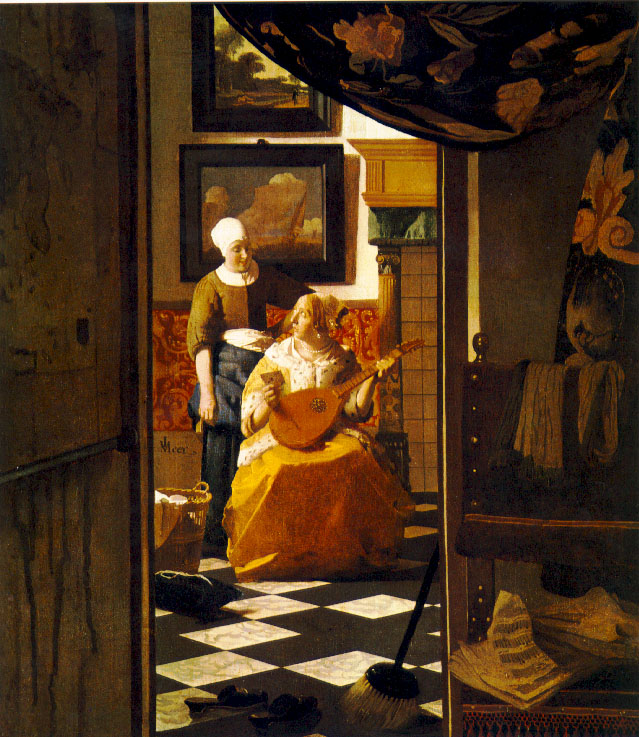
This week's visit to Amsterdam also included a visit to the Stedelijk Museum, where I saw Jobstijding (Bad Tidings), 1932 / Carel Willink (1900-1983). On Saturday I marvelled at Vermeer's The Love Letter and many other great works at the Rijksmuseum. ...

Through art and these works in particular we can contrast the social impact of information, of news - its meaning past and present with our ongoing preoccupation with binary representation and the information age.

Snail mail may be less common and yet the impact of decisions, news, life events ... remains.

individual
INTERPERSONAL : SCIENCES
humanistic ------------------------------------------- mechanistic
SOCIOLOGY : POLITICAL
group

https://www.rijksmuseum.nl/en/collection/SK-A-1595
Vermeer - The Love Letter
1 0
0 1
http://www.stedelijk.nl/en/artwork/3872-de-jobstijding
Carel Willink - Jobstijding (Bad Tidings)

0 1
1 0

Image sources:
The Love Letter, Vermeer
http://www.sai.msu.su/wm/paint/auth/vermeer/vermeer.love-letter.jpg

Jobstijding (Bad Tidings), 1932, Carel Willink (1900-1983)Stedelijk Museum, Amsterdam, The Netherlands

http://www.pinterest.com/pin/567383253025365412/

Thursday, 7 August 2014

Health and Social Care Policy: Always - from a distance

individual
INTERPERSONAL : SCIENCES
humanistic ------------------------------------------- mechanistic
SOCIOLOGY : POLITICAL
group

"Cura te ipsum." - "Take care of your own self."


mental health


physical

social


policy


Additional link:
http://en.wikipedia.org/wiki/Cura_te_ipsum


Latin source: Mediawatch, tpm the philosophers' magazine, 2nd quarter 2014, p.14.

(which cites: http://www.3ammagazine.com/3am/cura-te-ipsum/ )

Thursday, 12 June 2014

Psychiatric Bulletin - Letter: Psychiatry for medical students: need for a more holistic approach to teaching?

From: Psychiatric Bulletin -

http://pb.rcpsych.org/content/38/3/138.2.full

Kristina Rodney and Laura Wilkinson

Kristina Rodney and Laura Wilkinson are both ST4 medical students, Newcastle University, Newcastle, UK, email:k.rodney AT newcastle.ac.uk.

We are two medical students who wish to offer a perspective on undergraduate education and psychiatry.

During our student placement, we attended the old age psychiatry module at the Northern Deanery MRCPsych programme focusing on dementia and ethics. This was aimed at trainees and not specifically medical students but we were surprised to find that this was not above our level of knowledge. This prompted discussion of undergraduate psychiatry training more broadly, which we felt focused too heavily on the diagnosis of mental illness and less so on the holistic approach to the patient and their presentation as covered by the MRCPsych course. From our experience of undergraduate psychiatry we feel that the assessment by means of a logbook of conditions encourages students to find patients with a certain diagnosis, and in doing so overlooks the true essence of psychiatry. To our mind this incorporates the ability to consider all aspects of a patient’s life and formulating these, while demonstrating compassion for another person at a time of most need.

Through choosing a 6-week placement in old age psychiatry we have been able to explore the specialty more thoroughly and broadly than facilitated within the standard undergraduate programme, and we have realised how little of psychiatry we have been exposed to as undergraduates. We have become more aware of the importance of considering the patient’s personal and social circumstances alongside their diagnosis, and how these can influence each other. Specifically, the importance of a sound ethical approach to practice has been highlighted through the higher-level teaching we experienced, where the Mental Capacity Act was discussed in detail.

We believe that it would benefit undergraduates to experience a more realistic and rounded placement in psychiatry and truly consider the social implications of mental illness. As it currently stands, undergraduate education in psychiatry is oversimplified to focus on diagnosis and does not acknowledge the capabilities of medical students to adopt a holistic approach. An opportunity to consider all aspects of a psychiatrist’s role may encourage more students to consider a career in this field.

<>

I have contacted the authors of this letter to inform them of Hodges' model and its scope in assuring holistic and integrated care. The model could also facilitate curriculum development. The authors of the letter are not endorsing Hodges' model, I am seeking to highlight the need for such a resource.

Thanks to:
Lucy Alexander
Rights and Permissions Manager
Royal College of Psychiatrists

Tuesday, 3 June 2014

Never give up on someone ...

individual
INTERPERSONAL : SCIENCES
humanistic ------------------------------------------- mechanistic
SOCIOLOGY : POLITICAL
group

Never give up on someone with Mental Illness – 

when 'I' is replaced with -


'We' 
'illness' becomes 'Wellness'


Thanks to colleague Julie Draper - apparently this is doing the rounds on Facebook and elsewhere.

Sunday, 23 February 2014

18th Annual International Philosophy of Nursing Conference

in association with the International Philosophy of Nursing Society
(IPONS)

September 8th, 9th and 10th, 2014

Hosted by the School of Health Sciences, University of Nottingham, England, UK

Brave new world?
Health, technology and evidence based practice

Nurses have seen some fundamental changes in the way that healthcare is delivered. Body care is at the centre of nursing practice but the nature of that care has been extended beyond the personal, human-to-human contact, and is increasingly refracted through the medium of technological/scientific interventions. The way that these technologies interact with the human dimension does, and should, require critical analysis.This is particularly the case for nurses who are increasingly expected to adopt methods and approaches that change the nature of the nurse patient relationship.  Added to this is the way that clinicians/academics/researchers interact with health care issues, locally as well as globally.

There is an established debate and tension within the evidence based practice literature that illustrates a deep ambivalence about how a holistic approach to clinical practice relates to, enhances, or is undermined by the new health technologies. These include care pathways, systematic reviews of knowledge, the enabling/disabling effects of technology and the putative implication that there is an empiricist and dehumanising process involved in these developments. For example, what happens to the complexity of ethical debates when they are shaped in the form of arguments based on literature reviews? These may wittingly or unwittingly serve as a means of translating complex moral issues into usable clinical regimes that partially mimic meta-analyses. Furthermore we may ask what place narrative knowledge and qualitative experiences may have in this new world of implementation technologies? And how do the new interventions of telemedicine and other policy drivers that emphasise the “hospital-at-home” impact on the ways that nurses carry out health care?

This conference intends to examine these and other issues related to ‘Health, technology, and evidence-based practice’.


CONFERENCE DETAILS

Details of the Conference can now be found at the following link:
http://www.nottingham.ac.uk/conference/fac-mhs/healthsciences/aipnursingconference/index.aspx

These details include the list of Keynote speakers; the venue; a Call for Abstracts; conference registration and accommodation, and transportation. Abstracts of the Keynote speakers and the full Conference Programme will be available soon on the above link.

Any specific queries should be addressed to Dr Stuart Nairn
stuart.nairn AT nottingham.ac.uk


other IPONS posts on W2tQ

Monday, 27 January 2014

'Intellectual brutalisation' and the saving grace and power of poetry

BBC Radio 4 Today: An eminent cardiologist has organised and funded a poetry competition for his medical students to stop them becoming, in his words, intellectually brutalised.
Gabrielle Gascoigne, pictured, is a previous winner.
The BBC’s Jane Dreaper discovers more.

PBS: For these medical students, poetry nurtures the soul

Here's (source: http://www.bbc.co.uk/programmes/b03s6mdp/live ) the full version of Mastectomy - For His Wife, by Gabrielle Ruth Gascoigne:

It will be an honour
to bathe the scars.
Don’t think my tears imply
an ounce of sorrow -
only joy
could fill my eyes.

It will be a pleasure
to hold you close.
Know this – your precious flesh
calls the bluff on gold
and silver -
makes me a king.

It will be a delight
to talk with you
into the night we thought
stolen, clean away -
until day
renews our hope.

It would be too heartless
if all this love,
these sinner’s prayers and more
should fall to nothing
more than rain
on empty streets.

INTERPERSONAL : SCIENCES
humanistic ------------------------------------------- mechanistic
SOCIOLOGY : POLITICAL

individual
subjectivity
insight, rapport, empathy
emotional control, detachment, engagement
risk of burnout
objectivity
anatomy, physiology         
physicality, processes, mechanistic
intellectual brutalisation
humanistic
communication, relationships
(medic) poetry

funding, crowded curricula
hidden curriculum
group - population

Friday, 24 January 2014

Syria's Trojan women

http://www.syriatrojanwomen.org/

The Syria Trojan Women project began by creating drama workshops in Amman, Jordan in autumn 2013, and put on a theatrical production of Euripides’ anti-war tragedy, 'The Trojan Women' in December with a cast and crew of Syrian refugees. The first performances were a great success, and we hope to stage further performances in and around Amman, and a tour of Jordan and the region. http://www.syriatrojanwomen.org/

My source: Charlotte Eagar, Syria's Trojan women. FT Weekend, Life&Arts, 4 - 5 January 2014. pp.1-2.

INTERPERSONAL : SCIENCES
humanistic ------------------------------------------- mechanistic
SOCIOLOGY : POLITICAL

individual
"personal
parallels" p.2.


drama therapy


conflict
group - population

http://hodges-model.blogspot.co.uk/search/label/Jordan

Sunday, 19 January 2014

FOUR QUARTETS T.S. Eliot from EAST COKER - IV


FOUR QUARTETS

T.S. Eliot


EAST COKER
(No. 2 of 'Four Quartets')


IV
The wounded surgeon plies the steel
That questions the distempered part;
Beneath the bleeding hands we feel
The sharp compassion of the healer's art
Resolving the enigma of the fever chart.

    Our only health is the disease
If we obey the dying nurse
Whose constant care is not to please
But to remind of our, and Adam's curse,
And that, to be restored, our sickness must grow worse.

    The whole earth is our hospital
Endowed by the ruined millionaire,
Wherein, if we do well, we shall
Die of the absolute paternal care
That will not leave us, but prevents us everywhere.

    The chill ascends from feet to knees,
The fever sings in mental wires.
If to be warmed, then I must freeze
And quake in frigid purgatorial fires
Of which the flame is roses, and the smoke is briars.

    The dripping blood our only drink,
The bloody flesh our only food:
In spite of which we like to think
That we are sound, substantial flesh and blood—
Again, in spite of that, we call this Friday good.


T.S. Eliot Nobel Prizes biography
http://www.nobelprize.org/nobel_prizes/literature/laureates/1948/eliot-bio.html

Source copy:
http://www.davidgorman.com/4Quartets/notes.htm

http://www.davidgorman.com/4Quartets/2-coker.htm

Monday, 23 December 2013

SCNTST - Self Therapy

INTERPERSONAL : SCIENCES
SOCIOLOGY : POLITICAL
individual
Self Therapy
SCNTST


"... Self Therapy 
is designed for the headphones
 not the dance floor, ..."


Hunter-Tilney, L., Life&Arts, FT Weekend November 16-17 2013, p.19.

group - population


Image source: http://renownedforsound.com/index.php/album-review-scntst-self-therapy/

Saturday, 7 December 2013

Reading and writing the minutia of locked doors and windows (still a draught)

Couples, married or not, partners are the cards that frequently, if not by definition, lean on each other beyond the pale, to the n-th degree. Witness so many lessons of what love really is.

They bend and flex. Tested by history, timelines entwined, ties-that-bind, trying to persist in the hear and how.

Their psychological union is challenged as memories become eroded and physically frailty takes hold. Usually; mostly, on the one.

Eventually things, established relationships break and one or the other - should we say: finds themselves in - residential care.

Courtship enables us to become socialised to and with each other and respective families and in some instances other cultures and beliefs.

In this crucial transition sometimes there is learning through experience as respite care is sought.

In other cases health services wonder how this relationship has survived for so long. A crisis is a precipice for change. A chaotic invitation. Radical.

A sudden shift from what was home to a new world of corridors, r, ro, roo, room, rooms; my room? New noises and smells and altered routines and jumbled faces, touches, days and nights

The dolls of childhood are left behind, but may be picked up again literally as an emotional comforter. If not this then perhaps a ‘paper clad dol’ that is bound to be - ‘deprivation of liberty’.

In this new home, this person walks the corridor and inspects the minutia of the doors and windows. Staff pass by(e) waving by their walk - "so-busy-look-no-hands" while trying to be butterflies.

Butterflies that cannot say which way is ‘out’.

They are they. Difficult to follow with eye, head and a hand to catch. The individual recognises the whole of the comings and goings, the main thoroughfare. The strategic point, the nexus of comings and goings.

Something's not right though! I need to be somewhere else.

Sadly (or Usually), there is no going back.

Is there a pattern to this confused-coming-to-terms-with?

From asking repeatedly about being elsewhere, especially with the setting of the sun is there a shift in attempted reasoning? So correct, so responsible all those decades ago. Perhaps even months ago...

If no one will listen to me then perhaps if I have my wife/husband with me then they will see the importance of my cause, my mission.

See look - I have my wife, husband, partner with me now: we really need to go!

Can the residential care home support this person? Can they meet their care needs? They say they are ‘struggling’. Will they need to move – again?

How do they work through this transition? What do we know of how individuals negotiate this transition in their lives? How can we try to understand?

How do they make sense of what has happened, and where they now find themselves? Will their level of distress, agitation gradually extinguish as with their efforts to leave?

As they look to the windows, seek to traverse the doorway, cross the foreign threshold and venture to that somewhere that is not here, we know one thing.

Person centredness lies in the minutia of the life once lived through those locked doors and windows.

We can ‘open’ the doors and windows by travelling with them, together, sharing that journey, the sense of those times and upon returning help them adjust to this new listen and how. Clearly, deprivation of liberty is not a punishment here, yet it demands compensation by provision of high quality personalised care.

Saturday, 30 November 2013

The Resurgence of - Soul Soil Society - in h2cm

On my travels into Manchester for Drupal NW and other monthly meetings I sometimes have time to call at the Cornerhouse. It's an independent cinema and visual arts venue. The shop is open until about 7pm and amongst many interesting publications I discovered Resurgence which is now Resurgence & ECOLOGIST. It is a great read - as per its banner - on the environment, activism, social justice, arts and ethical living. The great read lies not just in the content, but the fact that it challenges your way of life.

The welcome in the latest issue Nov/Dec 2013 by Satish Kumar the editor-in-chief includes mention of two books, one by Satish Kumar himself: Soul Soil Society.

As technology races ahead and governments chase economic growth through capitalist-based socio-economic systems what stands out is the failure of political systems to keep up.

The question is not how soil is created through a natural process that takes time and is itself a vital variable in a complex ecosystem. The question is how hard can we push soil?

What are the global effects of giant excavators that can move mountains, cut swathes of tarmac through rain forests? What is the natural value of soil, of land for individual farmers against synthetic fertilisers, genetically modified seed, land grabs ...? Why do we call the rainforests - rainforests#? The impacts are local, global and glocal as this issue of Resurgence and others highlights.

Below I've transposed the book's title on to Hodges' model:
INTERPERSONAL : SCIENCES
SOCIOLOGY : POLITICAL

individual
Soul


Soil

Society


What is missing?
group - population

# See also: PHYSICS & THE RAINFOREST, Peter Bunyard, pp.12-14.

Additional book:
Jonathon Porritt, The World We Made

Tuesday, 19 November 2013

Immortality, the matrix and Hodges' model

The 5th care - knowledge - domain is the Spiritual

INTERPERSONAL : SCIENCES
SOCIOLOGY : POLITICAL
individual

floating off as souls
not dying


coming back to life
living on through legacy


group - population


My source: FT Weekend March 31 - April 1 2012, Memento mori, Book review by Julian Baggani of Stephen Cave's Immortality: The Quest to Live Forever and How It Drives Civilization.

Thursday, 29 November 2012

(Extreme) sensitivity to initial conditions: Employment - Sickness

There was an item today on BBC Radio 4's You and Yours on the government's Fit for Work tests.

The new fitness for work assessments have been under review. The discussion featured Professor Malcolm Harrington and his final report on the Work Capability Assessment Review and highlighted the humanistic and mechanistic dimensions of this very complex issue (see also the back-to-work programme?). Points raised include:
  • the impact of certain medications and treatments on an individual's ability to partake in an interview;
  • the meaningfulness of an appeals process that once won, then sees subsequent recalls;
  • 4/10 appeals are won;
  • the need to balance decision making and the computer based process, with the former utilising documentary evidence;
  • people with mental health and cognitive problems may be less able to advocate for themselves.
What troubled me is (the admittedly) single example were a client attending a review was advised not to bring documentary evidence. What this does is to effectively switch OFF three of four care domains: SOCIAL, INTERPERSONAL and (remarkably) the SCIENTIFIC.

What are the purposes to which clinical assessments, tests, reviews can be put? Why do clinicians and the social care team create records?

Relying primarily upon, or being driven by a computer based algorithm makes this a POLITICAL 'exercise'.

As such it will be seen SPIRITUALLY as cold and uncaring.
POLITICAL neglect reinforcing similar neglect and disinterest in the CITIZENRY.

Sunday, 25 November 2012

Hodges' model 'Always Waiting' with Michael Kiwanuka

Seeing and listening with Hodges' model:
INTERPERSONAL : SCIENCES
SOCIOLOGY : POLITICAL

Safety,
'Illness',
...?
LIFE HISTORY, several selves,
...?
LIBERTY
...?


Thursday, 31 May 2012

Book for Review: Risjord's - Nursing Knowledge - Science, Practice, and Philosophy

In order to put Hodges' model on a more theoretical and practical footing (especially as part of an extended project) I approached the publishers of Mark Risjord's Nursing Knowledge: Science, Practice, and Philosophy. Wiley-Blackwell have kindly forwarded me a review copy of this book.

My preoccupation with nursing theory, practice and informatics could form the basis of a multiple choice question:

Having an earnest interest in nursing theory, practice and informatics is:

a) a grand academic and intellectual enterprise (you're a historian, journalist and futurologist).
b) a sign of our times for ALL nurses (doh!) this is the 21st century after all.
c) a contradiction in terms.
d) a sign you are informationally overloaded, trapped in the gap.

Seriously, the effort to understand nursing, informatics and retrofit theory (conceptual spaces, threshold concepts...?) to support Hodges' model needs to be philosophically sound - rigorous. This book will help.

Sunday, 15 April 2012

What really makes us human?

Remembering is fundamentally recursive,
because it involves inserting a past mental state
into the present one.

Michael Corballis
New Scientist, 1st September 2007 p.48-49.