Showing posts with label relationships. Show all posts

Tuesday, 30 September 2014

Bits of information a-cross the centuries - Bad Tidings & The Love Letter

As noted previously on W2tQ the significance of information practically and as a concept is very obvious in health and social care. Not just the debate about assuring privacy and confidentiality of clinical records and professional disclosure, but the meaning of information to an individual. This is assuming that the person concerned has the mental capacity to recognise what a particular circumstance, event, item of news means; and not just this morning, but tomorrow...

A diagnosis, lab result, a date for this procedure or that operation all can be a major source of anxiety and stress.

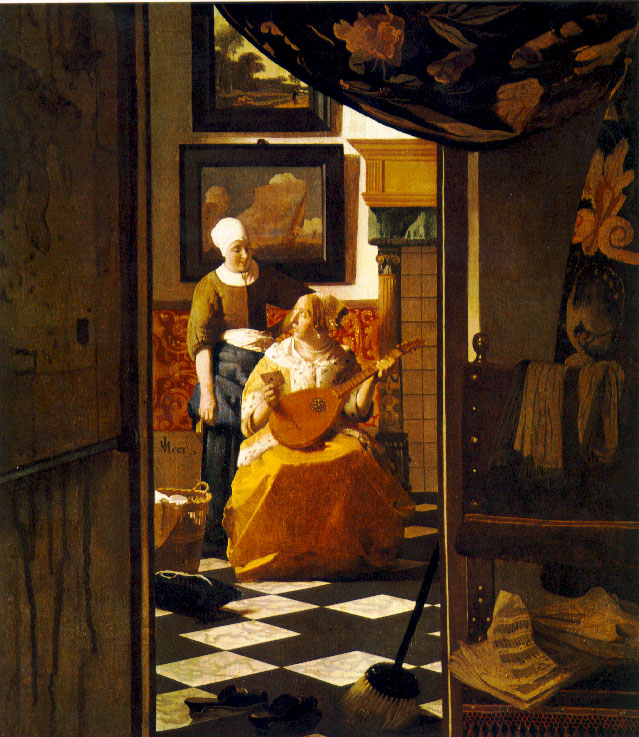
This week's visit to Amsterdam also included a visit to the Stedelijk Museum, where I saw Jobstijding (Bad Tidings), 1932 / Carel Willink (1900-1983). On Saturday I marvelled at Vermeer's The Love Letter and many other great works at the Rijksmuseum. ...

Through art and these works in particular we can contrast the social impact of information, of news - its meaning past and present with our ongoing preoccupation with binary representation and the information age.

Snail mail may be less common and yet the impact of decisions, news, life events ... remains.

individual
INTERPERSONAL : SCIENCES
humanistic ------------------------------------------- mechanistic
SOCIOLOGY : POLITICAL
group

https://www.rijksmuseum.nl/en/collection/SK-A-1595
Vermeer - The Love Letter
1 0
0 1
http://www.stedelijk.nl/en/artwork/3872-de-jobstijding
Carel Willink - Jobstijding (Bad Tidings)

0 1
1 0

Image sources:
The Love Letter, Vermeer
http://www.sai.msu.su/wm/paint/auth/vermeer/vermeer.love-letter.jpg

Jobstijding (Bad Tidings), 1932, Carel Willink (1900-1983)Stedelijk Museum, Amsterdam, The Netherlands

http://www.pinterest.com/pin/567383253025365412/

Monday, 8 September 2014

Interviews: In the political melee don't forget the green corner...!

individual
INTERPERSONAL : SCIENCES
humanistic ------------------------------------------- mechanistic
SOCIOLOGY : POLITICAL
group

Therapeutic
alliance


"Sir Robin cited research conducted by two psychologists on interviews during the 1987 general election campaign. Dr Peter Bull and Kate Mayer found that Kinnock and Thatcher avoided more than half the questions put to them. They concluded the party leaders used 31 different forms of evasion, among them ignoring the question, acknowledging the question without answering, questioning the question, attacking the question, attacking the interviewer, declining to answer, giving an incomplete answer, repeating a previous answer and claiming already to have answered the question." FT Weekend. p.1


Source:
Katz, Ian, (2014) The death of the political interview. FT Weekend, Life & Arts, September 6-7th. p.1.

Wednesday, 4 June 2014

Would you let a robot take your blood?

A Robot With A Hypodermic Needle 

Written by Lucy Black
27 July 2013

Would you let a robot take your blood? The answer to this question illuminates our real relationship to machines that aspire to rise above the robot vac. Is there another sort of uncanny valley?

Veebot is a very clever use of some basic image processing plus some very accurate positioning mechanisms. It first locates a good vein using infrared. Once it has a target it switches to ultrasound to make sure that there is enough blood flow to make it worth inserting the needle.

More...


My source:
International Society for Presence Research: June
http://ispr.info/


individual
INTERPERSONAL : SCIENCES
humanistic ------------------------------------------- mechanistic
SOCIOLOGY : POLITICAL
group
trust, confidence, anxiety, expectations, 'needles' - phobia, previous experiences, model of the 'other', intelligence, physical tests to differentiate mental health problems, subjective feelings - 'creepiness'
human
pa
safety, measurement, imaging, mechanics, technology, electromagnetic spectrum, infra red, ultrasound, motion, accuracy, research, trials, evidence, logic, blood sample,  appearance, (surgical robots R-here)
factors
in             RFT - 'right first time'
public awareness, interaction, relationships, community of practice - acceptance, publicity, media, dissemination
investment, policy, certification, law, standards, testing, supervision, labour relations

Saturday, 31 May 2014

At a glance 65: Better Life for older people with high support needs: the role of social care

I am referencing the following as I struggle to complete a piece of work for the TEL course. These key messages resonate with Hodges' model (back to work....):

Published: May 2014

Key messages

The Joseph Rowntree Foundation has identified seven key challenges to be addressed for older people with high support needs to achieve a better quality of life. Social care has a key role to play in meeting these challenges.
  1. Old age is not about 'them': it is about all of us
  2. Older people are individuals and they are, as a group, becoming more diverse
  3. Relationships matter to us whatever our age; we have a fundamental human need to connect with others meaningfully
  4. Older people with high support needs have many assets, strengths and resources that they can also bring to the development and provision of services
  5. Whatever our age or support needs, we should all be treated as citizens: equal stakeholders with both rights and responsibilities
  6. The individual and collective voices of older people with high support needs should be heard and given power
  7. We need both to innovate and improve existing models
SCIE's role is to share knowledge about what works and use this to produce practical resources. Many of these resources will support people working in all aspects of social care to address these challenges.

http://www.scie.org.uk/index.aspx

Thursday, 22 May 2014

New: Journal of Critical Anti-Oppressive Social Inquiry (CAOS)

CAOS 
is an interdisciplinary peer reviewed journal that publishes original articles/art work/poetry that foreground critical forms of social inquiry, research and practice.  

http://caos.library.ryerson.ca/index.php/caos

Tuesday, 22 April 2014

International Council of Women's Health; Multidisciplinary Conference - Beyond 2015: What will it take

http://icowhi2014.com/

Dear Colleagues and friends

FUNDISA with SIGMA THETA TAU INTERNATIONAL as diamond partner, is hosting the -

INTERNATIONAL COUNCIL ON WOMEN'S HEALTH ISSUE (ICOWHI) 20th conference

- from 12-14 November 2014 at the ICC in Cape Town. Please note this is a MULTIDISCIPLINARY conference and any discipline working on women's health issues or related topics are invited to submit an abstract. See the call for abstracts.

Please distribute to relevant colleagues in your network.

Kind regards

Hester
Prof Hester C. Klopper (PhD, MBA, FANSA)
President: Sigma Theta Tau International
Chief Executive Officer: FUNDISA
Professor: UWC and NWU
Office tel: +27 (0) 12 333 1415+27 (0) 12 333 1415
Twitter: @klopperhc

The GANM is part of the Johns Hopkins University School of Nursing PAHO/WHO Collaborating Center. The thoughts, opinions and views that are posted on the GANM do not reflect those of either Johns Hopkins University or WHO.

Please visit the GANM webpage at: http://knowledge-gateway.org/ganm/
If you want to reply privately, read below.
You are receiving this message because you are a member of the community GANM (Global Alliance for Nursing and Midwifery).

Friday, 18 April 2014

[ Exclusive* preview ] Wrinkles


individual, dignity, person, memories, identity,
security, communication, perception, meaning, friends,
belonging, mood, orientation ...


demographics, evidence based care, medication, treatments, physical environment ....
policy, standards, inspection, training, organisation, safety, governance, management culture, leadership ...

Link:
http://www.arrugaslapelicula.com/

*Person centered?

Saturday, 29 March 2014

Amelia: with Human Steps Lalala

INTERPERSONAL : SCIENCES
humanistic ------------------------------------------- mechanistic
SOCIOLOGY : POLITICAL
individual

Just-be


with us


NO!
Be still!
Just-ice
group - population

My source: Sky Arts 1 and Amelia - my grandmother

Thursday, 27 February 2014

Book: The Last Asylum

INTERPERSONAL : SCIENCES
humanistic ------------------------------------------- mechanistic
SOCIOLOGY : POLITICAL
individual
The Last Asylum
 -sociology
-medicine

medical-
social-


group - population

Winwick Hospital remembered

Image source: Metro

Monday, 27 January 2014

'Intellectual brutalisation' and the saving grace and power of poetry

BBC Radio 4 Today: An eminent cardiologist has organised and funded a poetry competition for his medical students to stop them becoming, in his words, intellectually brutalised.
Gabrielle Gascoigne, pictured, is a previous winner.
The BBC’s Jane Dreaper discovers more.

PBS: For these medical students, poetry nurtures the soul

Here's (source: http://www.bbc.co.uk/programmes/b03s6mdp/live ) the full version of Mastectomy - For His Wife, by Gabrielle Ruth Gascoigne:

It will be an honour
to bathe the scars.
Don’t think my tears imply
an ounce of sorrow -
only joy
could fill my eyes.

It will be a pleasure
to hold you close.
Know this – your precious flesh
calls the bluff on gold
and silver -
makes me a king.

It will be a delight
to talk with you
into the night we thought
stolen, clean away -
until day
renews our hope.

It would be too heartless
if all this love,
these sinner’s prayers and more
should fall to nothing
more than rain
on empty streets.

INTERPERSONAL : SCIENCES
humanistic ------------------------------------------- mechanistic
SOCIOLOGY : POLITICAL

individual
subjectivity
insight, rapport, empathy
emotional control, detachment, engagement
risk of burnout
objectivity
anatomy, physiology         
physicality, processes, mechanistic
intellectual brutalisation
humanistic
communication, relationships
(medic) poetry

funding, crowded curricula
hidden curriculum
group - population

Saturday, 7 December 2013

Reading and writing the minutia of locked doors and windows (still a draught)

Couples, married or not, partners are the cards that frequently, if not by definition, lean on each other beyond the pale, to the n-th degree. Witness so many lessons of what love really is.

They bend and flex. Tested by history, timelines entwined, ties-that-bind, trying to persist in the hear and how.

Their psychological union is challenged as memories become eroded and physically frailty takes hold. Usually; mostly, on the one.

Eventually things, established relationships break and one or the other - should we say: finds themselves in - residential care.

Courtship enables us to become socialised to and with each other and respective families and in some instances other cultures and beliefs.

In this crucial transition sometimes there is learning through experience as respite care is sought.

In other cases health services wonder how this relationship has survived for so long. A crisis is a precipice for change. A chaotic invitation. Radical.

A sudden shift from what was home to a new world of corridors, r, ro, roo, room, rooms; my room? New noises and smells and altered routines and jumbled faces, touches, days and nights

The dolls of childhood are left behind, but may be picked up again literally as an emotional comforter. If not this then perhaps a ‘paper clad dol’ that is bound to be - ‘deprivation of liberty’.

In this new home, this person walks the corridor and inspects the minutia of the doors and windows. Staff pass by(e) waving by their walk - "so-busy-look-no-hands" while trying to be butterflies.

Butterflies that cannot say which way is ‘out’.

They are they. Difficult to follow with eye, head and a hand to catch. The individual recognises the whole of the comings and goings, the main thoroughfare. The strategic point, the nexus of comings and goings.

Something's not right though! I need to be somewhere else.

Sadly (or Usually), there is no going back.

Is there a pattern to this confused-coming-to-terms-with?

From asking repeatedly about being elsewhere, especially with the setting of the sun is there a shift in attempted reasoning? So correct, so responsible all those decades ago. Perhaps even months ago...

If no one will listen to me then perhaps if I have my wife/husband with me then they will see the importance of my cause, my mission.

See look - I have my wife, husband, partner with me now: we really need to go!

Can the residential care home support this person? Can they meet their care needs? They say they are ‘struggling’. Will they need to move – again?

How do they work through this transition? What do we know of how individuals negotiate this transition in their lives? How can we try to understand?

How do they make sense of what has happened, and where they now find themselves? Will their level of distress, agitation gradually extinguish as with their efforts to leave?

As they look to the windows, seek to traverse the doorway, cross the foreign threshold and venture to that somewhere that is not here, we know one thing.

Person centredness lies in the minutia of the life once lived through those locked doors and windows.

We can ‘open’ the doors and windows by travelling with them, together, sharing that journey, the sense of those times and upon returning help them adjust to this new listen and how. Clearly, deprivation of liberty is not a punishment here, yet it demands compensation by provision of high quality personalised care.

Friday, 4 October 2013

Thursday, 3 October 2013

two books two islands two doctors - beyond a cappuccino

My uncle Doug (I do miss him) mentioned a book to me when I was some time around 1974. I think I found a copy in their bookcase when the whole family used to visit on a Sunday afternoon.
A decade later 1983, the year before I got married I visited Sorrento and during this holiday took a day trip to Capri.

With my fiancé I found myself walking around the Villa San Michele. The book was The Story of San Michele by Axel Munthe. I don’t recall consciously deciding to go to Anacapri, but I found myself there. It really made an impression on the 24 year old. What an amazing place to be, study, to try to be creative if not grandiose.

I’m sure I read the book after this visit, it dawning on me that this was - not just - that place, but the story too.

In between on holiday in Kefalonia in 1995 and read Captain Corelli’s Mandolin while there. Axel Munthe was a doctor and there’s a doctor in de Bernières’ book.

Two islands, two doctors, two books: fact and fiction and the spaces in between.

Thirty years later it was a lovely experience to take the bus to Anacapri this September and spend some time at San Michele.

Now the mix of history and styles is a bit jarring, but it is still, for me at least, an amazing space to be. The views of the Bay of Naples are stunning.

The light, the air, the sky.

Inspirational.

At some point if I could spend some time there, beyond a cappuccino...


The Bay of Naples - Vesuvius from San Michele 4 Sept 2013

literatureandmedicine

Monday, 27 May 2013

'Lost Luggage': From the many to the one

Source: http://www.amazon.ca/Lost-Luggage-Jordi-Punti/dp/1780720440


Christof, Christophe, 
Christopher and Cristòfol 

- are four brothers – sons of the same father and four very different mothers...

One mother, an English nurse on a cross channel ferry...


The Times, Saturday Review, 25 May 2013, p.17.

Sunday, 31 March 2013

DTMD 2013 & Three different perspectives on a model

I am really looking forward to next week's the Difference That Makes a Difference an interdisciplinary workshop on Information: Space, Time, and Identity at the The Open University and the MK Gallery, Milton Keynes, UK. 

There's a session of instant interest to me as it refers to Peter Gärdenfors' work on conceptual spaces -

Session 1: Information and Space

Spacification: How to design and construct spaces
that can enhance artistic experiences

Ambjörn Naeve (KTH, Sweden) and Carl Smith (London Metropolitan University, UK)

Naeve and Smith provide a further reference:
A (conceptual) model is a description of the most important concepts and their respective relationships within a certain domain of interest. Whatever domain of interest that you focus on, your model will consist of (conceptually simplified) parts that interact with each other in some way. This leads to three different types of models:
  1. The static model describes WHAT the (most important) parts are about.
  2. The dynamic model describes HOW these parts interact with each other.
  3. The intentional model describes WHY they display this behavior.
As we will see, these modeling types can often be mixed into a single model, and then these different types should be thought of more as “aspects” or “perspectives” of the model.

Ref: Ambjörn Naeve. 2011-01-31. A Modeling Primary on Methods and Techniques for Communicative Modeling and Disagreement Management. European Commission Seventh Framework Project (IST-257822).

Friday, 15 March 2013

The Breakthrough Prize in Life Sciences & the scope of innovation

A prize that furthers progress in the life sciences is to be welcomed and the winners certainly lauded. Logic would dictate that The Life Sciences Breakthrough Prize and the funding behind it targets the hard sciences: biology, physics and chemistry and the vast and growing number of associated specialist disciplines.

'Life', however, as in living is more than a binary operation - as the FT Weekend editorial notes:

Those eureka ideas

... It would be good to see more daring choices in the future: those outside the well-trodden circuit of university departments and research institutions in the industrialised world.
Breakthroughs in life science go beyond the laboratory to interactions with patients, doctors, public health officials, drug companies and regulators. They should also tap into advances in information technology. ...
(Financial Times - FT Weekend, page 10, 9th - 10th March 2013)

Sunday, 13 January 2013

Health in the Round - A paper Griffiths et al. ...

The quote below from Griffiths et al. highlights what might be described as health in the round. As the authors address: the rapid growth of online social networking for health, health care systems are experiencing an inescapable increase in complexity - they contrast disease-centred health care with patient-centred. In so doing they distinguish the mechanistic tendencies in health care systems with the humanistic. For me reading this section of the paper was a circumnavigation of health and social care domains of Hodges' model:
Good communication between doctors and patients has been widely recognised by professional bodies in North America (AAMC, 1999) and Europe (GMC, 2009) as essential to the delivery of health care and appears to contribute to healing (Street, Makoul, Arora, & Epstein, 2009). Stewart (2001) has argued for a shift away from disease-centred biomedicine to a more holistic patient-centred alternative. This approach encompasses: exploring the patient’s reason for consulting; developing an understanding of their context; finding common ground in problem characterisation and management; supporting health promotion; and enabling the doctor-patient relationship to continue (Stewart et al., 2003). Patient-centred practice reflects (Bensing, 2000) a set of social and political ideas about the nature of the doctor patient relationship (Mead & Bower, 2000), which, it could be argued, forms a complex system (Situngkir, 2004). p.2237.

Griffiths, F., Cave, J., Boardman, F., Ren, J., Pawlikowska, T., Ball, R., Clarke, A., Cohen, A. (2012). Social networks - The future for health care delivery. Social Science & Medicine. 75: 2233-2241.

Friday, 18 May 2012

106? No! That's not the meaning of 'personalised' care [I]

INTERPERSONAL : SCIENCES
SOCIOLOGY : POLITICAL

Person-alised care c/o Andrea, Jamal, Leila, Kareem, Nada, Cassie, Graham, Addy, Gizela, Sandra, Kate, Tony, Em, ...

Diagnosis - dementia, confusion, agitation
Care needs include: personal hygiene, dressing, washing ...
Carer - support
relationship building
trust, empathy, rapport...
106
Policy, Governance, Audit, Outcomes, Feedback, Commissioning, ...

What is the meaning of continuity?

BBC News: Dementia patient 'had 106 carers'.