Showing posts with label rapport. Show all posts

Tuesday, 30 September 2014

Bits of information a-cross the centuries - Bad Tidings & The Love Letter

As noted previously on W2tQ the significance of information practically and as a concept is very obvious in health and social care. Not just the debate about assuring privacy and confidentiality of clinical records and professional disclosure, but the meaning of information to an individual. This is assuming that the person concerned has the mental capacity to recognise what a particular circumstance, event, item of news means; and not just this morning, but tomorrow...

A diagnosis, lab result, a date for this procedure or that operation all can be a major source of anxiety and stress.

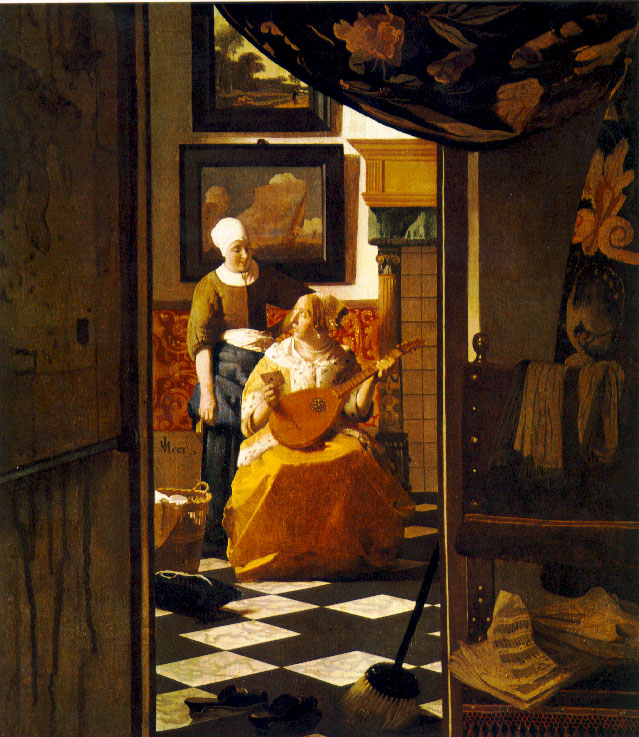
This week's visit to Amsterdam also included a visit to the Stedelijk Museum, where I saw Jobstijding (Bad Tidings), 1932 / Carel Willink (1900-1983). On Saturday I marvelled at Vermeer's The Love Letter and many other great works at the Rijksmuseum. ...

Through art and these works in particular we can contrast the social impact of information, of news - its meaning past and present with our ongoing preoccupation with binary representation and the information age.

Snail mail may be less common and yet the impact of decisions, news, life events ... remains.

individual
INTERPERSONAL : SCIENCES
humanistic ------------------------------------------- mechanistic
SOCIOLOGY : POLITICAL
group

https://www.rijksmuseum.nl/en/collection/SK-A-1595
Vermeer - The Love Letter
1 0
0 1
http://www.stedelijk.nl/en/artwork/3872-de-jobstijding
Carel Willink - Jobstijding (Bad Tidings)

0 1
1 0

Image sources:
The Love Letter, Vermeer
http://www.sai.msu.su/wm/paint/auth/vermeer/vermeer.love-letter.jpg

Jobstijding (Bad Tidings), 1932, Carel Willink (1900-1983)Stedelijk Museum, Amsterdam, The Netherlands

http://www.pinterest.com/pin/567383253025365412/

Monday, 8 September 2014

Interviews: In the political melee don't forget the green corner...!

individual
INTERPERSONAL : SCIENCES
humanistic ------------------------------------------- mechanistic
SOCIOLOGY : POLITICAL
group

Therapeutic
alliance


"Sir Robin cited research conducted by two psychologists on interviews during the 1987 general election campaign. Dr Peter Bull and Kate Mayer found that Kinnock and Thatcher avoided more than half the questions put to them. They concluded the party leaders used 31 different forms of evasion, among them ignoring the question, acknowledging the question without answering, questioning the question, attacking the question, attacking the interviewer, declining to answer, giving an incomplete answer, repeating a previous answer and claiming already to have answered the question." FT Weekend. p.1


Source:
Katz, Ian, (2014) The death of the political interview. FT Weekend, Life & Arts, September 6-7th. p.1.

Saturday, 5 July 2014

i c u

individual
INTERPERSONAL : SCIENCES
humanistic ------------------------------------------- mechanistic
SOCIOLOGY : POLITICAL
group


tears


tears


Avatar image "I see me through your eyes."
te ar s

Wired: Avatar 2, 3 and 4

ICU - Intensive Care Unit
Image: http://i1.ytimg.com/vi/Ek5C0NhnNlA/maxresdefault.jpg

Tuesday, 17 June 2014

Book: The Empathy Exams & Michel Serres Institute

individual
INTERPERSONAL : SCIENCES
humanistic ------------------------------------------- mechanistic
SOCIOLOGY : POLITICAL
group
http://www.lesliejamison.com/
The Natural Sciences
Local, Society & Socio-

-Economic


As recent posts reveal I'm overwhelmed with reading at present. Material that is essential for the TEL course and reading more tangential and yet potentially enjoyable titles. It will be a busy summer as all this is brought together(!?). Especially as I've a literature search in mind as a module submission - progress permitting.

The publication of Jamison's book this (N) spring sits well after the findings last year about the benefits of reading fiction in increasing empathy.

Since 2008-2009 I've lost touch with the work of Michel Serres:

Jones, Peter, Exploring Serres’ Atlas, Hodges’ Knowledge Domains and the Fusion of Informatics and Cultural Horizons (Aug 15, 2007). SOCIAL INFORMATION TECHNOLOGY CONNECTING SOCIETY AND CULTURAL ISSUES. Available at SSRN: http://ssrn.com/abstract=1842504 or http://dx.doi.org/10.2139/ssrn.1842504

- having only just found the Institute. I only scratched the surface of Serres' oeuvre in the above paper and must recharge my reflective capacity.

http://institutmichelserres.ens-lyon.fr/
Book cover image: http://www.ew.com/ew/article/0,,20800427,00.html

My source: The Empathy Exams
FT Weekend, June 7-8, 2014.

Monday, 27 January 2014

'Intellectual brutalisation' and the saving grace and power of poetry

BBC Radio 4 Today: An eminent cardiologist has organised and funded a poetry competition for his medical students to stop them becoming, in his words, intellectually brutalised.
Gabrielle Gascoigne, pictured, is a previous winner.
The BBC’s Jane Dreaper discovers more.

PBS: For these medical students, poetry nurtures the soul

Here's (source: http://www.bbc.co.uk/programmes/b03s6mdp/live ) the full version of Mastectomy - For His Wife, by Gabrielle Ruth Gascoigne:

It will be an honour
to bathe the scars.
Don’t think my tears imply
an ounce of sorrow -
only joy
could fill my eyes.

It will be a pleasure
to hold you close.
Know this – your precious flesh
calls the bluff on gold
and silver -
makes me a king.

It will be a delight
to talk with you
into the night we thought
stolen, clean away -
until day
renews our hope.

It would be too heartless
if all this love,
these sinner’s prayers and more
should fall to nothing
more than rain
on empty streets.

INTERPERSONAL : SCIENCES
humanistic ------------------------------------------- mechanistic
SOCIOLOGY : POLITICAL

individual
subjectivity
insight, rapport, empathy
emotional control, detachment, engagement
risk of burnout
objectivity
anatomy, physiology         
physicality, processes, mechanistic
intellectual brutalisation
humanistic
communication, relationships
(medic) poetry

funding, crowded curricula
hidden curriculum
group - population