Showing posts with label life story. Show all posts

Tuesday, 30 September 2014

Bits of information a-cross the centuries - Bad Tidings & The Love Letter

As noted previously on W2tQ the significance of information practically and as a concept is very obvious in health and social care. Not just the debate about assuring privacy and confidentiality of clinical records and professional disclosure, but the meaning of information to an individual. This is assuming that the person concerned has the mental capacity to recognise what a particular circumstance, event, item of news means; and not just this morning, but tomorrow...

A diagnosis, lab result, a date for this procedure or that operation all can be a major source of anxiety and stress.

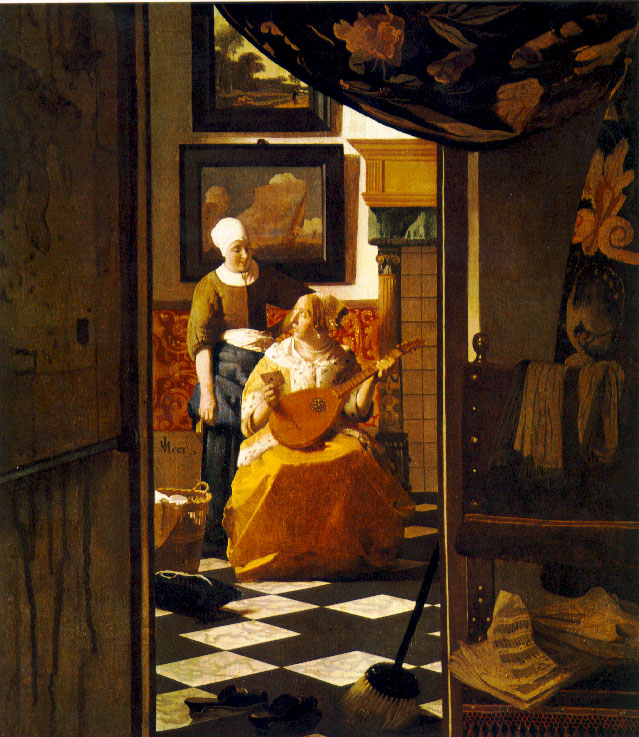
This week's visit to Amsterdam also included a visit to the Stedelijk Museum, where I saw Jobstijding (Bad Tidings), 1932 / Carel Willink (1900-1983). On Saturday I marvelled at Vermeer's The Love Letter and many other great works at the Rijksmuseum. ...

Through art and these works in particular we can contrast the social impact of information, of news - its meaning past and present with our ongoing preoccupation with binary representation and the information age.

Snail mail may be less common and yet the impact of decisions, news, life events ... remains.

individual
INTERPERSONAL : SCIENCES
humanistic ------------------------------------------- mechanistic
SOCIOLOGY : POLITICAL
group

https://www.rijksmuseum.nl/en/collection/SK-A-1595
Vermeer - The Love Letter
1 0
0 1
http://www.stedelijk.nl/en/artwork/3872-de-jobstijding
Carel Willink - Jobstijding (Bad Tidings)

0 1
1 0

Image sources:
The Love Letter, Vermeer
http://www.sai.msu.su/wm/paint/auth/vermeer/vermeer.love-letter.jpg

Jobstijding (Bad Tidings), 1932, Carel Willink (1900-1983)Stedelijk Museum, Amsterdam, The Netherlands

http://www.pinterest.com/pin/567383253025365412/

Tuesday, 25 March 2014

Extraordinary lives: Demographic influences on academic studies - Life Writing, Life Story Work

Recent reading for studies at Lancaster included
Ethics of Internet Research: Contesting the Human Subjects Research Model

Beyond a week's focus on ethics the above refers to Life Writing:
The study of Life Writing spans many disciplines, and represents 'a fast changing terrain' which is concerned with the study of the writing of lives, encompassing auto/biography as well as aspects of life story that originate outside the written form, such as oral history, testimony, and artifacts such as photography and the visual arts (Jolly, 2001, p. ix). The written text is viewed as a vehicle for an individual's construction of identity, the personal narrative that it records being

…a fundamental means by which people comprehend their own lives and present a 'self' to their audience. (Borland, 1991, p. 71)
...
The multiple approaches taken in Life Writing research can arguably be attributed to the multidisciplinary background of its practitioners. Like Internet researchers, those researching Life Writing have been trained in a variety of disciplines including anthropology, sociology, history, linguistics and literary theory. These various disciplines have contributed a range of insights into the collection of oral history and analysis of the resultant texts (Gluck and Patai, 1991, p. 3). Ethical guidelines for the conduct of Life Writing researchers, such as those published by the Oral History Society in the UK, appear to follow a human subjects model, focussing on the undertaking of the interview, and restricting discussion of the resultant text to issues of copyright. Yet practitioners emphasise the need to remember that as:

…the typical product of an interview is a text, not a reproduction of reality …models of textuality [are] therefore needed. (Gluck and Patai, 1991, p. 3)
What chance is there that Life Writing will be - is being influenced by current demographic and societal trends? Trends and challenges that inevitably present new meanings for history within life and with this new ethical issues? While life writing is clearly an established discipline, how might it develop and what other challenges might apply?

In health and social care Life Story Work is an important part in of assessment and interventions. Has it been discussed, is it appropriate, completed and if so, is this work available and accessible? Do we need people beyond the existing establishment with a dedicated set of skills and knowledge to engage with people diagnosed early on, or will treatments soon make this less of an issue? Will dementia and early dementia especially, with the latest technology prompt new perspectives, or reinforce existing life writing practices? What is an archive? In life story work these people, persons, individuals (and their lives?) are more than subjects.

There are many overlaps already in the mental health state of past and present national leaders, while health services continue to bridge the dementia gap in diagnosis. Biography: world leaders, other recognised lives in Life Story Work and seeking to preserve personal identities in dementia care: clearly these are figures that count.

Thursday, 27 February 2014

Book: The Last Asylum

INTERPERSONAL : SCIENCES
humanistic ------------------------------------------- mechanistic
SOCIOLOGY : POLITICAL
individual
The Last Asylum
 -sociology
-medicine

medical-
social-


group - population

Winwick Hospital remembered

Image source: Metro

Saturday, 22 February 2014

Call for contributions: 'Interpreting the Information Age' new avenues for research and display

November 24 – 26 2014
Science Museum, London

In autumn 2014, the Science Museum will open a new permanent gallery, Information Age. The gallery will expose, examine and celebrate how information and communication technologies have transformed our lives over the last 200 years. To mark this launch, the Museum is hosting a three day conference which will discuss how the history and material culture of information can be made relevant for today’s audiences.

From the development of global telegraph and computer networks, the creation of constellations of satellites that silently orbit our earth, and the growth of radio, telephony and cellular networks; each technology can be understood through a network of people, practices, devices and infrastructure. Approaches which focus on overly technical histories, individual innovation or inevitable progress fail to acknowledge the role of users in the history of technologies and marginalise a majority of readers or visitors who are engaged by human stories and social history. By contrast, Information Age has taken a user-centric approach, not only in the stories and objects selected for display, but in the way the gallery has been designed and developed. Participation with a diverse range of audiences has been at the heart of the process, providing new avenues for research, fresh perspectives on our collections and original ways to interpret the information networks of which we are all part. We invite papers that include insights from researchers, academics, museum professionals, community partners and participants.

The conference structure is proposed to include:

Day 1: New avenues in the history of information and communication technologies

Day 2: Interpreting and displaying the history of information and communication technologies

Day 3: Reflections on the process and practicalities of participatory practice

We are especially interested in papers that address the following themes, but are happy to consider other proposals. Please contact the organisers for guidance. 

New avenues in the history of information and communication technologies

  • From devices to networks: taking a broader approach to the history of information and communication. How has historical analysis expanded our understanding of information networks as inherently social-cultural phenomena? How can museums move beyond displays of devices, to reveal how networks unite people, places and ideas?
  • User-driven innovation: technological change does not only occur at the moment of invention, but in the hands of users, who adapt and appropriate new technologies. What tools and techniques can we use to reveal previously hidden user stories?
  • Spaces and places of information: How are institutions celebrating the local and global stories in the history of information and communication technology? What partnerships are being formed to support this?

Interpreting and displaying the history of information and communication technologies

  • Collecting information: what are the challenges of collecting the material culture of information and communication? How can opening collecting processes to wider audiences enhance understanding, and what are the benefits for both researchers and the wider public?
  • Displaying information: innovative approaches to the history, present or future of information and communication technologies.
  • Preserving information: the challenges for museums, libraries and archives in preserving our increasingly digital lives.
  • Whose story? As institutions strive to tell the story of information and communication technologies from the perspective of users and co-producers, how can we ensure that we are representing a diverse range of voices? 

Reflections on the process and practicalities of participatory practice

  • Breaking down barriers: what approaches are being taken to ensure museum collections are accessible to wider audiences? What interpretation approaches can be adopted?
  • Collaborative interpretation and design: how are institutions and audiences working together in exhibition development? What are the benefits to the museum, participant and ultimately the gallery visitor? What are the perceived risks to the museum’s authority?
  • Ensuring legacy: how do museums capture the process of participatory practice in a meaningful way? What evaluation methodologies can be adopted? How can museums support partners and participants in the longer-term? 

How to contribute

To submit a proposal, please send a 250 abstract outlining the topic of your paper, along with a 100 word biography, to [ research AT sciencemuseum.ac.uk ] by Friday 28th March 2014.

We welcome proposals which could be delivered either as paper presentations or for consideration as panel discussions with other contributors, along with proposals for workshops which practically address the conference themes.

My source: HUMANIST list

Saturday, 7 December 2013

Reading and writing the minutia of locked doors and windows (still a draught)

Couples, married or not, partners are the cards that frequently, if not by definition, lean on each other beyond the pale, to the n-th degree. Witness so many lessons of what love really is.

They bend and flex. Tested by history, timelines entwined, ties-that-bind, trying to persist in the hear and how.

Their psychological union is challenged as memories become eroded and physically frailty takes hold. Usually; mostly, on the one.

Eventually things, established relationships break and one or the other - should we say: finds themselves in - residential care.

Courtship enables us to become socialised to and with each other and respective families and in some instances other cultures and beliefs.

In this crucial transition sometimes there is learning through experience as respite care is sought.

In other cases health services wonder how this relationship has survived for so long. A crisis is a precipice for change. A chaotic invitation. Radical.

A sudden shift from what was home to a new world of corridors, r, ro, roo, room, rooms; my room? New noises and smells and altered routines and jumbled faces, touches, days and nights

The dolls of childhood are left behind, but may be picked up again literally as an emotional comforter. If not this then perhaps a ‘paper clad dol’ that is bound to be - ‘deprivation of liberty’.

In this new home, this person walks the corridor and inspects the minutia of the doors and windows. Staff pass by(e) waving by their walk - "so-busy-look-no-hands" while trying to be butterflies.

Butterflies that cannot say which way is ‘out’.

They are they. Difficult to follow with eye, head and a hand to catch. The individual recognises the whole of the comings and goings, the main thoroughfare. The strategic point, the nexus of comings and goings.

Something's not right though! I need to be somewhere else.

Sadly (or Usually), there is no going back.

Is there a pattern to this confused-coming-to-terms-with?

From asking repeatedly about being elsewhere, especially with the setting of the sun is there a shift in attempted reasoning? So correct, so responsible all those decades ago. Perhaps even months ago...

If no one will listen to me then perhaps if I have my wife/husband with me then they will see the importance of my cause, my mission.

See look - I have my wife, husband, partner with me now: we really need to go!

Can the residential care home support this person? Can they meet their care needs? They say they are ‘struggling’. Will they need to move – again?

How do they work through this transition? What do we know of how individuals negotiate this transition in their lives? How can we try to understand?

How do they make sense of what has happened, and where they now find themselves? Will their level of distress, agitation gradually extinguish as with their efforts to leave?

As they look to the windows, seek to traverse the doorway, cross the foreign threshold and venture to that somewhere that is not here, we know one thing.

Person centredness lies in the minutia of the life once lived through those locked doors and windows.

We can ‘open’ the doors and windows by travelling with them, together, sharing that journey, the sense of those times and upon returning help them adjust to this new listen and how. Clearly, deprivation of liberty is not a punishment here, yet it demands compensation by provision of high quality personalised care.

Tuesday, 19 November 2013

Immortality, the matrix and Hodges' model

The 5th care - knowledge - domain is the Spiritual

INTERPERSONAL : SCIENCES
SOCIOLOGY : POLITICAL
individual

floating off as souls
not dying


coming back to life
living on through legacy


group - population


My source: FT Weekend March 31 - April 1 2012, Memento mori, Book review by Julian Baggani of Stephen Cave's Immortality: The Quest to Live Forever and How It Drives Civilization.

Tuesday, 2 July 2013

Living in the Memory Room: BBC Radio 4

Some people have no choice - they must become time travellers ....
There are 800,000 dementia sufferers in the UK. Kim Normanton presents a personal programme about memory and dementia, inspired by her mother's illness. She explores a new approach to treatment - recreating the past.

As her mother's memory of recent events was destroyed ... more

Monday, 20 May 2013

Dementia care related (and other) courses, northern England

C/o of a former colleague now at Huddersfield University and the MHHE mailing list respectively, I've been aware of two learning opportunities ("up North") for quite some time and thought I would share these here:

Today there was a masterclass on Mindfulness, Compassion, Life Story Work and Cognitive Behaviour Therapy and the Older Person
http://www.hud.ac.uk/hsc/cpd/studysessionsandevents/mindfulnesscompassionlifestoryworkandcbtandtheolderpersonmasterclass/

Whilst this is too late, it should be repeated and the combination of CBT, older adults, long term conditions and pain are key knowledge themes to pass on - as needed - to the residential and nursing home care sectors. There are many other CPD courses including:

Cognitive Behavioural Therapy and Older People - January 2014, 30 Master's level credits 
http://www.hud.ac.uk/hsc/cpd/cpdcourses/hmh2007/

Bradford Dementia Group is now recruiting for a part-time PG Cert in Dementia Studies available by open and distance learning.

Special Features
  • Our courses are part-time, flexible and delivered by distance learning, addressing the needs of adult learners who are combining study with busy work and home life.
  • Our Experts by Experience panel (Individuals and families affected by dementia) are involved in teaching, assessment and programme management.
  • Learning materials are developed in house by members of the course team; all of whom are research active and in regular contact with individuals and organisations committed to improving the quality of life for people affected by dementia.
  • We recognise that our learners are adults with a wealth of practical experience and skills to bring to the field of dementia studies
  • Building on the work of the founder of Bradford Dementia Group, Professor Tom Kitwood, our courses continue to promote a holistic, person-centred and bio-psycho-social model of dementia.