Showing posts with label society. Show all posts

Saturday, 30 August 2014

Welcome to the QUAD to be archived by The British Library

http://www.webarchive.org.uk/ukwa/The old website is archived on the Internet Archive Wayback Machine going back to 1999 and so is W2tQ.

The British Library also has a web archive, UK based of course. The website's there and now I've news that Welcome to the QUAD will be too.

Tuesday, 12 August 2014

Disobedient Objects

individual
INTERPERSONAL : SCIENCES
humanistic ------------------------------------------- mechanistic
SOCIOLOGY : POLITICAL
group


personal ethics


objects

social justice


The Victoria and Albert Museum 26 July 2014 – 1 February 2015
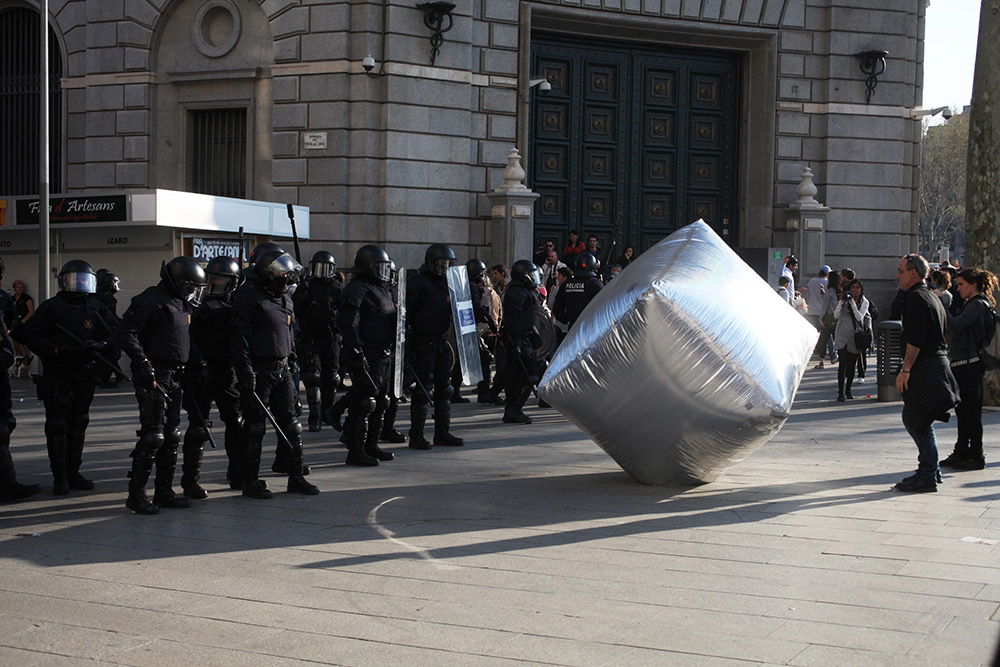
Disobedient Objects:
From Suffragette teapots to protest robots, this exhibition is the first to examine the powerful role of objects in movements for social change. It demonstrates how political activism drives a wealth of design ingenuity and collective creativity that defy standard definitions of art and design.

Image source: Inflatable cobblestone, action of Eclectic Electric Collective in cooperation with Enmedio collective during the General Strike in Barcelona 2012.
© Oriana Eliçabe/Enmedio.info

Monday, 21 July 2014

The Cost of Things: The quality of what is fixed and what is marginal

individual
INTERPERSONAL : SCIENCES
humanistic ------------------------------------------- mechanistic
SOCIOLOGY : POLITICAL
group

Internet of Things 
(IoT)
http://www.thezeromarginalcostsociety.com/
The Zero Marginal Cost Society

IoT is not just an incredible prospect it is an incredible happening.

Let us not forget however
the Fixed Costs of Social Care


Should some of the costs that assure High Quality be fixed, or remain intangible?

Wednesday, 9 July 2014

ERCIM News No. 98 Special theme: "Smart Cities"

http://ercim-news.ercim.eu/en98
ERCIM NEWS #98
Dear ERCIM News Reader,

ERCIM News No. 98 has just been published at:
http://ercim-news.ercim.eu/en98

Special Theme: "Smart Cities"
http://ercim-news.ercim.eu/en98/special/

featuring a keynote by Eberhard van der Laan, Mayor of Amsterdam
http://ercim-news.ercim.eu/en98/keynote-smart-cities

Guest editors:
- Ioannis Askoxylakis, ICS-FORTH, Greece
- Theo Tryfonas, Faculty of Engineering, University of Bristol, UK

This issue is also available for download as:
pdf:  http://ercim-news.ercim.eu/images/stories/EN98/EN98-web.pdf
epub: http://ercim-news.ercim.eu/images/stories/EN98/EN98.epub

Next issue: No. 99, October 2014 - Special Theme: "Quality Software"
(see Call at http://ercim-news.ercim.eu/call)

Thank you for your interest in ERCIM News.
Feel free to forward this message to others who might be interested.

Best regards,
Peter Kunz
ERCIM News central editor

Includes:
Urban Civics - Democratizing Urban Data for Healthy Smart Cities
CityLab@Inria - A Lab on Smart Cities fostering Environmental and Social Sustainability
‘U-Sense’, A Cooperative Sensing System for Monitoring Air Quality in Urban Areas 
---------------------------------
ERCIM News
is published quarterly by ERCIM, the European Research Consortium for Informatics and Mathematics.
The printed edition will reach about 6000 readers.
This email alert reaches over 7500 subscribers.
-------------------------------------------------------
About ERCIM
ERCIM - the European Research Consortium for Informatics and Mathematics - aims to foster collaborative work within the European research community and to increase co-operation with European industry. Leading European research institutes are members of ERCIM. ERCIM is the European host of W3C.
http://www.ercim.eu/

Follow us on twitter http://twitter.com/#!/ercim_news
and join the open ERCIM LinkedIn Group
http://www.linkedin.com/groups/ERCIM-81390

Monday, 7 July 2014

Book: The social atlas of Europe

www.europemapper.orgSee Europe as never before!

The social atlas of Europe
Dimitris Ballas, University of Sheffield
Danny Dorling, University of Oxford
Benjamin Hennig, University of Oxford

"An insightful look at today's Europe - through the underlying realities that Europeans live every day, all brought to life in charts and maps that reveal the human geography of this vitally important area of the world." Robert B. Reich, University of California at Berkeley.

The social atlas of Europe is the first human geography atlas to consider the European economy, culture, history, human and physical geography as a single land mass and a more unified European people. It provides an accessible overview of Europe and a human geography contribution to debates about a wide range of topics. It includes:

- Maps on over 80 topics ranging from life expectancy, greenhouse gas emissions to Eurovision Song Contest voting patterns
- Uses innovative full colour visualisation methods
- Explores Europe's society, culture, economy, politics and the environment
- State-of-the-art Geographical Information Systems (GIS) and new human cartography techniques

More information about the book is available on its website www.europemapper.org

Available at the special price of £19.99 (plus p&p) at www.policypress.co.uk/display.asp?K=9781447313533
Kathryn King
Marketing Manager
Policy Press, University of Bristol
6th Floor, Howard House, Queen's Avenue, Clifton, Bristol BS8 1SD
Tel: +44 (0) 117 331 5369
Email: kathryn.king AT bristol.ac.uk

My source: EUROPEAN-SOCIOLOGIST list at JISCMAIL.AC.UK

Saturday, 21 June 2014

disABLED: What's behind a symbol?

individual
INTERPERSONAL : SCIENCES
humanistic ------------------------------------------- mechanistic
SOCIOLOGY : POLITICAL
group

NY State

Well done NY excellent MOVE!
(and hope to visit next year)

My source: James Moore, Clash of Symbols, The Independent 20 June 2014, p.35.
 
Image source from upper right:
http://in-abled.com/blog/2014/04/would-martin-luther-king-jr-care-about-disabilities/
http://en.wikipedia.org/wiki/Disability

Sunday, 15 June 2014

Blood: A Biography of the Stuff of Life

individual
INTERPERSONAL : SCIENCES
humanistic ------------------------------------------- mechanistic
SOCIOLOGY : POLITICAL
group

Blood, blood cells, functions, blood pressure, blood gases, haemoglobin, Hb - Hgb, bruising, circulation, pulse, time, events, measures, observations, processes, systems, chaos ...

http://www.waterstones.com/waterstonesweb/products/lawrence+hill/blood/10208678/


emphasis here on *biography*

Image: Waterstones

My source:
The Times, June 7, 2014.

Saturday, 7 June 2014

This May Hurt A Bit ...

individual
INTERPERSONAL : SCIENCES
humanistic ------------------------------------------- mechanistic
SOCIOLOGY : POLITICAL
group

 Here -


Here -


- Here (especially)
and Here...


and here - all around these care domains in the Spiritual domain.

Tuesday, 3 June 2014

L-earning a Living with McLuhan

individual
INTERPERSONAL : SCIENCES
humanistic ------------------------------------------- mechanistic
SOCIOLOGY : POLITICAL
group

In 1964, Marshall McLuhan predicted that the future of work would involve -


 "learning a living"... .


production


communities of practice
earning a living


Source:
Parchoma, G. (2006). A proposed e-learning policy field for the Academy. International Journal of Teaching and Learning in Higher Education, 18(3), 230-40. (p.232).
Reading for module 2.

Never give up on someone ...

individual
INTERPERSONAL : SCIENCES
humanistic ------------------------------------------- mechanistic
SOCIOLOGY : POLITICAL
group

Never give up on someone with Mental Illness – 

when 'I' is replaced with -


'We' 
'illness' becomes 'Wellness'


Thanks to colleague Julie Draper - apparently this is doing the rounds on Facebook and elsewhere.

Saturday, 8 March 2014

International Women's Day 2014 “Equality for women is progress for all” He for She

8 March is International Women’s Day, #IWD2014! 

This year, the theme is “Equality for women is progress for all”.

http://www.unwomen.org/en/news/in-focus/international-womens-day#webcast


In order to achieve gender equality, we have to change what it means to be a man. For International
Women’s Day [@UN Women] highlights in its #HeforShe initiative men leaders who stand up for gender equality.
“Women’s empowerment works for men, too. Where men and women have equal rights and opportunities, societies prosper. I am a He for She.”
-Ban Ki-moon, UN Secretary-General. 

See what other prominent men from around the world have to say:
http://owl.li/ucuvz #IWD2014

Friday, 7 March 2014

Living with Practical Realities, 1978: Courtesy the Artist © Stephen Willats

Within Intermediate Support, Older Adults we are short-staffed at present. I was asked to work this Saturday - tomorrow - but was able to take Wednesday off. This helpfully coincided with a half-day event in Liverpool - Developing (research) proposals for Research for Patient Benefit (RfPB).

In the afternoon I took two hours (with reading to do also) at the Tate, this included:

Keywords: Art, Culture and Society in 1980s Britain

The exhibition included the three photographs displayed below by Stephen Willats. They are usually presented side-by-side. Since the 1970s and 80s the photographs made me wonder about social policy, social care, change and progress.

I was also prompted to recall a visit to a pensioner's club with my nan (maternal grandmother as we called her) in Liverpool in 1969-70.
[Clicking on the photos provides a more legible copy, or see collection link below ].

INTERPERSONAL : SCIENCES
humanistic ------------------------------------------- mechanistic
SOCIOLOGY : POLITICAL
individual

?


group - population

Image source:
Stephen Willats
Living with Practical Realities, 1978
Photographs
Letraset, gouache and ink on card
3 panels, each 109 x 76 cm

Collection: Tate London

Courtesy the Artist
© Stephen Willats

Thursday, 27 February 2014

Rare Disease Day 28 February 2014


INTERPERSONAL : SCIENCES
humanistic ------------------------------------------- mechanistic
SOCIOLOGY : POLITICAL
I am honored to stand, in her graceful place, and shine a light on a delicate group of individuals who, nevertheless, in sheer numbers are a force to be reckoned with.
Thank you,

Sean Hepburn Ferrer
A disease or disorder is defined as rare in Europe when it affects fewer than 1 in 2000.
A disease or disorder is defined as rare in the USA when it affects fewer than 200,000 Americans at any given time. One rare disease may affect only a handful of patients in the EU (European Union), and another touch as many as 245,000. In the EU, as many as 30 million people alone may be affected by one of over 6000 rare diseases existing.
  • 80% of rare diseases have identified genetic origins whilst others are the result of infections (bacterial or viral), allergies and environmental causes, or are degenerative and proliferative.
  • 50% of rare diseases touch children.
In the words of Audrey Hepburn,

“We cannot save everyone… but the knowledge that someone is coming to their rescue… that we care as a society is ultimately as important…”.

It is in this spirit that we invite you, alongside Sean Hepburn Ferrer, to Join Together for Better Care.
group - population

Winwick Hospital remembered

Image source: Metro

Book: The Last Asylum

INTERPERSONAL : SCIENCES
humanistic ------------------------------------------- mechanistic
SOCIOLOGY : POLITICAL
individual
The Last Asylum
 -sociology
-medicine

medical-
social-


group - population

Winwick Hospital remembered

Image source: Metro

Saturday, 22 February 2014

Call for contributions: 'Interpreting the Information Age' new avenues for research and display

November 24 – 26 2014
Science Museum, London

In autumn 2014, the Science Museum will open a new permanent gallery, Information Age. The gallery will expose, examine and celebrate how information and communication technologies have transformed our lives over the last 200 years. To mark this launch, the Museum is hosting a three day conference which will discuss how the history and material culture of information can be made relevant for today’s audiences.

From the development of global telegraph and computer networks, the creation of constellations of satellites that silently orbit our earth, and the growth of radio, telephony and cellular networks; each technology can be understood through a network of people, practices, devices and infrastructure. Approaches which focus on overly technical histories, individual innovation or inevitable progress fail to acknowledge the role of users in the history of technologies and marginalise a majority of readers or visitors who are engaged by human stories and social history. By contrast, Information Age has taken a user-centric approach, not only in the stories and objects selected for display, but in the way the gallery has been designed and developed. Participation with a diverse range of audiences has been at the heart of the process, providing new avenues for research, fresh perspectives on our collections and original ways to interpret the information networks of which we are all part. We invite papers that include insights from researchers, academics, museum professionals, community partners and participants.

The conference structure is proposed to include:

Day 1: New avenues in the history of information and communication technologies

Day 2: Interpreting and displaying the history of information and communication technologies

Day 3: Reflections on the process and practicalities of participatory practice

We are especially interested in papers that address the following themes, but are happy to consider other proposals. Please contact the organisers for guidance. 

New avenues in the history of information and communication technologies

  • From devices to networks: taking a broader approach to the history of information and communication. How has historical analysis expanded our understanding of information networks as inherently social-cultural phenomena? How can museums move beyond displays of devices, to reveal how networks unite people, places and ideas?
  • User-driven innovation: technological change does not only occur at the moment of invention, but in the hands of users, who adapt and appropriate new technologies. What tools and techniques can we use to reveal previously hidden user stories?
  • Spaces and places of information: How are institutions celebrating the local and global stories in the history of information and communication technology? What partnerships are being formed to support this?

Interpreting and displaying the history of information and communication technologies

  • Collecting information: what are the challenges of collecting the material culture of information and communication? How can opening collecting processes to wider audiences enhance understanding, and what are the benefits for both researchers and the wider public?
  • Displaying information: innovative approaches to the history, present or future of information and communication technologies.
  • Preserving information: the challenges for museums, libraries and archives in preserving our increasingly digital lives.
  • Whose story? As institutions strive to tell the story of information and communication technologies from the perspective of users and co-producers, how can we ensure that we are representing a diverse range of voices? 

Reflections on the process and practicalities of participatory practice

  • Breaking down barriers: what approaches are being taken to ensure museum collections are accessible to wider audiences? What interpretation approaches can be adopted?
  • Collaborative interpretation and design: how are institutions and audiences working together in exhibition development? What are the benefits to the museum, participant and ultimately the gallery visitor? What are the perceived risks to the museum’s authority?
  • Ensuring legacy: how do museums capture the process of participatory practice in a meaningful way? What evaluation methodologies can be adopted? How can museums support partners and participants in the longer-term? 

How to contribute

To submit a proposal, please send a 250 abstract outlining the topic of your paper, along with a 100 word biography, to [ research AT sciencemuseum.ac.uk ] by Friday 28th March 2014.

We welcome proposals which could be delivered either as paper presentations or for consideration as panel discussions with other contributors, along with proposals for workshops which practically address the conference themes.

My source: HUMANIST list

Tuesday, 7 January 2014

ESRC PhD North West Doctoral Training Centre (NWDTC) CASE Studentships 2014: The spatial and social dynamics of public inclusion for people with dementia & Masters HI Sweden

The Faculty of Health and Medicine, Lancaster University offers an exciting opportunity for an ESRC funded +3 collaborative studentship for PhD research: The spatial and social dynamics of public inclusion for people with dementia

Suitably qualified candidates are invited to apply for this fully-funded three-year PhD CASE studentship which is a collaboration between the Centre for Ageing Research, at Lancaster University, and AgeUK Lancashire. The studentship covers full fees plus a Basic Maintenance Grant (£14,421 p.a.). The student will receive a small contribution for research costs.

The CASE studentship will draw on innovative participatory mixed methods to assess the impact of a range of dementia friendly community initiatives to explore how people with dementia experience social and spatial inclusion, across personal and public spaces. The research offers an opportunity to engage with important policy initiatives and how they impact upon people’s lives. The successful applicant will also benefit from the work placement opportunity within AgeUK Lancashire.

The studentship will be supervised by a team lead by Dr Katherine Froggatt and Professor Christine Milligan at Lancaster University and Mrs Diane Armstrong, Dementia Support Coordinator at AgeUK Lancashire.

Eligible candidates will be UK/EU honours graduate students with a good 2.1 from a recognised University, who show evidence of exceptional ability; they must have completed research methods training as part of an ESRC recognised Masters (or demonstrate research training to an equivalent standard) in a relevant health and social sciences discipline. Students who are currently undertaking a Masters degree (or equivalent) and are expecting to graduate during the 2013-14 academic session are also eligible to apply. Candidates should demonstrate a committed interest and experience in the field of dementia ageing research, preferably in community contexts.

Candidates must satisfy the ESRC's academic and residential eligibility requirements and be UK or EU citizens who have been resident in the UK for three years. Further information on eligibility can be downloaded from the ESRC web site:
http://www.esrc.ac.uk/esrccontent/postgradfunding/foindex.asp

For further information contact Dr Katherine Froggatt: k.froggatt AT lancaster.ac.uk

To apply please submit the following documents electronically, by 5.00pm Thursday February 13th 2014, to Dr Katherine Froggatt: k.froggatt AT lancaster.ac.uk with ‘ESRC CASE studentship’ in the subject line:
  • An up-to-date CV: including two named referees (one of whom should be your most recent academic tutor/supervisor); the applicant will be expected to have approached their referees to arrange for references (including anticipated grade if Masters is ongoing) in advance of shortlisting.
  • A letter of application (not exceeding 2 pages) outlining your suitability for the CASE studentship and how you would anticipate approaching the research.
  • A copy of your first degree and Master’s degree transcripts.
Shortlisted candidates should be available for interview on February 21st 2014

PLUS from LinkedIn

On 01/06/14 1:53 PM, Sabine Koch wrote:
--------------------
In case you know somebody interested in advanced studies in HI please forward this message.
Thanks,
Sabine
----------------------------------------------------------------------------------------
Interested in a two year Master Programme in health informatics at Karolinska Institutet/Stockholm University in Sweden?

Apply online latest January 15th at universityadmissions.se

https://www.universityadmissions.se/intl/search?period=HT_2014&publishers=ki&freeText=Joint+Master%27s+Programme+in+Health+Informatics&courseProgram=programs&level=advanced 

Saturday, 30 November 2013

The Resurgence of - Soul Soil Society - in h2cm

On my travels into Manchester for Drupal NW and other monthly meetings I sometimes have time to call at the Cornerhouse. It's an independent cinema and visual arts venue. The shop is open until about 7pm and amongst many interesting publications I discovered Resurgence which is now Resurgence & ECOLOGIST. It is a great read - as per its banner - on the environment, activism, social justice, arts and ethical living. The great read lies not just in the content, but the fact that it challenges your way of life.

The welcome in the latest issue Nov/Dec 2013 by Satish Kumar the editor-in-chief includes mention of two books, one by Satish Kumar himself: Soul Soil Society.

As technology races ahead and governments chase economic growth through capitalist-based socio-economic systems what stands out is the failure of political systems to keep up.

The question is not how soil is created through a natural process that takes time and is itself a vital variable in a complex ecosystem. The question is how hard can we push soil?

What are the global effects of giant excavators that can move mountains, cut swathes of tarmac through rain forests? What is the natural value of soil, of land for individual farmers against synthetic fertilisers, genetically modified seed, land grabs ...? Why do we call the rainforests - rainforests#? The impacts are local, global and glocal as this issue of Resurgence and others highlights.

Below I've transposed the book's title on to Hodges' model:
INTERPERSONAL : SCIENCES
SOCIOLOGY : POLITICAL

individual
Soul


Soil

Society


What is missing?
group - population

# See also: PHYSICS & THE RAINFOREST, Peter Bunyard, pp.12-14.

Additional book:
Jonathon Porritt, The World We Made

Monday, 25 November 2013

Winter Exhibition at Wellcome Trust: Foreign Bodies, Common Ground

INTERPERSONAL : SCIENCES
SOCIOLOGY : POLITICAL
individual


Art in Global Health: Reflections


http://www.wellcome.ac.uk/News/2013/WTP054754.htmThe exhibition brings together artworks including painting, photography, sculpture, film and performance, made during residencies at medical research centres funded by the Wellcome Trust in Kenya, Malawi, South Africa, Thailand, Vietnam and the UK.

The contributing artists were given a simple and wide-ranging brief: to find out about research being undertaken and produce work responding to their investigations. The result is a series of varied, moving and humorous works, recording journeys taken within the complex realm that lies between scientific processes and local communities, often on the frontlines of communicable diseases.
http://www.wellcome.ac.uk/News/2013/WTP054754.htm
"Health issues are usually addressed by women
because of their standing in society.
The question is: how do we bring the
 
men
into the picture?"
Elson Kambalu
About Art in Global Health

‘Global health’ is a phrase we hear more and more frequently. As it attracts more attention it attracts more investment and more research. But what does it mean? ...
group - population


‘Foreign Bodies, Common Ground’ at Wellcome Collection


My source: FT Weekend Magazine