Showing posts with label analysis. Show all posts

Saturday, 26 April 2014

Alex through the Looking-Glass: How Life Reflects Numbers and Numbers Reflect Life

Alex through the Looking-Glass: How...

individual
INTERPERSONAL : SCIENCES
humanistic ------------------------------------------- mechanistic
SOCIOLOGY : POLITICAL
group


...Numbers Reflect Life
Life Reflects Numbers...


Image source:
http://pages.bloomsbury.com/favouritenumber/2

Thursday, 20 March 2014

[c/o hipnet] Data Visualization Enthusiast? Join us on the Data Viz Hub!

Dear Colleagues

The recently launched Data Viz for Development Hub [http://datavizhub.co] is a vibrant community for sharing resources, tools, examples, and ideas about data visualization. Using graphs, charts, maps, tables, infographics, and other visualizations can improve how we communicate information to stakeholders and the larger development community. With a wealth of resources available, and a growing interest across international development practitioners to build effective visualizations, the Hub will help keep communicators, evaluators, developers and others in the know about data viz best practices and new tools, connecting visualizers from all domains of expertise.

Check out the Hub at datavizhub.co, and join the community listserv by emailing:
dataviz AT knowledge-gateway.org with the subject "Join." We look forward to connecting with you about all things data viz!

Questions? Contact Libby Skolnik at libby.skolnik AT jhu.edu

Source: http://www.hipnet.org/

Saturday, 1 March 2014

Drupalcamp London 2014: The Government Digital Service, Drupal 8 Multilingual features, Twig

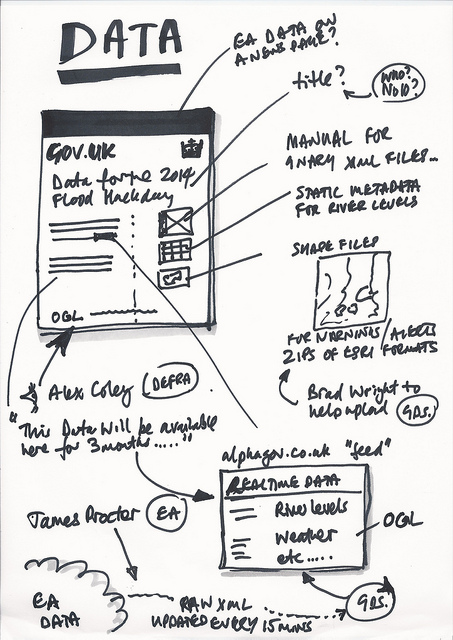
https://gds.blog.gov.uk/2014/02/23/flood-hack-developing-solutions/
Flood hack
DrupalCamp London today got underway with a keynote Delivering User-centred Digital Services by Mark O'Neill from the UK Government Digital Service.

Given the record of public and private sector led IT projects it was refreshing to hear of the GDS's approach being user-centred, the extension of 7 design principles and Mark's previous experience. It's clearly too late for the health care sector to coin and create the Needotron - GDS beat us to it.

Drupal 8 is looking formidable both in its potential and the (learning) stack it presents. Another great session to pick out was - A whole new world for multilingual sites in Drupal 8 by Gábor Hojtsy. The progress here is phenomenal and even though incomplete it is a major achievement and a credit to the Drupal community.

It's humbling as it reminds me to post some introductions to Hodges' model on W2tQ in several languages.

As to being user-centred, the Harmony Forum is a real tease. I know a forum will not moderate itself (is that the new Sorcerer's Apprentice?) and yet time is of the essence. Harmony is one for me to watch - so I'm signed up for the newsletter. Two sessions on Twig and Entities rounded up a busy few days.

This began on Thursday with Cutty Sark, the Royal Greenwich Observatory (learned much from their interactive designs), Turner and the Sea, The British Library - Beautiful Science (60-90 mins ample), and Ibsen's Ghosts at Trafalgar Studios.

I was also able to visit a university yesterday and meet a member of faculty who used Hodges' model many years ago. Here's hoping that some of the materials can be retrieved even though it seems unlikely. I hope to keep in touch with this nursing contact (and not just for the dinner!). I've met several other people here, the Drupal community is another great asset - and with thanks to the sponsors who make these events feasible for many of us.

Output from Needotron


I'll end this post back with Mr O'Neill and the GDS.

I wonder to what extent healthcare figured in the flood deliberations?

It seems that an output from the Needotron may not be so far removed from h2cm?

Happy St David's Day too - in the closing minutes here!


Tuesday, 15 October 2013

ERCIM News No. 95 Special theme: "Image Understanding"

Dear ERCIM News Reader,

ERCIM News No. 95 has just been published at
http://ercim-news.ercim.eu/en95

Special Theme: "Image Understanding"
Guest editors: Michal Haindl, Institute of Information Theory and Automation, Academy of Sciences of the Czech Republic, and Josef Kittler, University of Surrey, UK
http://ercim-news.ercim.eu/en95/special/

Keynote: "Image Understanding – An EU Perspective"
by Libor Král, Head of Unit A2 – Robotics in Directorate General Communication Networks, Content & Technology, European Commission

This issue for download
pdf
: http://ercim-news.ercim.eu/images/stories/EN95/EN95-web.pdf
epub: http://ercim-news.ercim.eu/images/stories/EN95/EN95.epub

Next issue: No. 96, January 2014 - Special Theme: "Linked Open Data"
(see Call at http://ercim-news.ercim.eu/call)

Thank you for your interest in ERCIM News.
Feel free to forward this message to others who might be interested.

Best regards,
Peter Kunz
ERCIM News central editor

------------------------------------------------------------------------
ERCIM "Alain Bensoussan" Fellowship Programme
ERCIM offers fellowships for PhD holders from all over the world. The next round is open!
Next deadline 31 October 2013
http://fellowship.ercim.eu/

Thursday, 21 February 2013

Journal of Learning Analytics - inaugural issue

ISSN 1929-7750 (online)
Homepage: http://epress.lib.uts.edu.au/journals/index.php/JLA
Twitter:  http://twitter.com/jla_editorial
Contact:  jla.editorial at gmail.com

Submission deadline (inaugural issue): April 30, 2013

Overview
Journal of Learning Analytics is a peer-reviewed, open-access journal, disseminating the highest quality research in the field. The journal is the official publication of the Society for Learning Analytics Research (SoLAR). With an international Editorial Board comprising leading scholars, it is the first journal dedicated to research into the challenges of collecting, analysing and reporting data with the specific intent to improve learning and teaching practice. “Learning” is broadly defined across a range of contexts, including informal learning on the internet, formal academic study in institutions (primary/secondary/tertiary), and workplace learning.

The journal seeks to connect researchers and developers with practitioners, creating and disseminating new tools and techniques, studying transformations, and providing ongoing evaluation and critique of the conceptual, technical, and practical outcomes. The interdisciplinary focus of the journal recognizes that computational, pedagogical, institutional, policy and social domains must be brought into dialogue with each other to ensure that interventions and organizational systems serve the needs of all stakeholders. The journal seeks to bring into dialogue the intersection of the fields of Education, Computation and Sensemaking.
Journal of Learning Analytics welcomes papers that either describe original research or offer a review of the state of the art in a particular area. The journal also welcomes practice-focused papers that detail Learning Analytics applications in real-world settings, provided that they offer innovative insights for advancing the field (see the About section).

Focus and Scope
The following topics are indicative of the journal’s scope:

Education
- Connections between learning analytics and the learning sciences
- Personalization and adaptation in the learning process
- Educational research methods
- Learner modeling
- The study of emotion, flow, and affective data

Computation
- Social network analysis
- Web science, the Semantic Web, and linked data
- Data mining and machine learning techniques
- Natural language processing and text mining
- Recommendation engines

Sensemaking
- Visualization and user experience
- Data and multimedia literacy
- Decision-support
- Organizational dynamics
- Ethical issues

Research Papers
Journal of Learning Analytics welcomes papers that either describe original research or offer a review of the state of the art in a particular area of learning analytics. No submission, or substantially overlapping submission, be published or be under review elsewhere.  Submissions that extend previously published conference papers are welcome provided that the journal submission has sufficiently been extended (at least 25-30% of new contribution).

The Reflective Practitioner Section
This section of the Journal of Learning Analytics is peer-reviewed and  covers the application of learning analytics across a diversity of contexts. This section spotlights trends and practices; provides new insights and ideas; and analyzes the implications of learning analytics. This section is not intended as an avenue for publication of research articles.

Editors
- Shane Dawson, University of South Australia, Australia
- Dragan Gasevic, Athabasca University, Canada
- Phillip Long, University of Queensland, Australia

Editor of the Reflective Practitioner Section
- John Campbell, West Virginia University, USA

Sunday, 27 January 2013

Dialectics in therapy, case formulation, h2cm and a tree

Kuyken et al. (2009) propose three dialectics that are useful in an evaluation of their model for case conceptualization, these are:
Released today - 28th Jan 2013

nomothetic – idiopathic; 
simple – complex; 
and subjective – objective.

This act of identifying polarities can be described as a diagrammatic formulation in itself.

These dialectics and many others can be readily incorporated into h2cm: for example;

socio – technical,
macro – micro.
...

Kuyken, W., Padesky, C., Dudley, R. (2009). Collaborative case conceptualization. New York, The Guilford Press.

Sunday, 2 December 2012

FatFonts - fonts with real weight: Giving space and data form

How it works (from fatfonts.org):

Fatfonts are designed so that the amount of dark pixels in a numeral character is proportional to the number it represents. For example, “2″ has twice the ink than “1″, “8″ has two times the amount of dark ink than “4″ etc. You can see this easily in the set of characters below:


Source for the above and animated: http://visual.ly/fatfonts-player?view=true

My source: Jacob Aron, Making numbers punch their weight, New Scientist, 5 May 2012, 214, 2863, p.12.

Saturday, 13 October 2012

ERCIM News No. 91 Special Theme: "What is Computation? — Alan Turing’s Legacy"

Dear ERCIM News Reader,

ERCIM News No. 91 has just been published at http://ercim-news.ercim.eu/
Special Theme: "What is Computation? — Alan Turing’s Legacy"

Guest editors: Gilles Dowek, Inria, and Samson Abramsky, University of Oxford
http://ercim-news.ercim.eu/en91/special

Keynote: "The Impact of Alan Turing" by Andrew Hodges
http://ercim-news.ercim.eu/en91/keynote

This issue for download in pdf:
http://ercim-news.ercim.eu/images/stories/EN91/EN91-web.pdf

Next issue: No. 92, January 2012 - Special Theme: "Smart Energy Systems"
(see call at http://ercim-news.ercim.eu/call)


Thank you for your interest in ERCIM News.
Feel free to forward this message to others who might be interested.
Peter Kunz
ERCIM News central editor

Saturday, 4 August 2012

IdN Extra 07: Infographics — Designing Data

Visiting Manchester twice this past fortnight I'd noticed this IdN special issue on infographics in the Cornerhouse shop. The shop's only small but there is lots to dive into - arts, media, design and philosophy.

When a database becomes a thing of beauty

Infographics or information graphics are visual representations of information, data or knowledge. They are often used when complex information needs to be presented as quickly and effectively as possible, such as signs and maps. Infographics can be as simple as a bar chart or a pie graph to represent percentages in business information; or as elaborative as some of the examples in this book to communicate stories in newspapers and magazine.

Infographics can be entertaining when the information they represent is of personal interest; but it is especially fun and challenging when the topic may be as dry as representing concepts in technical manuals or scientific statics.

 <->

I don't know if it's the reduced scale, or my right eye talking but some of the text descriptions are difficult to read. The graphics and ideas are stunning, both in themselves and the questions they provoke.

Tuesday, 17 July 2012

ERCIM News No. 90 Special Theme: "Cybercrime and Privacy Issues"

Dear ERCIM News Reader,

ERCIM News No. 90 has just been published at http://ercim-news.ercim.eu/

Special Theme: "Cybercrime and Privacy Issues"

Guest editors: Jean-Jacques Quisquater (Université catholique de Louvain), Solange Ghernaouti-Hélie (University of Lausanne), Jens Tölle and Peter Martini (Fraunhofer Institute for Communication, Information Processing and Ergonomics FKIE)
http://ercim-news.ercim.eu/en90/special

Keynote: "Current Cybersecurity Best Practices – a Clear and Present Danger to Privacy" by Roger R. Schell
http://ercim-news.ercim.eu/en90/keynote

ERCIM News 90 issue for download in pdf:
http://ercim-news.ercim.eu/EN90/EN90-web.pdf

Next issue: No. 91, October 2012 - Special Theme: "What is Computation? Alan Turing's Legacy"
(see call at http://ercim-news.ercim.eu/call)

Thank you for your interest in ERCIM News.

Feel free to forward this message to others who might be interested.
Peter Kunz
ERCIM News central editor

Wednesday, 20 June 2012

Visual Methodologies Workshop in Newcastle

After Oxford Drupal Education Camp this Friday-Saturday proceedings move on to a NE workshop.

If your focus is on person-centered health care then the volume of data involved that pertaining to the individual can be readily apprehended. At least the example of a single episode of care. Of course, there are exceptions, people who might be the subject of special case studies so complex is their condition and pathology. Data volumes do vary markedly from person to person. A great deal of generated data in an individual instance might be taken for granted. In the reported findings, for example, of an MRI scan that is included in a referral. When provided existing diagnoses do much to enrich the information and knowledge contained in a referral, whilst reducing possible avenues for further data gathering.

Once we move from individuals to groups and populations then the volumes involved quickly become massive. Purposes and context reflect this change in scale; codified, anonymised, aggregated the individual is lost.

Both my day-to-day work and study of Hodges' model (in nursing, informatics, literacy...) are centered on individuals. 'Caseness' in a clinical word: a referral, home visits for the day, face-to-face interaction, care concepts in assessments, plans. ... Then there is envisioning a nurse-patient (carer) interaction, or individual's episode of care through Hodges' model. As per the model's structure, however, groups and populations must also be represented. This duality of personal and data scales makes this workshop on visual methodologies of instant relevance. The two days next week cover (with my emphasis):
Introduction to working with visual methodologies: understanding epistemologies and disciplinary boundaries
  • Mapping
  • Story-boarding
  • Artefacts
Quality in visual methods: ethics, validity and reliability
Doing visual methods: lived examples of managing data capture, synthesis, analysis and dissemination
Modes of analysis: focusing on methodological and epistemological influence on the research process

Workshop part 1: working with self-created data
Workshop part 2: creating shared analytic frameworks for self-created data
Overarching ideas and ways forward for thinking about visual methodology
Hodges' model can be readily interpreted and presented as a map and a series of story boards. The model can also support analysis, synthesis: well, this is my belief that is shared by some people.

I have completed modules on research methods, but it seems increasingly that research methods, methodologies, data structures and algorithms overlap. It may be that advances in media, technology, data gathering and improved access to data sets is having this effect. Perhaps more integrative and open attitudes (interdisciplinarity) towards quantitative and qualitative research also accounts for this blurring; or it could just be me? Whatever is the case, I'm really looking forward to the programme, meeting the facilitators and students. I am hoping this will inform my project as per the aims of the workshop:
  • Consider the role of visual methods in data collection, research ethics, synthesis, analysis and dissemination;
  • Explore the theoretical prospectives, epistemological traditions and latest practices that have shaped the development of visual methodologies; and
  • Enable participants to translate how visual methodologies can be used to support their own research.
I'll try and post from Oxford this Friday - Saturday and from Newcastle next week. From Newcastle I'll be heading to Edinburgh for the Scottish Ruby Conference. Lots to follow as I put 10 days unpaid leave to use.

Thursday, 3 May 2012

Visual Methodologies Doctoral Training Workshop 26 - 27 June 2012

Developing Theory & Practice in Visual Methodologies


The School of Education, Communication & Language Sciences and Durham University’s School of Education are holding a two-day workshop for doctoral students on the development and use of visual methodologies.

The workshop will take place on Tuesday, 26 June and Wednesday, 27 June 2012 at Newcastle University.

Further information about the workshop and how to register can be found at:

http://www.dur.ac.uk/education/postgraduate/visualmethodologies/

The workshop is part of the North East Doctoral Training Centre’s (NEDTC) annual programme of advanced training in the social sciences.

Please do not hesitate to contact Anne Parks ( NEDTC Secretary email a.l.park AT durham.ac.uk ) if you need any further information about the event.

My source:
ESA-ALL at JISCMAIL.AC.UK

Saturday, 28 April 2012

Personal Health Records: Part II - revisiting Kim and Johnson 2002

Part I continued ...

What Kim and Johnson reveal is a level of transience that can be quite scary in this context. True, electronic health records can be archived and printed, but the latter surely defeats the purpose of the 'e'. Printing undermines the credentials. The virtual landscape presented in part I by checking the current status of these domains highlights the issue of ownership of data in a way that has provoked much debate in social media and the transferability of a person's data - information. If I want to move to another vendor, system, company (however the 'entity' is described) there needs to be standards and a degree of interoperability to facilitate this. 

Next, we have to bow to the notion of a year on the internet compared with 'real time'. M-health was a dream a decade ago. Here is another pressure on the PHR and its family members. A public-facing health record, whatever its nomenclature, must not only be responsive to the public and professional users and the 'total stakeholder community'. Now the record must be responsive according to device: from desktop, to tablet through to mobile phone.

In 2002 the PHR project was set to run and run. It had a slow, strong pulse with speedy recovery after exertion. The PHR looked fit for Olympic* endeavors.

But then the algorithms set to change personal health care (to fuse ill-health and well-being) suffered a major arrhythmia. The fate of those who became the new PHR frontrunners, the heavyweights no less: NHS's Healthspace, the initiatives of Google and Microsoft suffered the same fate. This post is from 2009:

Self-care in e-space and the need to Impress

Given the changes since Kim and Johnson you have to wonder what the next decade will bring. Whatever there will still be fog, but that just adds to the excitement as we climb the trees. Then we realise that to all of the users of health information systems (remember the user and stakeholders?), whichever TLA is employed, they are all X-HRs by proxy.
Kim MI, Johnson KB. Personal Health Records: Evaluation of Functionality and Utility. Journal of the American Medical Informatics Association. 2002. Mar-Apr; 9(2):171-180. Selected for inclusion in the IMIA 2003 Yearbook of Medical Informatics. 

 *All trademarks acknowledged.

Saturday, 21 April 2012

Personal Health Records: Part I - revisiting Kim and Johnson 2002

When I was at HC2004 or 2005 I was given a copy of the Medical Informatics Yearbook 2003 from the British Computer Society - Nursing Specialist Group stand. Within this volume of key papers for the year April 2001 - March 2002 I found the following:
Kim MI, Johnson KB. Personal Health Records: Evaluation of Functionality and Utility. Journal of the American Medical Informatics Association. 2002. Mar-Apr; 9(2):171-180. Selected for inclusion in the IMIA 2003 Yearbook of Medical Informatics. 
The paper identified candidate Personal Health Records [PHRs], then developed criteria examining the entry and display of data elements necessary for the PHRs to serve as adequate representations of information. Then in the final third phase a selected group of PHRs were assessed for their functionality and utility (p.370). Of the 12 PHRs assessed I thought it would be interesting to check  their current status (this was a quick visit to the published domains).

Several Personal Health Records 2002 - 2012
Web Site
Record
URL
Findings
Dr. I-Net My Medical Record www.drinet.com/ A good start! Still operational domain redirects from original www.aboutmyhealth.com Continues to offer a PHR.
HealthCompass: Lifelong Health Record www.healthcompassnet.com While there are several site using 'Health Compass' the original version was not obvious.
MedicalEdge Medical Register www.medicaledge.com/ Domain currently offers support to physicians, so a PHR may be part of a package?
MedicalRecord.com Your Medical Record www.medicalrecord.com This now appears to be a directory to electronic medical records.
MedicData MedicData www.medicdata.com/ This does not appear to offer a PHR and the homepage is 'under construction'. It looks like the domain may have a new owner.
Medscape AboutMyHealth Personal Health Record www.aboutmyhealth.com/ Now leads to GE Healthcare.
myhealthnotes.com Personal Health Manager www.myhealthnotes.com/ Server not found.
PersonalMD My Medical Records www.personalmd.com Retired - leads to: www.eheandme.com/personalmd_announcement.html
TheDailyApple Health Records www.thedailyapple.com/ Social networking is vital to well-being but no PHR here.
VistaLink Health Profile vistalink.com Domain for sale.
WebMD WebMD www.webmd.com/ Very much alive and kicking commercially, but my health record / PHR not in immediately in evidence.
Wellmed.com Health Record www.wellmed.com This site leads to http://www.webmdhealthservices.com/


Kim and Johnson provide several lessons as a high quality contribution to the medical informatics literature. From the above we see that while we talk about timeliness in terms of the written record, time takes on a series of new meanings when it comes to electronic records, media, commercial companies and clearly the internet.

As I read the paper and reflected on the past decade other things fell into focus. At the end of the day a PHR should be what it says - personal. Reading Kim and Johnson this did not stop them looking at the PHRs from the perspective of doctors and informatics practitioners. There is nothing wrong with this. Although developers and political masters quite rightly seek to engage with the user, espouse usability and user testing - a system is aimed at a community.

If title [personal] follows function [record] and form [electronic] follows function then what do we have?

Don't worry if you're lost, me too (I'm musing again); let's add the fog....

It's crucial to know what's going on over the fence (similarly sometimes it helps to climb a tree). In this case the person in the form of patient is not the only consumer of the information in the record.

This is the point: systems are about a user AND a stakeholder community. Stakeholder is a much maligned word, found on the lips of those seeking to reach and engage remote ('difficult' to reach) community groups. It has a definite role here though.

Every health discipline has its record, that is a professional must. So in effect you have a series of 'X' -HRs. On paper they were - and remain in many cases - a mess. What we should have then is a hybrid health record that depending on the user morphs itself accordingly. But what is the point in pointing to users and stakeholders? Well, conceptually how far is personal from medical (nursing...) and how far again to personality? Add to the mix the question of where patient, well-being and health fit in to the management of long term medical conditions as per the critieria of Kim and Johnson, accurate entry of medicines, medical conditions, lab tests, monitoring ... and you see what is frequently a record breaking task.

This is (or was*) the challenge: to transform something that is generically personal (with the potential contradiction this implies) to something that is personalised as in 'I'.

*Part II to follow.

Thursday, 5 April 2012

ERCIM News No. 89 Special Theme: "Big Data"

Dear ERCIM News Reader,

ERCIM News No. 89 has just been published at http://ercim-news.ercim.eu/

Special Theme: "Big Data"

Guest editors: Stefan Manegold, Martin Kersten, CWI, The Netherlands, and Costantino Thanos, ISTI-CNR, Italy
http://ercim-news.ercim.eu/en89/special

Keynote: "E-Infrastructures for Big Data: Opportunities and Challenges" by Kostas Glinos, European Commission
http://ercim-news.ercim.eu/en89/keynote/e-infrastructures-for-big-data-opportunities-and-challenges

Next issue: No. 90, July 2012 - Special Theme: "Cybercrime and Privacy Issues"
(see preliminary call at http://ercim-news.ercim.eu/call)

Thank you for your interest in ERCIM News. Feel free to forward this message to others who might be interested.
Peter Kunz
ERCIM News central editor

ERCIM "Alain Bensoussan" Fellowship Programme
ERCIM offers fellowships for PhD holders from all over the world. The next round is now open!
Deadline for applications: 30 April
http://fellowship.ercim.eu/

Issue 89 includes:
Performance Analysis of Healthcare Processes through Process Mining
by Diogo R. Ferreira
A-Brain: Using the Cloud to Understand the Impact of Genetic Variability on the Brain
by Gabriel Antoniu, Alexandru Costan, Benoit Da Mota, Bertrand Thirion and Radu Tudoran

Tuesday, 3 January 2012

ERCIM News No. 88 Special Theme: "Evolving Software"

Dear ERCIM News Reader,

ERCIM News No. 88 has just been published at http://ercim-news.ercim.eu/

Guest editors: Tom Mens (University of Mons, Belgium) and Jacques Klein (University of Luxembourg)

http://ercim-news.ercim.eu/en88/special

Keynote "Change is the Constant" by Joost Visser, Head of Research at Software Improvement Group
http://ercim-news.ercim.eu/en88/keynote/change-is-the-constant

Next issue: No. 89, April 2012 - Special Theme: "Big Data"
(see call at http://ercim-news.ercim.eu/call)

Thank you for your interest in ERCIM News.
Feel free to forward this message to others who might be interested.
Happy New Year!
Peter Kunz
ERCIM News central editor

[Includes: An introduction to this theme; Holistic Software Evolution; Wireless Sensor Networks and the Tower that Breathes; and Innovation in Disaster Management: Report from Exercise EU POSEIDON 2011. ] PJ

ERCIM News
is published quarterly by ERCIM, the European Research Consortium for Informatics and Mathematics.
The printed edition will reach about 10,000 readers.
This email alert reaches some 6000 subscribers.