Showing posts with label individual. Show all posts

Thursday, 9 October 2014

Privacy: Open Data, Individual and Group

The vertical axis of Hodges' model is the individual - group, or self through to collective. Health and social care constantly negotiates this from the ideals and delivery of person-centred care to public mental health. So often for health professionals the emphasis is on the individual, the person's care needs, their strengths, their rights, outcomes and feedback on care received. The same individual focus is also ascribed to records and information. Protection of data, maintaining confidentiality is an essential duty of health care  professionals.  

Earlier this year the government's care.data scheme was placed on hold. 'Open' is the way of the world: open access, open source, open data and open government. Increasingly the group as an entity needs to considered in what may be a new way, as Floridi writes:
The idea that groups may have a right to privacy is not new, and it is open to debate, but it has not yet received all the attention it deserves, although it is becoming increasingly important.
 ...
Open data is more likely to treat types (of customers, users, citizens, demographics population, etc.) rather than tokens (you, Alice, me), and hence groups rather than individuals. But re-identifiable groups are ipso facto targetable groups.It is therefore a very dangerous fallacy to think that, if we protect personal data that identify individuals, the protection of the groups will take care of itself. p.23.

Luciano Floridi. Group Privacy. The Philosophers' Magazine. Issue 65, 2nd Quarter 2014. Pages 22-23.


http://grantabooks.com/The-Private-Life

Here is a related book (on my list) a BMJ award winner:

The Private Life, Josh Cohen

The war over private life spreads inexorably. Some seek to expose, invade and steal it, others to protect, conceal and withhold it. Either way, the assumption is that privacy is a possession to be won or lost.

But what if what we call private life is the one element in us that we can't possess? Could it be that we're so intent on taking hold of the privacy of others, or keeping hold of our own only because we're powerless to do either? ...


Tuesday, 23 September 2014

Agnostic qualities in Hodges' model

In the previous post I highlighted "Holistic approaches to learning are agnostic as to method." 

I added that there would be more to follow as Hodges' model can be viewed as agnostic on several levels. The following is taken from a paper on Hodges' model and its application in forensic nursing:
Hodges’ model claims to be person-centred and situated (Jones, 2008). What exactly does this mean for forensic nursing? The utility of Hodges’ model lies in it being agnostic. By ‘agnostic’ this means that the model is not dependent upon, dedicated to, sanctioned by, or owned by any particular discipline (even nursing). It was not designed with a particular media, clinical setting, situation or organization in mind. It is true, however, that the model was formulated within academia and health and social care, being taught and applied by community mental health nurses, learning disability and health visiting students. Apart from the history and universality of the model’s cruciform structure and its inherent 2 x 2 matrix form [often referred to as a Johari window (Luft and Ingham, 1955)], the model is also culturally neutral. This is an essential requirement to reflect and enact nursing values and codes of conduct (Nursing and Midwifery Council, 2008).
Doyle, M., Jones, P. (2013). Hodges’ Health Career Model and its role and potential application in forensic mental health nursing. Journal of Psychiatric and Mental Health Nursing. 20, 7, 631-640.
http://onlinelibrary.wiley.com/doi/10.1111/j.1365-2850.2012.01961.x/abstract

Saturday, 20 September 2014

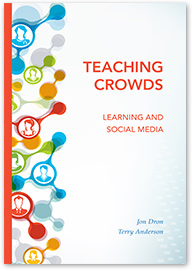
Book: Teaching Crowds - Learning and Social Media

This book is available as an open access pdf. Here is an extract from chapter 2 on Social Learning Theories.
http://www.aupress.ca/index.php/books/120235Holistic approaches to learning are agnostic as to method. Drawing from connectivist and older models, they valorize diversity and the socially distributed cognition afforded by the read-write Web and other publishing models, accepting that every learning experience is unique, and every learner’s needs are different. Connectivist approaches, for all their extensive reliance on networks of people engaging socially, are at heart focused on the individual—specifically, the individual’s learning. Holistic models embrace the fact that it is sometimes more important that a group learns, rather than an individual, especially in collectivist cultures (Potgieter et al., 2006). Holistic models recognize that, sometimes, guidance is what is most needed, that people can learn without direct engagement with others and, even that transmittive instructionist models of teaching have a place. p.61.
In the next post I will explain the emphasis placed in the quote.


Jon Dron and Terry Anderson (2014) Teaching Crowds: Learning and Social Media, AU Press.

My source:
ITFORUM mailing list 
http://listserv.lt.unt.edu/mailman/listinfo/
This is a listserv of the Association for Educational Communications and Technology

Tuesday, 5 August 2014

Trade winds and time: The Clock of the South

S
INTERPERSONAL : SCIENCES
E --------------------------------------- W
SOCIOLOGY : POLITICAL
N
G7
G8
 ..


Alt


trade-winds
Socio-
(political)

Clock of the South
individual
INTERPERSONAL : SCIENCES
humanistic ------------------------------------------- mechanistic
SOCIOLOGY : POLITICAL
group

C/o BBC: Bolivian Congress clock changed to turn anti-clockwise

The clock displayed on the Bolivian Congress building, located in the city of La Paz, has been re-set to run in reverse.

Its hands turn left and the numbers have been inverted to go from one to twelve to the left.

It's the latest measure taken by the government of President Evo Morales to promote the indigenous identity of the Andean country. ...
http://www.bbc.co.uk/news/world-latin-america-28040065

Additional link:
World Economic Forum

updated 26 August 2014
BBC Radio 4 20:00: Whatever Happened to Global Governance?
http://www.bbc.co.uk/programmes/b04f9rdr

Original image source:
http://bubblear.com/wp-content/uploads/2014/06/clock1-1110x400.jpg

Monday, 4 August 2014

why - { Ctrl Alt Del } ?

individual
INTERPERSONAL : SCIENCES
humanistic ------------------------------------------- mechanistic
SOCIOLOGY : POLITICAL
group

Alt

Del
Why?

Ctrl


Ctrl provides the power to decide what/who is 'Alt' and What/Who is 'Del' -eted.
The masses are left to ask why?


My source: Peter Kurilecz - RECORDS-MANAGEMENT-UK at JISCMAIL.AC.UK
A Fresh Start: Ctrl + Alt + Delete - Neatorama

One of the programmers’ pet peeves was that whenever the computer encountered a coding glitch, they had to manually restart the entire system. Turning the machine back on automatically initiated a series of memory tests, which stole valuable time. “Some days, you’d be rebooting every five minutes as you searched for the problem,” Bradley says. The tedious tests made the coders want to pull their hair out.

So Bradley created a keyboard shortcut that triggered a system reset without the memory tests. He never dreamed that the simple fix would make him a programming hero, someone who’d someday be hounded to autograph keyboards at conferences. And he didn’t foresee the command becoming such an integral part of the user experience.
http://m.neatorama.com/2014/08/01/A-Fresh-Start-Ctrl-Alt-Delete/#!buNWwY


Additional link: The Holographic Principle
http://apod.nasa.gov/apod/ap090913.html

Saturday, 5 July 2014

i c u

individual
INTERPERSONAL : SCIENCES
humanistic ------------------------------------------- mechanistic
SOCIOLOGY : POLITICAL
group


tears


tears


Avatar image "I see me through your eyes."
te ar s

Wired: Avatar 2, 3 and 4

ICU - Intensive Care Unit
Image: http://i1.ytimg.com/vi/Ek5C0NhnNlA/maxresdefault.jpg

Tuesday, 3 June 2014

Never give up on someone ...

individual
INTERPERSONAL : SCIENCES
humanistic ------------------------------------------- mechanistic
SOCIOLOGY : POLITICAL
group

Never give up on someone with Mental Illness – 

when 'I' is replaced with -


'We' 
'illness' becomes 'Wellness'


Thanks to colleague Julie Draper - apparently this is doing the rounds on Facebook and elsewhere.

Saturday, 31 May 2014

At a glance 65: Better Life for older people with high support needs: the role of social care

I am referencing the following as I struggle to complete a piece of work for the TEL course. These key messages resonate with Hodges' model (back to work....):

Published: May 2014

Key messages

The Joseph Rowntree Foundation has identified seven key challenges to be addressed for older people with high support needs to achieve a better quality of life. Social care has a key role to play in meeting these challenges.
  1. Old age is not about 'them': it is about all of us
  2. Older people are individuals and they are, as a group, becoming more diverse
  3. Relationships matter to us whatever our age; we have a fundamental human need to connect with others meaningfully
  4. Older people with high support needs have many assets, strengths and resources that they can also bring to the development and provision of services
  5. Whatever our age or support needs, we should all be treated as citizens: equal stakeholders with both rights and responsibilities
  6. The individual and collective voices of older people with high support needs should be heard and given power
  7. We need both to innovate and improve existing models
SCIE's role is to share knowledge about what works and use this to produce practical resources. Many of these resources will support people working in all aspects of social care to address these challenges.

http://www.scie.org.uk/index.aspx

Monday, 5 May 2014

[Itforum] Unique Technology / Assessment Request

The ITForum featured the following post with ongoing discussion and resources related to TEL - technology enhanced learning:

Hello Michael,

When I read your post my thought was that this was a classic example for an adaptive learning module/set of modules. This was a significant concept in the 1970s/1980s when elearning was peaking.

It seems unfortunate that the proliferation of the LMS has all but reduced the learning environment to subject-matter presentation and quizzes.

The recent proclamation of the eLearning Manifesto (http://elearningmanifesto.org) as well as ideas expressed by OULDI (http://www.open.ac.uk/blogs/OULDI/) and my own ideas of Design Alchemy (Sims, 2014) provide alternative ways of thinking about elearning. These may assist in re-thinking strategies to achieve your goals.

Roderick Sims, PhD
design alchemist
 
ITFORUM mailing list
http://listserv.lt.unt.edu/mailman/listinfo/
This is a listserv of the Association for Educational Communications and Technology. The focus of this list is instructional and educational technology topics ranging from technology integration through cognitive systems thinking and beyond.


Thanks to R Sims and Ack. ITForum. I have added the link to Sims, 2014 above.

The original question concerned - core competencies required for nursing programs....

Sunday, 27 April 2014

12th May Lancaster, Workshop: Patient knowledge and involvement in healthcare

An event I am looking forward to: 

Royal Institute of Philosophy Workshop
Storey Institute, Lancaster
Monday 12th May

In recent years great efforts have been made to listen to “patient voices” in healthcare practice, research, and policy, but such initiatives have met with mixed success and many patients continue to feel that their view are overlooked (sometimes despite the best efforts of health care professionals). In this workshop we consider whether and why patient views matter. We ask what factors act to limit the possibilities for communication between patients and professionals, and consider how they might be overcome.
  • 10-10.40 Chaos, conflict and cooperation. Havi Carel, Senior Lecturer in Philosophy, Bristol University
  • 10.40-11.20 Silencing the sick. Ian J. Kidd, Addison Wheeler Fellow in Philosophy, Durham University
  • 11.50-12.30 On trusting and being trusted. Garrath Williams, Senior Lecturer in Philosophy, Lancaster University
  • 2-2.40 Patient advocacy challenged: The case of ME/CFS. Nancy Blake, Patient activist and PhD candidate, Lancaster University
  • 2.40- 3.20 Medical paternalism and the right not to know. Emma Bullock, Postdoctoral Fellow “Concepts of Health”, King’s College London
  • 3.50-4.30 Negotiating as individuals and groups. Rachel Cooper, Senior Lecturer in Philosophy, Lancaster University
Organisers: Ian J. Kidd and Rachel Cooper

Free and open to all, but numbers are limited. To reserve a place please email
Rachel Cooper - on r.v.cooper AT lancaster.ac.uk

Friday, 18 April 2014

[ Exclusive* preview ] Wrinkles


individual, dignity, person, memories, identity,
security, communication, perception, meaning, friends,
belonging, mood, orientation ...


demographics, evidence based care, medication, treatments, physical environment ....
policy, standards, inspection, training, organisation, safety, governance, management culture, leadership ...

Link:
http://www.arrugaslapelicula.com/

*Person centered?

Wednesday, 9 April 2014

Angling for Ideas

The Angler by Paul Klee (1879-1940, Switzerland)

This is just a rock pool
I reflect

So is this, even before Pollock
just a single drip in the ocean

Fishing for praise

Here we trawl, as we do we maul.
Why owns the holistic ocean?
Does it bleed, does it leak?
Abs-orbs all angles?
just?


Image source: http://en.wahooart.com/@@/8LT48X-Paul-Klee-The-Angler

Tuesday, 8 April 2014

From local field to global arena: the rough and tumble of conceptual sport

Jo hit the deck. it was a foul tackle, an apt description for a move that Jo did not see coming.

Talk about a change of perspective!! Sheesh! Was it bone crunching, did I hear something?

It could have been worse. At least the ground knows it’s March and not January.

There was no anticipation, no reflex adjustment, no ability to shift, just in time, no poetry in motion this time.

The coach and physio dashed on to the field. Jo looked up and said “OK, tell me straight, what’s the damage?”

Coach looked down. "Well you're talking that's a start." Assessing rapidly though and through gritted teeth he replied:

“It’s not looking good Jo.”
“Wha?

[Silence]

Oh come on tell me…”

“Well, kid it’s bad, yes, really bad.
You’ve got an academic detachment.”

Jo groaned, "Oh no, not that! What about the future!!"

<->

OK, sorry about that and I do realise that a great many world class athletes are very well educated people.

The tendency of young and promising athletes to relinquish contact with their academic side and really be the best they can be - remains a challenge for some, but this post concerns academic detachment as in - educational institutions and students with the world.

Call it a paradox, a contradiction in this hyper-connected world, what with gap years, travel opportunities.... that there seem so many examples of a lack of awareness of the bigger picture that is the international stage. Not just in students, in education, but the wider citizenry.

Does this matter. Well it does, at least according to the 2012 Conference of The Association of International Education Administrators (AIEA) which included:

Academic detachment is not an option in the 21st Century

on the theme “Building a Secure World through International Education.”

The point I’d like to make is that Hodges’ model is fit to assist in some of the objectives that the AIEA outlines in this context:
Keynote speaker Abiodan Williams, Senior Vice ‐ President of the US Institute for Peace, offered remarks at the opening plenary. Mr. Williams said that his own international education began with post ‐ secondary level study at the Lester B. Pearson College, United World College of the Pacific, in Victoria, BC. To develop graduates committed to peace and security, he urged educational institutions to teach:
  • Knowledge – including greater interdisciplinarity and learning about conflict prevention
  • International outlook – to shape the attitudes and outlook of a new generation, encourage all students to spend at least six months studying abroad, learn at least one new language and take at least one course about another country
  • Sensibility – alluding to Fielding’s definition of ‘good nature’, developing people of benevolent and amiable temper of mind, who sympathize with the problems of others and who enjoy the happiness of others
“Academic detachment from the world is not an option in the 21st Century,” he said. Globalization is here to stay, and international education is playing a key role in contributing positive answers to many of the challenges that it presents.

Many institutions are actively engaged in programs that further environmental and energy sustainability, broader access to health care and education, resolution of conflicts, pursuit of fundamental human rights, economic development, and greater cross‐cultural understanding around the world. Harnessing the collective effort, and lessons learned, from each of these individual initiatives is important in moving internationalization forward. [AIEA conference website]
With thanks to Katy Rosenbaum:
27 March 2014:
Good morning,
Thank you for your email. I will check with my colleagues to see if they have any suggestions for someone who might be able to provide more information on work within this theme, and if they have any insights on this, I will certainly forward these on to you.
In the meantime, all conference session materials that presenters made available to download are available at the link below. The zip files include multiple presentations and handouts; underneath are links to these materials hosted on other websites: http://www.aieaworld.org/2012-conference#Presentations
The article you referred to mentioned Abiodan Williams' keynote address, which is available here: http://www.aieaworld.org/assets/docs/Conference_Materials/2012/abiodunwilliamsspeech2012.pdf
Thank you for your interest; I hope this information is useful. If my colleagues have other suggestions, I will certainly pass them on.

Best,
Katy Rosenbaum
Program Associate - AIEA
Association of International Education Administrators
www.aieaworld.org
kathryn.rosenbaum AT duke.edu

Additional link:
http://www.ruthnestvold.com/tomjones.htm
Thanks Dad.

Thursday, 27 February 2014

Rare Disease Day 28 February 2014


INTERPERSONAL : SCIENCES
humanistic ------------------------------------------- mechanistic
SOCIOLOGY : POLITICAL
I am honored to stand, in her graceful place, and shine a light on a delicate group of individuals who, nevertheless, in sheer numbers are a force to be reckoned with.
Thank you,

Sean Hepburn Ferrer
A disease or disorder is defined as rare in Europe when it affects fewer than 1 in 2000.
A disease or disorder is defined as rare in the USA when it affects fewer than 200,000 Americans at any given time. One rare disease may affect only a handful of patients in the EU (European Union), and another touch as many as 245,000. In the EU, as many as 30 million people alone may be affected by one of over 6000 rare diseases existing.
  • 80% of rare diseases have identified genetic origins whilst others are the result of infections (bacterial or viral), allergies and environmental causes, or are degenerative and proliferative.
  • 50% of rare diseases touch children.
In the words of Audrey Hepburn,

We cannot save everyone… but the knowledge that someone is coming to their rescue… that we care as a society is ultimately as important…”.

It is in this spirit that we invite you, alongside Sean Hepburn Ferrer, to Join Together for Better Care.
group - population

Winwick Hospital remembered

Image source: Metro

Sunday, 23 February 2014

Man Runs a Loop-the-Loop (in Hodges' model - discuss?)

INTERPERSONAL : SCIENCES
humanistic ------------------------------------------- mechanistic
SOCIOLOGY : POLITICAL
individual


group - population

Monday, 17 February 2014

Good Health, Manchester Training Programme 2014/15

Dear Colleague,

Manchester Public Health Development Service are delighted to announce the launch of their updated and refreshed training programme – the Good Health, Manchester Training Programme 2014/15.

This year we are very excited to announce an online booking system that will make booking on our courses even easier for you and your colleagues. Please visit www.goodhealth-manchester.nhs.uk/training to browse and book onto the many public health training courses we have on offer for 2014/15. We have over 50 courses covering a multitude of topics. All courses are free-of-charge to those who work with Manchester people. If your organisation would prefer a bespoke training tailor-made to your needs, please click here.

Please forward this email to any individuals or colleagues that may be interested in attending one of our courses.

We look forward to seeing you soon,

Brian Goodman
Training Coordinator
Manchester Mental Health and Social Care Trust
Manchester Public Health Development Service
Victoria Mill
Lower Vickers Street
Miles Platting
Manchester
M40 7LJ
Tel: 0161 882 2584 (Temporary)
Fax: 0161 203 5817
e-mail: Brian.Goodman AT mhsc.nhs.uk

Saturday, 11 January 2014

moon, resources and Materialism


INTERPERSONAL : SCIENCES
humanistic ------------------------------------------- mechanistic
SOCIOLOGY : POLITICAL

individual
http://southbanklondon.com/republic-of-the-moon


group - population

Republic of the Moon
http://southbanklondon.com/republic-of-the-moon
(I missed this when it was in Liverpool!)

Additional links:

NASA Releases New Earthrise Simulation Video

UNODA: Treaty on Principles Governing the Activities of States in the Exploration and Use of Outer Space, including the Moon and Other Celestial Bodies
http://disarmament.un.org/treaties/t/outer_space/text

UNOOSA: 34/68. Agreement Governing the Activities of States on the Moon and Other Celestial Bodies
http://www.oosa.unvienna.org/oosa/SpaceLaw/gares/html/gares_34_0068.html

Images:
Leonid Tishkov, Personal Moon - Republic of the Moon
http://www.artscatalyst.org/projects/detail/republic_of_the_moon_Liverpool/

Omega Speedmaster Moonwatch -
http://www.omegawatches.com/collection/speedmaster/moonwatch/anniversary-limited-series/31130423099002


Monday, 30 December 2013

Le Ballet Mécanique (1924, Fernand Leger) & the axes of Hodges' model

INTERPERSONAL : SCIENCES
humanistic ------------------------------------- mechanistic
SOCIOLOGY : POLITICAL

individual
Le Ballet ?


Le Ballet ?


Le Ballet ?

group - population

The Ballet mécanique faq
http://www.antheil.org/faq.html

My source: Budick, A. (2013) Hymn to progress, Life&Arts, FT Weekend, 14-15 December. p.16.