Showing posts with label energy. Show all posts

Sunday, 28 September 2014

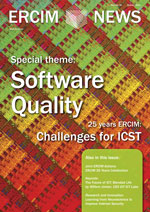
ERCIM News No. 99 Special theme: "Software Quality"

Dear ERCIM News Reader,

ERCIM News No. 99 has just been published at
http://ercim-news.ercim.eu/en99

http://ercim-news.ercim.eu/en99Special Theme: "Software Quality"
http://ercim-news.ercim.eu/en99/special/

And on the occasion of ERCIM’s 25th anniversary, we published a selection of articles on the future challenges of ICST:
http://ercim-news.ercim.eu/en99/challenges-for-icst

Keynote by Willem Jonker, CEO EIT ICT Labs: "The Future of ICT: Blended Life"
http://ercim-news.ercim.eu/en99/keynote/the-future-of-ict-blended-life


This issue is also available for download as:
pdfhttp://ercim-news.ercim.eu/images/stories/EN99/EN99-web.pdf
epub: http://ercim-news.ercim.eu/images/stories/EN99/EN99.epub

Next issue: No. 100, January 2015 - Special Theme: "Scientific Data Sharing"

Thank you for your interest in ERCIM News.
Feel free to forward this message to others who might be interested.

Best regards,
Peter Kunz
ERCIM News central editor

------------------------------------------------------------------------
ERCIM "Alain Bensoussan" Fellowship Programme
ERCIM offers fellowships for PhD holders from all over the world.
Next application deadline: 30 September 2014 http://fellowship.ercim.eu/
------------------------------------------------------------------------
ERCIM News
is published quarterly by ERCIM, the European Research Consortium for Informatics and Mathematics.
The printed edition will reach about 6000 readers.
This email alert reaches over 7300 subscribers.
------------------------------------------------------------------------
About ERCIM
ERCIM - the European Research Consortium for Informatics and Mathematics - aims to foster collaborative work within the European research community and to increase co-operation with European industry. Leading European research institutes are members of ERCIM. ERCIM is the European host of W3C.
http://www.ercim.eu/

Follow us on twitter http://twitter.com/#!/ercim_news
and join the open ERCIM LinkedIn Group http://www.linkedin.com/groups/ERCIM-81390

Thursday, 28 August 2014

Compare and contrast potential - Energy for Change Index and Hodges' model

The biopsychosocial model is quite all encompassing used as it is to help explain and represent pain, explain human development and balance the physical excesses of psychiatry.

For all its scope the biopsychosocial model is two domains short of Hodges' model.

Hodges' model is dated though, a child of the mid-1980s. The biopsychosocial model predates Hodges' and as models of nursing have fallen out of favour in terms of the attention they receive the biopsychosocial is subjected to critique as per:
Ghaemi, S.N. (2009). The rise and fall of the biopsychosocial model. Br J Psychiatry.195(1):3–4.

Hatala, A.R. (2012). The status of the “biopsychosocial” model in health psychology: Towards an integrated approach and a critique of cultural conceptions. Open Journal of Medical Psychology, 1, 51-62. doi: 10.4236/ojmp.2021.14009
A cursory check reveals a diverse and current literature on the biopsychosocial model. If this is positive for the general role of 'models' in health and social care education and learning then there is another encouraging source in the five energies for change with its five domains, as per the figure:
http://www.changemodel.nhs.uk/pg/cv_blog/content/view/74232/network?cview=62406
The five energy domains
  • Spiritual
  • Social
  • Physical
  • Psychological
  • Intellectual
There is clearly great similarity with Hodges' model although in h2cm the spiritual combines all the four domains of which the political also replaces the intellectual. I would equate the intellectual with the psychological, accepting of course the existence of individual and group psychologies. Being intellectual and becoming intellectual to the extent of an individual realising their potential has long been recognised as a political matter and consequence (Freire). As such the Political domain within Hodges' model is central to its relevance within the field of engagement and innovation and beyond.

Whilst the energy for change domains have a specific derivation and (instrumental) purpose I would suggest that a possible strength for Hodges' might lie in the notion (which it is) that there is an underlying conceptual structure from which the domains arise. This structure might support the model's application in time, as well as assuring its longevity and the stamina of its champion.


My prompt: Land, M., et al. (2014) Pedal to the metal to improve the NHS. HSJ, 124, 6389, 26-27.

Image: (please see title and image link)

Tuesday, 8 April 2014

From local field to global arena: the rough and tumble of conceptual sport

Jo hit the deck. it was a foul tackle, an apt description for a move that Jo did not see coming.

Talk about a change of perspective!! Sheesh! Was it bone crunching, did I hear something?

It could have been worse. At least the ground knows it’s March and not January.

There was no anticipation, no reflex adjustment, no ability to shift, just in time, no poetry in motion this time.

The coach and physio dashed on to the field. Jo looked up and said “OK, tell me straight, what’s the damage?”

Coach looked down. "Well you're talking that's a start." Assessing rapidly though and through gritted teeth he replied:

“It’s not looking good Jo.”
“Wha?

[Silence]

Oh come on tell me…”

“Well, kid it’s bad, yes, really bad.
You’ve got an academic detachment.”

Jo groaned, "Oh no, not that! What about the future!!"

<->

OK, sorry about that and I do realise that a great many world class athletes are very well educated people.

The tendency of young and promising athletes to relinquish contact with their academic side and really be the best they can be - remains a challenge for some, but this post concerns academic detachment as in - educational institutions and students with the world.

Call it a paradox, a contradiction in this hyper-connected world, what with gap years, travel opportunities.... that there seem so many examples of a lack of awareness of the bigger picture that is the international stage. Not just in students, in education, but the wider citizenry.

Does this matter. Well it does, at least according to the 2012 Conference of The Association of International Education Administrators (AIEA) which included:

Academic detachment is not an option in the 21st Century

on the theme “Building a Secure World through International Education.”

The point I’d like to make is that Hodges’ model is fit to assist in some of the objectives that the AIEA outlines in this context:
Keynote speaker Abiodan Williams, Senior Vice ‐ President of the US Institute for Peace, offered remarks at the opening plenary. Mr. Williams said that his own international education began with post ‐ secondary level study at the Lester B. Pearson College, United World College of the Pacific, in Victoria, BC. To develop graduates committed to peace and security, he urged educational institutions to teach:
  • Knowledge – including greater interdisciplinarity and learning about conflict prevention
  • International outlook – to shape the attitudes and outlook of a new generation, encourage all students to spend at least six months studying abroad, learn at least one new language and take at least one course about another country
  • Sensibility – alluding to Fielding’s definition of ‘good nature’, developing people of benevolent and amiable temper of mind, who sympathize with the problems of others and who enjoy the happiness of others
“Academic detachment from the world is not an option in the 21st Century,” he said. Globalization is here to stay, and international education is playing a key role in contributing positive answers to many of the challenges that it presents.

Many institutions are actively engaged in programs that further environmental and energy sustainability, broader access to health care and education, resolution of conflicts, pursuit of fundamental human rights, economic development, and greater cross‐cultural understanding around the world. Harnessing the collective effort, and lessons learned, from each of these individual initiatives is important in moving internationalization forward. [AIEA conference website]
With thanks to Katy Rosenbaum:
27 March 2014:
Good morning,
Thank you for your email. I will check with my colleagues to see if they have any suggestions for someone who might be able to provide more information on work within this theme, and if they have any insights on this, I will certainly forward these on to you.
In the meantime, all conference session materials that presenters made available to download are available at the link below. The zip files include multiple presentations and handouts; underneath are links to these materials hosted on other websites: http://www.aieaworld.org/2012-conference#Presentations
The article you referred to mentioned Abiodan Williams' keynote address, which is available here: http://www.aieaworld.org/assets/docs/Conference_Materials/2012/abiodunwilliamsspeech2012.pdf
Thank you for your interest; I hope this information is useful. If my colleagues have other suggestions, I will certainly pass them on.

Best,
Katy Rosenbaum
Program Associate - AIEA
Association of International Education Administrators
www.aieaworld.org
kathryn.rosenbaum AT duke.edu

Additional link:
http://www.ruthnestvold.com/tomjones.htm
Thanks Dad.

Friday, 28 June 2013

Visual representation of nature - ASEH2014

I subscribe to quite a few mail lists including the H-ENVIRONMENT list at H-NET.MSU.EDU. The post below caught my attention being always intrigued by diagrams and how they are applied. Caleb Wellum's post - copied below with thanks - stood out, not so much for the panel and being there (San Francisco!) as the theme. I've added links plus an image below and edited slightly:

Dear Colleagues,

I am organizing a panel about the visual representation of nature (and the politics of different representational forms) for ASEH 2014. My paper will examine H.T. Odum's energy diagrams in his popular 1970s works "Environment, Power, and Society" and "Energy: Basis for Man and Nature."
Michael Clemens will discuss nature documentaries at the National Film Board of Canada in the 1960s and 1970s and Duygu Kasdogan will be doing a visual ethnography of biofuels. We are looking for a 4th person to round out our panel. Your paper can be about any period, region, or form of visual representation.

Sincerely
Caleb Wellum
PhD Candidate
University of Toronto

Tuesday, 2 April 2013

ERCIM News No. 93 Special theme: "Mobile Computing"


Dear ERCIM News Reader,

ERCIM News No. 93 has just been published at
http://ercim-news.ercim.eu/en93

Special Theme: "Mobile Computing"
Guest editors: Edgar Weippl (SBA Research, AARIT, Austria) and Pietro Manzoni (Universitat Politècnica de Valéncia, SpaRCIM)
http://ercim-news.ercim.eu/en93/special


Keynote:  "Strategies of the European ICST Public Research Organisations towards Horizon 2020" by Domenico Laforenza
http://ercim-news.ercim.eu/en93/keynote

This issue for download in pdf:
http://ercim-news.ercim.eu/images/stories/EN93/EN93-web.pdf

Next issue: No. 94, July 2013 - Special Theme: "Intelligent Cars"

Thank you for your interest in ERCIM News.
Feel free to forward this message to others who might be interested.

Peter Kunz
ERCIM News central editor

------------------------------------------------------------------------
ERCIM "Alain Bensoussan" Fellowship Programme
ERCIM offers fellowships for PhD holders from all over the world. The next round is open!
Next deadline 30 April 2013
http://fellowship.ercim.eu/

Friday, 18 January 2013

ERCIM News No. 92 Special theme: "Smart Energy Systems"

Dear ERCIM News Reader,

ERCIM News No. 92 has just been published at
http://ercim-news.ercim.eu/en92

Special Theme: "Smart Energy Systems"
Guest editors: Carl Binding, IBM Research Lab, Switzerland and Han La Poutré, CWI and Utrecht University, the Netherlands
Modern, industrialized, society is heavily dependent on ubiquitous, cheap energy, which we expect to be readily available, not to be polluting, and to be convenient to use.
Since the invention of the steam engine by James Watt, this paradigm has lead towards tremendous improvement of life quality in the developed world, and developing countries eagerly aspire to similar energy standards.
However, the price of this hunger for energy is increasing. Fossil fuel resources such as oil or gas are becoming harder to explore, even leading to environmental disasters as with the Gulf of Mexico oil-platform, recently. Exploration of shale gas (“fracking”) causes negative environmental impact, beyond the well-known CO2 problematics. Besides the sheer availability of fossil energy, associated CO2 emissions have caused wide-spread concerns about impacts on climate and on human health (fine particle emissions).
http://ercim-news.ercim.eu/en92/special

Keynote:  "Smart Energy Systems – A European Perspective" by Ariane Sutor
http://ercim-news.ercim.eu/en92/keynote

This issue for download in pdf:
http://ercim-news.ercim.eu/images/stories/EN92/EN92-web.pdf

Includes: Research and Innovation
A Projector as Mobile Visualization device on an Assistive Robot (p.48)
by Paul Panek, Christian Beck, Georg Edelmayer, Peter Mayer and Wolfgang L. Zagler 

Next issue: No. 93, January 2012 - Special Theme: "Mobile Computing"
(see call at http://ercim-news.ercim.eu/call)
Thank you for your interest in ERCIM News.
Feel free to forward this message to others who might be interested.

Peter Kunz
ERCIM News central editor
--------------------------------------------------------------------
ERCIM "Alain Bensoussan" Fellowship Programme
ERCIM offers fellowships for PhD holders from all over the world. The next round is now open!
Next deadline for applications is exceptionally 28 February 2013
http://fellowship.ercim.eu/


Additional links [by PJ]:
UNDP: Sustainable Energy
The Communication Initiative Network - Natural Resource Management
UNESCO: Renewable and Alternative Energies