Showing posts with label holistic competency. Show all posts

Tuesday, 23 September 2014

Agnostic qualities in Hodges' model

In the previous post I highlighted "Holistic approaches to learning are agnostic as to method." 

I added that there would be more to follow as Hodges' model can be viewed as agnostic on several levels. The following is taken from a paper on Hodges' model and its application in forensic nursing:
Hodges’ model claims to be person-centred and situated (Jones, 2008). What exactly does this mean for forensic nursing? The utility of Hodges’ model lies in it being agnostic. By ‘agnostic’ this means that the model is not dependent upon, dedicated to, sanctioned by, or owned by any particular discipline (even nursing). It was not designed with a particular media, clinical setting, situation or organization in mind. It is true, however, that the model was formulated within academia and health and social care, being taught and applied by community mental health nurses, learning disability and health visiting students. Apart from the history and universality of the model’s cruciform structure and its inherent 2 x 2 matrix form [often referred to as a Johari window (Luft and Ingham, 1955)], the model is also culturally neutral. This is an essential requirement to reflect and enact nursing values and codes of conduct (Nursing and Midwifery Council, 2008).
Doyle, M., Jones, P. (2013). Hodges’ Health Career Model and its role and potential application in forensic mental health nursing. Journal of Psychiatric and Mental Health Nursing. 20, 7, 631-640.
http://onlinelibrary.wiley.com/doi/10.1111/j.1365-2850.2012.01961.x/abstract

Saturday, 20 September 2014

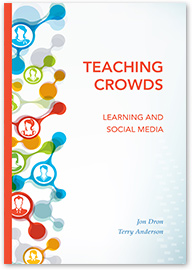
Book: Teaching Crowds - Learning and Social Media

This book is available as an open access pdf. Here is an extract from chapter 2 on Social Learning Theories.
http://www.aupress.ca/index.php/books/120235Holistic approaches to learning are agnostic as to method. Drawing from connectivist and older models, they valorize diversity and the socially distributed cognition afforded by the read-write Web and other publishing models, accepting that every learning experience is unique, and every learner’s needs are different. Connectivist approaches, for all their extensive reliance on networks of people engaging socially, are at heart focused on the individual—specifically, the individual’s learning. Holistic models embrace the fact that it is sometimes more important that a group learns, rather than an individual, especially in collectivist cultures (Potgieter et al., 2006). Holistic models recognize that, sometimes, guidance is what is most needed, that people can learn without direct engagement with others and, even that transmittive instructionist models of teaching have a place. p.61.
In the next post I will explain the emphasis placed in the quote.


Jon Dron and Terry Anderson (2014) Teaching Crowds: Learning and Social Media, AU Press.

My source:
ITFORUM mailing list 
http://listserv.lt.unt.edu/mailman/listinfo/
This is a listserv of the Association for Educational Communications and Technology

Thursday, 25 July 2013

6Cs Live! Story of the Month - Competition

Dear Peter,
We wanted to let you know about our new and exciting Story of the Month competition, in partnership with Nursing Times online.

This is your chance to really shout about the great work that you or your team is doing that underpins the values of the 6Cs – and what’s more, if you win you will be featured in Nursing Times online and 6Cs Live! Communications Hub.

So please take the time to fill in the short entry form on the 6Cs! Live Communication Hub – it’s not too long and time consuming we promise. 

Click here to find out more and access all the information you need.

Each month the entries will be reviewed by four judges, Matthew Hodson (COPD Nurse Consultant at the Homerton University Hospital, London), Sam Sherrington (Head of Nursing and Midwifery Strategy at NHS England), Jenni Middleton (editor of Nursing Times) and Matt King who is a lawyer, professional speaker, charity campaigner and 6Cs Live! Patient Champion.

The deadline for August entries is Friday 2nd August so you’ve still got a chance to be our first winner of ‘Story of the Month’.

We look forward to hearing from you and good luck!

If you have any questions please email us.
6Cs Live! Team

Don't forget to make your 6Cs Live! pledge: www.6cs.england.nhs.uk

Sunday, 13 January 2013

Health in the Round - A paper Griffiths et al. ...

The quote below from Griffiths et al. highlights what might be described as health in the round. As the authors address: the rapid growth of online social networking for health, health care systems are experiencing an inescapable increase in complexity - they contrast disease-centred health care with patient-centred. In so doing they distinguish the mechanistic tendencies in health care systems with the humanistic. For me reading this section of the paper was a circumnavigation of health and social care domains of Hodges' model:
Good communication between doctors and patients has been widely recognised by professional bodies in North America (AAMC, 1999) and Europe (GMC, 2009) as essential to the delivery of health care and appears to contribute to healing (Street, Makoul, Arora, & Epstein, 2009). Stewart (2001) has argued for a shift away from disease-centred biomedicine to a more holistic patient-centred alternative. This approach encompasses: exploring the patient’s reason for consulting; developing an understanding of their context; finding common ground in problem characterisation and management; supporting health promotion; and enabling the doctor-patient relationship to continue (Stewart et al., 2003). Patient-centred practice reflects (Bensing, 2000) a set of social and political ideas about the nature of the doctor patient relationship (Mead & Bower, 2000), which, it could be argued, forms a complex system (Situngkir, 2004). p.2237.

Griffiths, F., Cave, J., Boardman, F., Ren, J., Pawlikowska, T., Ball, R., Clarke, A., Cohen, A. (2012). Social networks - The future for health care delivery. Social Science & Medicine. 75: 2233-2241.

Friday, 27 July 2012

A World Record for Health Care: The 4 minute reflection

Of all the things that can be done within 4 minutes one of the most significant in the history of sport is undoubtedly who would be the first to run a mile in under four minutes:

In health care four minutes is both an age and an instant in someone's health career.

If we took four minutes to reflect upon a person's care across the care domains what difference might that make?

Just one minute per care domain to help deliver - personalised care, self-care, carer support, integration, health promotion and how to stay well. ...

In healthcare we are constantly seeking GOLD.
Wherever you are have an amazing Olympics!