Showing posts with label experience. Show all posts

Tuesday, 30 September 2014

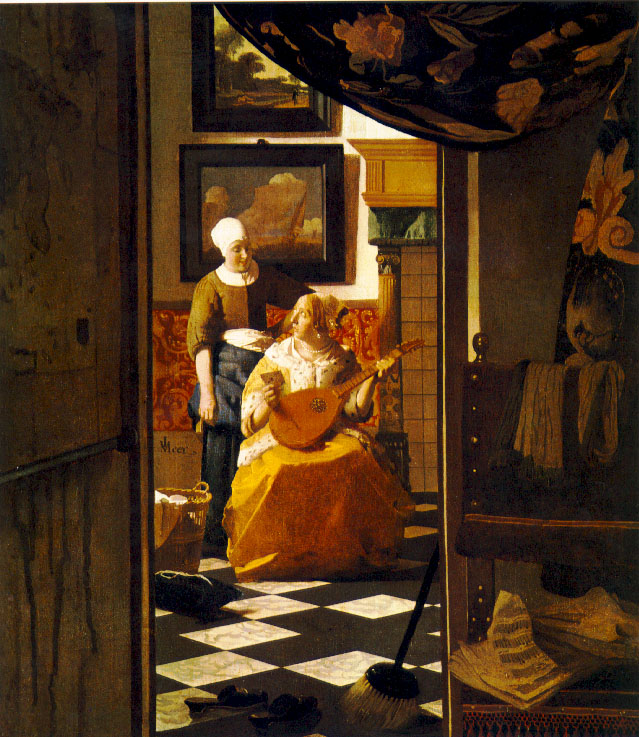
Bits of information a-cross the centuries - Bad Tidings & The Love Letter

As noted previously on W2tQ the significance of information practically and as a concept is very obvious in health and social care. Not just the debate about assuring privacy and confidentiality of clinical records and professional disclosure, but the meaning of information to an individual. This is assuming that the person concerned has the mental capacity to recognise what a particular circumstance, event, item of news means; and not just this morning, but tomorrow...

A diagnosis, lab result, a date for this procedure or that operation all can be a major source of anxiety and stress.

This week's visit to Amsterdam also included a visit to the Stedelijk Museum, where I saw Jobstijding (Bad Tidings), 1932 / Carel Willink (1900-1983). On Saturday I marvelled at Vermeer's The Love Letter and many other great works at the Rijksmuseum. ...

Through art and these works in particular we can contrast the social impact of information, of news - its meaning past and present with our ongoing preoccupation with binary representation and the information age.

Snail mail may be less common and yet the impact of decisions, news, life events ... remains.

individual
INTERPERSONAL : SCIENCES
humanistic ------------------------------------------- mechanistic
SOCIOLOGY : POLITICAL
group

https://www.rijksmuseum.nl/en/collection/SK-A-1595
Vermeer - The Love Letter
1 0
0 1
http://www.stedelijk.nl/en/artwork/3872-de-jobstijding
Carel Willink - Jobstijding (Bad Tidings)

0 1
1 0

Image sources:
The Love Letter, Vermeer
http://www.sai.msu.su/wm/paint/auth/vermeer/vermeer.love-letter.jpg

Jobstijding (Bad Tidings), 1932, Carel Willink (1900-1983)Stedelijk Museum, Amsterdam, The Netherlands

http://www.pinterest.com/pin/567383253025365412/

Saturday, 13 September 2014

In political hands person-centred care is a quantum phenomena (entanglement)

individual
INTERPERSONAL : SCIENCES
humanistic ------------------------------------------- mechanistic
SOCIOLOGY : POLITICAL
group
Acute mental health needs
RISK
Self-harm

Local care?
Empowering the individual?
Accessibility
Cognitive distance
Let therapy commence
Continuity
(dist-ress)
Remote policy touch
Organisational (distance) dementia?

threshold  
↘
RISK
 Self-neglect
personal hygiene
domestic environment


local-regional-national? 

metrics: Km or Miles or time?
Gallons or Litres?
Cost?
Illusory savings?

threshold
↓
RISK 
 Harm to others


to integrated care 
multidisciplinary care


     threshold →
Beds

Lintern, S. (2014) Mental health patients sent hundreds of miles for a bed, HSJ, 14 August.

Beds shortage = Gathered Sobs
Mental Health = Lethal Anthem?
Mental health = Lean Halt Them

Bed image:
By kieran jones (http://www.clker.com/clipart-bed-icon.html) [Public domain], via Wikimedia Commons

Tuesday, 27 May 2014

From: Slow is beautiful (Bloomstein, net, July 2014)

http://www.creativebloq.com/net-magazine


The quotes below are from a one page article in the July issue of net magazine. The message is that while efficiency in online experiences is critical especially in ecommerce and business there is still a place for 'slow' and content that asks questions (I hope so):


"Second thoughts undermine efficient ecommerce experiences. But if we only value efficiency, we ignore opportunities for learning and validation that characterise effective, less transactional experiences.

... (How several brands - "Foster Good Decisions")

DESIGN FOR QUESTIONS

These content types and design patterns aren't necessarily the fastest way for users to complete transactions. Instead, they help users engage with purchases with greater confidence, satisfaction and certainty. When content pushes us to weigh options and wrestle with difficult concepts, it pushes us to ask questions - and place greater weight on their answers."

It does not take a giant leap of imagination to consider this in health and social care contexts?

Margot Bloomstein, .net, July 2014, Issue 255, p. 42.

Tuesday, 25 March 2014

Extraordinary lives: Demographic influences on academic studies - Life Writing, Life Story Work

Recent reading for studies at Lancaster included
Ethics of Internet Research: Contesting the Human Subjects Research Model

Beyond a week's focus on ethics the above refers to Life Writing:
The study of Life Writing spans many disciplines, and represents 'a fast changing terrain' which is concerned with the study of the writing of lives, encompassing auto/biography as well as aspects of life story that originate outside the written form, such as oral history, testimony, and artifacts such as photography and the visual arts (Jolly, 2001, p. ix). The written text is viewed as a vehicle for an individual's construction of identity, the personal narrative that it records being

…a fundamental means by which people comprehend their own lives and present a 'self' to their audience. (Borland, 1991, p. 71)
...
The multiple approaches taken in Life Writing research can arguably be attributed to the multidisciplinary background of its practitioners. Like Internet researchers, those researching Life Writing have been trained in a variety of disciplines including anthropology, sociology, history, linguistics and literary theory. These various disciplines have contributed a range of insights into the collection of oral history and analysis of the resultant texts (Gluck and Patai, 1991, p. 3). Ethical guidelines for the conduct of Life Writing researchers, such as those published by the Oral History Society in the UK, appear to follow a human subjects model, focussing on the undertaking of the interview, and restricting discussion of the resultant text to issues of copyright. Yet practitioners emphasise the need to remember that as:

…the typical product of an interview is a text, not a reproduction of reality …models of textuality [are] therefore needed. (Gluck and Patai, 1991, p. 3)
What chance is there that Life Writing will be - is being influenced by current demographic and societal trends? Trends and challenges that inevitably present new meanings for history within life and with this new ethical issues? While life writing is clearly an established discipline, how might it develop and what other challenges might apply?

In health and social care Life Story Work is an important part in of assessment and interventions. Has it been discussed, is it appropriate, completed and if so, is this work available and accessible? Do we need people beyond the existing establishment with a dedicated set of skills and knowledge to engage with people diagnosed early on, or will treatments soon make this less of an issue? Will dementia and early dementia especially, with the latest technology prompt new perspectives, or reinforce existing life writing practices? What is an archive? In life story work these people, persons, individuals (and their lives?) are more than subjects.

There are many overlaps already in the mental health state of past and present national leaders, while health services continue to bridge the dementia gap in diagnosis. Biography: world leaders, other recognised lives in Life Story Work and seeking to preserve personal identities in dementia care: clearly these are figures that count.

Sunday, 23 March 2014

Sensing Spaces: Care architecture - memories of choice

Good architecture is often invisible,
but it allows whatever is happening in that space to
be the best experience possible.

Pezo von Ellrichshausen


Good architecture may have something in common with good health; it is something that can be taken for granted. When things go awry and are wrong then architecture and health suddenly impose upon us, a major intrusion.

As I may have mentioned before, in the past I've been asked how I've managed entering such and such care facility for so long. Within health there is recognition of heartsink patients. There are still heartsink buildings too. Not purpose built, seemingly either all narrow dark corridors, interrupted when doors let in shafts of light and assault dignity and privacy; or large 'lounges' that still invite armchairs to be flung against walls.

Architecture like this is not invisible. Walls are walls, blanc, flat and solid. Pictures removed due to safety concerns. Two holes and exposed plaster testify to what? Now, after six months....?

Even for the confused there are few potential found spaces, spaces to sit, stand, be; spaces towards which some personal impetus might have a person gravitate. A space of relative quite, looking out on some-thing relaxing even if not a small garden feature.

"Where's Joan, her friend's here to see her?"
"It's OK, I know where she'll be."

Royal Academy: Sensing Spaces
Education guide


Friday, 7 March 2014

Living with Practical Realities, 1978: Courtesy the Artist © Stephen Willats

Within Intermediate Support, Older Adults we are short-staffed at present. I was asked to work this Saturday - tomorrow - but was able to take Wednesday off. This helpfully coincided with a half-day event in Liverpool - Developing (research) proposals for Research for Patient Benefit (RfPB).

In the afternoon I took two hours (with reading to do also) at the Tate, this included:

Keywords: Art, Culture and Society in 1980s Britain

The exhibition included the three photographs displayed below by Stephen Willats. They are usually presented side-by-side. Since the 1970s and 80s the photographs made me wonder about social policy, social care, change and progress.

I was also prompted to recall a visit to a pensioner's club with my nan (maternal grandmother as we called her) in Liverpool in 1969-70.
[Clicking on the photos provides a more legible copy, or see collection link below ].

INTERPERSONAL : SCIENCES
humanistic ------------------------------------------- mechanistic
SOCIOLOGY : POLITICAL
individual

?


group - population

Image source:
Stephen Willats
Living with Practical Realities, 1978
Photographs
Letraset, gouache and ink on card
3 panels, each 109 x 76 cm

Collection: Tate London

Courtesy the Artist
© Stephen Willats

Thursday, 27 February 2014

Book: The Last Asylum

INTERPERSONAL : SCIENCES
humanistic ------------------------------------------- mechanistic
SOCIOLOGY : POLITICAL
individual
The Last Asylum
 -sociology
-medicine

medical-
social-


group - population

Winwick Hospital remembered

Image source: Metro

Saturday, 5 October 2013