Showing posts with label Netherlands. Show all posts

Tuesday, 30 September 2014

Bits of information a-cross the centuries - Bad Tidings & The Love Letter

As noted previously on W2tQ the significance of information practically and as a concept is very obvious in health and social care. Not just the debate about assuring privacy and confidentiality of clinical records and professional disclosure, but the meaning of information to an individual. This is assuming that the person concerned has the mental capacity to recognise what a particular circumstance, event, item of news means; and not just this morning, but tomorrow...

A diagnosis, lab result, a date for this procedure or that operation all can be a major source of anxiety and stress.

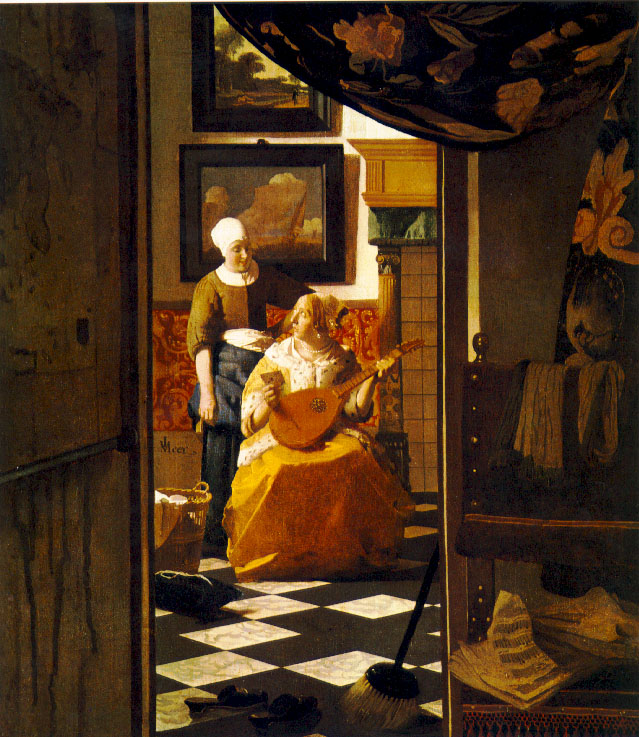
This week's visit to Amsterdam also included a visit to the Stedelijk Museum, where I saw Jobstijding (Bad Tidings), 1932 / Carel Willink (1900-1983). On Saturday I marvelled at Vermeer's The Love Letter and many other great works at the Rijksmuseum. ...

Through art and these works in particular we can contrast the social impact of information, of news - its meaning past and present with our ongoing preoccupation with binary representation and the information age.

Snail mail may be less common and yet the impact of decisions, news, life events ... remains.

individual
INTERPERSONAL : SCIENCES
humanistic ------------------------------------------- mechanistic
SOCIOLOGY : POLITICAL
group

https://www.rijksmuseum.nl/en/collection/SK-A-1595
Vermeer - The Love Letter
1 0
0 1
http://www.stedelijk.nl/en/artwork/3872-de-jobstijding
Carel Willink - Jobstijding (Bad Tidings)

0 1
1 0

Image sources:
The Love Letter, Vermeer
http://www.sai.msu.su/wm/paint/auth/vermeer/vermeer.love-letter.jpg

Jobstijding (Bad Tidings), 1932, Carel Willink (1900-1983)Stedelijk Museum, Amsterdam, The Netherlands

http://www.pinterest.com/pin/567383253025365412/

Saturday, 27 September 2014

Rijksmuseum Amsterdam - health in art : art in health

I arrived in Amsterdam last night and spent today, 8 hours in the Rijksmuseum. It is an amazing experience, even to just scratch the surface. Early on it was not busy! Entering the building, is as publicised, to discover a remarkable series of spaces.

There are so many highlights of a rewarding day. One must be within the final hour 1610 finding one of Van Gogh's self portraits. Van Gogh finds himself placed in the interpersonal domain not just by virtue of this self portrait, but his struggle with mental health and  hospitalisations.
individual
INTERPERSONAL : SCIENCES
humanistic ------------------------------------------- mechanistic
SOCIOLOGY : POLITICAL
group
http://www.vangoghmuseum.nl/en


The Anemic Woman
Samuel Dirksz van Hoogstraten [Public domain], via Wikimedia Commons
There were many other (ill-)health related examples (and many that are also bright and humorous).

The sick child. The Sick Woman....

When initially viewing Visiting the Sick you have some searching to do. The sick individual themselves and the doctor are rather lost in the background. The painting stresses the sociological, domestic aspects of health past and present.

In Visiting the Sick and The Anemic Woman we get a view of the way outside (possibly of spiritual significance?) and another room through doorways. From TV, reading and my visit today, this is a common device within Dutch genre painting. If we have a diagnosis now in the 21st century, we still need to look through the windows and doors that relate to the individual and their social situation. In the age of the interface and partitions we still need to negotiate them.  Doorways, windows and portals as changes in knowledge content, can in the form of care domains illuminate the boundary of what is objective and subjective. This is central in health and social care.


Van Gogh self portrait source:
http://historiek.net/chinezen-zeer-geinteresseerd-in-van-gogh/13217/#.VCb5mRbivTo

The Anemic Woman image source:
http://commons.wikimedia.org/wiki/File:Samuel_van_Hoogstraten_-_The_Anaemic_Lady_-_WGA11719.jpg

Thursday, 11 September 2014

Technologies for Development: Project - founding ideas

Reading the website of the project (posted yesterday) I noticed that their founding ideas can be mapped to Hodges' model. As depicted below some are pretty obvious, notably the POLITICAL domain and the SOCIOLOGICAL.

Their first founding idea is placed in the interpersonal domain. This is very subjective exercise - literally playing with words - but here I am prioritizing individual cognitive access above physical access. I am thinking of individual participants. As Nanotechnologies for Development state the first idea also focuses on countries - the group. So maybe I am wrong, if there is a wrong when using models - idealisations - in this way?

Staying with the group, access and participation are also a crucial matter of human rights - education, health information, health and social care, employment, freedoms, and security - freedom from violence, unlawful imprisonment...

These founding ideas clearly denote underpinning values, note in-particular the way risks and benefits are included at the individual and the group level.

In the SCIENCES domain from the beginning acknowledges time, process, project management. Nanotechnology needs to be understood in terms of the environments we inhabit. Not just us, now; but grandchildren... too. Not just the physical environment, but that embodied under and within this other divide: skin.

Within the mechanistic domains how will consultation about benefits and risks be negotiated and communicated to the humanistic domains?

How will the individual - group : community - commercial enterprise and innovation be squared?
 
This individual-group distinction is becoming ever more significant - of which more to follow.
individual
INTERPERSONAL : SCIENCES
humanistic ------------------------------------------- mechanistic
SOCIOLOGY : POLITICAL
group
The first founding idea of this project is that developing countries should not be denied participation in advanced modern technologies.The third core idea is that such developments entail risks and benefits that need to be addressed from the beginning.
The second that they should do that in their own culturally-specific ways. Our approach rejects any a priori distinction between traditional and modern technologies, but rather seeks innovative ways to connect indigenous and globalized knowledge and practices.
The fourth founding idea is that choices about those benefits and risks need to be made in a democratic way.

Source: Technologies for Development: Project Founding ideas

Wednesday, 10 September 2014

Technologies for Development: Project Closing Conference - Nanotechnologies for Development in India, Kenya, and the Netherlands

[ This is a small but interesting interdisciplinary conference - pj ]

December 15-17, 2014. Maastricht University Brussels Campus

What is the challenge of development today? What is the role of science and technology in development? What are the problems and possibilities that emerging technosciences—such as nano-bio-technoscience—pose for development? What institutional and organizational configurations enable development? How can interdisciplinary inquiries into the social studies of science, technology, and innovation contribute to developmental agendas?

The closing conference of the NWO-WOTRO http://www.nwo.nl/en/about-nwo/organisation/nwo-divisions/wotro sponsored project, *Nanotechnologies for Development* http://fasos-research.nl/nano-dev/, invites proposals that reflect on the relationship between science, technology, development, and innovation.

We are interested in contributions that offer insights into the historical and contemporary principles and practices of development and the role of science and technology therein. These reflections can be empirical, conceptual, or methodological. We also welcome contributions that reflect on collaboration between researchers and development practitioners. We thus invite proposals from a broad range of participants: activists, academics, development practitioners, and beyond.

The conference programme will strive to strike a balance between various approaches and perspectives and consist of keynotes, panel presentations, and a closing roundtable discussion.

The conference will be held at the Brussels campus of Maastricht University (Avenue de l’Armée / Legerlaan 10, 1040 Brussels, Belgium) on December 15-17, 2014. Participation is limited to 50 participants.

To participate, please submit a title, 500-word abstract, a list of 5 keywords, and your CV (max. 400 words) to techdev-conf-fasos AT maastrichtuniversity.nl. The deadline for sending your abstract is September 14, 2014. The conference committee will notify their decision by September 30, 2014.