Showing posts with label life. Show all posts

Tuesday, 30 September 2014

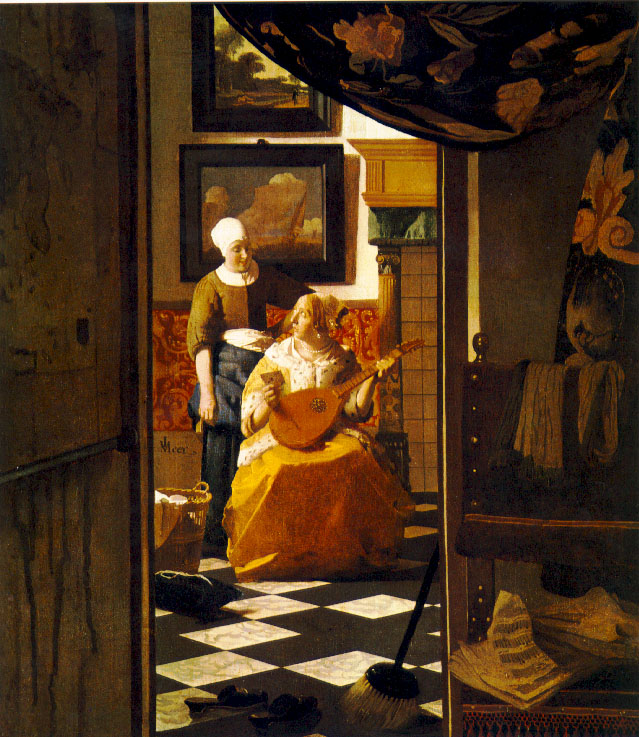
Bits of information a-cross the centuries - Bad Tidings & The Love Letter

As noted previously on W2tQ the significance of information practically and as a concept is very obvious in health and social care. Not just the debate about assuring privacy and confidentiality of clinical records and professional disclosure, but the meaning of information to an individual. This is assuming that the person concerned has the mental capacity to recognise what a particular circumstance, event, item of news means; and not just this morning, but tomorrow...

A diagnosis, lab result, a date for this procedure or that operation all can be a major source of anxiety and stress.

This week's visit to Amsterdam also included a visit to the Stedelijk Museum, where I saw Jobstijding (Bad Tidings), 1932 / Carel Willink (1900-1983). On Saturday I marvelled at Vermeer's The Love Letter and many other great works at the Rijksmuseum. ...

Through art and these works in particular we can contrast the social impact of information, of news - its meaning past and present with our ongoing preoccupation with binary representation and the information age.

Snail mail may be less common and yet the impact of decisions, news, life events ... remains.

individual
INTERPERSONAL : SCIENCES
humanistic ------------------------------------------- mechanistic
SOCIOLOGY : POLITICAL
group

https://www.rijksmuseum.nl/en/collection/SK-A-1595
Vermeer - The Love Letter
1 0
0 1
http://www.stedelijk.nl/en/artwork/3872-de-jobstijding
Carel Willink - Jobstijding (Bad Tidings)

0 1
1 0

Image sources:
The Love Letter, Vermeer
http://www.sai.msu.su/wm/paint/auth/vermeer/vermeer.love-letter.jpg

Jobstijding (Bad Tidings), 1932, Carel Willink (1900-1983)Stedelijk Museum, Amsterdam, The Netherlands

http://www.pinterest.com/pin/567383253025365412/

Saturday, 29 March 2014

Amelia: with Human Steps Lalala

INTERPERSONAL : SCIENCES
humanistic ------------------------------------------- mechanistic
SOCIOLOGY : POLITICAL
individual

Just-be


with us


NO!
Be still!
Just-ice
group - population

My source: Sky Arts 1 and Amelia - my grandmother

Sunday, 9 March 2014

THE LANCET From public to planetary health: a manifesto

http://t.co/TUIj0MRVb7

A new vision for planetary health

Copyright: European Space Agency/Science Photo Library
This manifesto for transforming public health calls for a social movement to support collective public health action at all levels of society. Our aim is to respond to the threats we face: threats to human health and wellbeing, threats to the sustainability of our civilisation, and threats to the natural and human-made systems that support us.

Our vision is for a planet that nourishes and sustains the diversity of life with which we co-exist and on which we depend. Our goal is to create a movement for planetary health.

If you agree with the broad thrust of the manifesto (not necessarily every detail), please register your agreement here.

Friday, 7 March 2014

Living with Practical Realities, 1978: Courtesy the Artist © Stephen Willats

Within Intermediate Support, Older Adults we are short-staffed at present. I was asked to work this Saturday - tomorrow - but was able to take Wednesday off. This helpfully coincided with a half-day event in Liverpool - Developing (research) proposals for Research for Patient Benefit (RfPB).

In the afternoon I took two hours (with reading to do also) at the Tate, this included:

Keywords: Art, Culture and Society in 1980s Britain

The exhibition included the three photographs displayed below by Stephen Willats. They are usually presented side-by-side. Since the 1970s and 80s the photographs made me wonder about social policy, social care, change and progress.

I was also prompted to recall a visit to a pensioner's club with my nan (maternal grandmother as we called her) in Liverpool in 1969-70.
[Clicking on the photos provides a more legible copy, or see collection link below ].

INTERPERSONAL : SCIENCES
humanistic ------------------------------------------- mechanistic
SOCIOLOGY : POLITICAL
individual

?


group - population

Image source:
Stephen Willats
Living with Practical Realities, 1978
Photographs
Letraset, gouache and ink on card
3 panels, each 109 x 76 cm

Collection: Tate London

Courtesy the Artist
© Stephen Willats

Sunday, 19 January 2014

FOUR QUARTETS T.S. Eliot from EAST COKER - IV


FOUR QUARTETS

T.S. Eliot


EAST COKER
(No. 2 of 'Four Quartets')


IV
The wounded surgeon plies the steel
That questions the distempered part;
Beneath the bleeding hands we feel
The sharp compassion of the healer's art
Resolving the enigma of the fever chart.

    Our only health is the disease
If we obey the dying nurse
Whose constant care is not to please
But to remind of our, and Adam's curse,
And that, to be restored, our sickness must grow worse.

    The whole earth is our hospital
Endowed by the ruined millionaire,
Wherein, if we do well, we shall
Die of the absolute paternal care
That will not leave us, but prevents us everywhere.

    The chill ascends from feet to knees,
The fever sings in mental wires.
If to be warmed, then I must freeze
And quake in frigid purgatorial fires
Of which the flame is roses, and the smoke is briars.

    The dripping blood our only drink,
The bloody flesh our only food:
In spite of which we like to think
That we are sound, substantial flesh and blood—
Again, in spite of that, we call this Friday good.


T.S. Eliot Nobel Prizes biography
http://www.nobelprize.org/nobel_prizes/literature/laureates/1948/eliot-bio.html

Source copy:
http://www.davidgorman.com/4Quartets/notes.htm

http://www.davidgorman.com/4Quartets/2-coker.htm

Saturday, 7 December 2013

Reading and writing the minutia of locked doors and windows (still a draught)

Couples, married or not, partners are the cards that frequently, if not by definition, lean on each other beyond the pale, to the n-th degree. Witness so many lessons of what love really is.

They bend and flex. Tested by history, timelines entwined, ties-that-bind, trying to persist in the hear and how.

Their psychological union is challenged as memories become eroded and physically frailty takes hold. Usually; mostly, on the one.

Eventually things, established relationships break and one or the other - should we say: finds themselves in - residential care.

Courtship enables us to become socialised to and with each other and respective families and in some instances other cultures and beliefs.

In this crucial transition sometimes there is learning through experience as respite care is sought.

In other cases health services wonder how this relationship has survived for so long. A crisis is a precipice for change. A chaotic invitation. Radical.

A sudden shift from what was home to a new world of corridors, r, ro, roo, room, rooms; my room? New noises and smells and altered routines and jumbled faces, touches, days and nights

The dolls of childhood are left behind, but may be picked up again literally as an emotional comforter. If not this then perhaps a ‘paper clad dol’ that is bound to be - ‘deprivation of liberty’.

In this new home, this person walks the corridor and inspects the minutia of the doors and windows. Staff pass by(e) waving by their walk - "so-busy-look-no-hands" while trying to be butterflies.

Butterflies that cannot say which way is ‘out’.

They are they. Difficult to follow with eye, head and a hand to catch. The individual recognises the whole of the comings and goings, the main thoroughfare. The strategic point, the nexus of comings and goings.

Something's not right though! I need to be somewhere else.

Sadly (or Usually), there is no going back.

Is there a pattern to this confused-coming-to-terms-with?

From asking repeatedly about being elsewhere, especially with the setting of the sun is there a shift in attempted reasoning? So correct, so responsible all those decades ago. Perhaps even months ago...

If no one will listen to me then perhaps if I have my wife/husband with me then they will see the importance of my cause, my mission.

See look - I have my wife, husband, partner with me now: we really need to go!

Can the residential care home support this person? Can they meet their care needs? They say they are ‘struggling’. Will they need to move – again?

How do they work through this transition? What do we know of how individuals negotiate this transition in their lives? How can we try to understand?

How do they make sense of what has happened, and where they now find themselves? Will their level of distress, agitation gradually extinguish as with their efforts to leave?

As they look to the windows, seek to traverse the doorway, cross the foreign threshold and venture to that somewhere that is not here, we know one thing.

Person centredness lies in the minutia of the life once lived through those locked doors and windows.

We can ‘open’ the doors and windows by travelling with them, together, sharing that journey, the sense of those times and upon returning help them adjust to this new listen and how. Clearly, deprivation of liberty is not a punishment here, yet it demands compensation by provision of high quality personalised care.

Tuesday, 19 November 2013

Immortality, the matrix and Hodges' model

The 5th care - knowledge - domain is the Spiritual

INTERPERSONAL : SCIENCES
SOCIOLOGY : POLITICAL
individual

floating off as souls
not dying


coming back to life
living on through legacy


group - population


My source: FT Weekend March 31 - April 1 2012, Memento mori, Book review by Julian Baggani of Stephen Cave's Immortality: The Quest to Live Forever and How It Drives Civilization.

Friday, 15 March 2013

The Breakthrough Prize in Life Sciences & the scope of innovation

A prize that furthers progress in the life sciences is to be welcomed and the winners certainly lauded. Logic would dictate that The Life Sciences Breakthrough Prize and the funding behind it targets the hard sciences: biology, physics and chemistry and the vast and growing number of associated specialist disciplines.

'Life', however, as in living is more than a binary operation - as the FT Weekend editorial notes:

Those eureka ideas

... It would be good to see more daring choices in the future: those outside the well-trodden circuit of university departments and research institutions in the industrialised world.
Breakthroughs in life science go beyond the laboratory to interactions with patients, doctors, public health officials, drug companies and regulators. They should also tap into advances in information technology. ...
(Financial Times - FT Weekend, page 10, 9th - 10th March 2013)

Monday, 30 January 2012

A Bigger Picture: David Hockney RA


The same year [2007], he continues, "the RA offered me this whole space, all 10 rooms, for 2011. I took a couple of days to say yes but I said it had to be 2012 - because I needed four springs: first to observe and prepare, then to paint. ..."


My source: Wullschlager, J. Blue-sky painting. FTWeekend, Life & Arts, January 14-15, 2012.  pp. 1-2.