Showing posts with label users. Show all posts

Tuesday, 27 May 2014

From: Slow is beautiful (Bloomstein, net, July 2014)

http://www.creativebloq.com/net-magazine


The quotes below are from a one page article in the July issue of net magazine. The message is that while efficiency in online experiences is critical especially in ecommerce and business there is still a place for 'slow' and content that asks questions (I hope so):


"Second thoughts undermine efficient ecommerce experiences. But if we only value efficiency, we ignore opportunities for learning and validation that characterise effective, less transactional experiences.

... (How several brands - "Foster Good Decisions")

DESIGN FOR QUESTIONS

These content types and design patterns aren't necessarily the fastest way for users to complete transactions. Instead, they help users engage with purchases with greater confidence, satisfaction and certainty. When content pushes us to weigh options and wrestle with difficult concepts, it pushes us to ask questions - and place greater weight on their answers."

It does not take a giant leap of imagination to consider this in health and social care contexts?

Margot Bloomstein, .net, July 2014, Issue 255, p. 42.

Saturday, 1 March 2014

Drupalcamp London 2014: The Government Digital Service, Drupal 8 Multilingual features, Twig

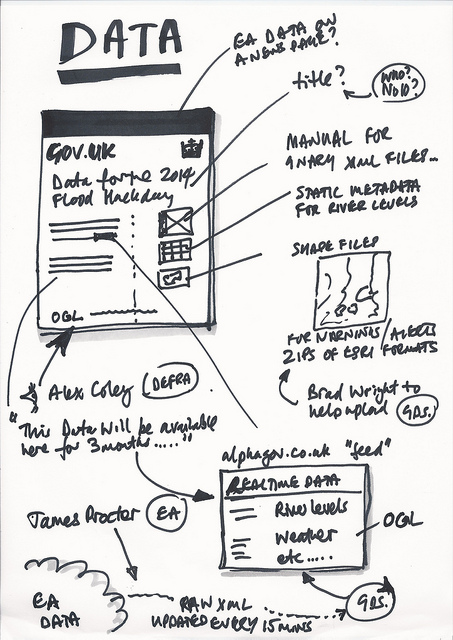
https://gds.blog.gov.uk/2014/02/23/flood-hack-developing-solutions/
Flood hack
DrupalCamp London today got underway with a keynote Delivering User-centred Digital Services by Mark O'Neill from the UK Government Digital Service.

Given the record of public and private sector led IT projects it was refreshing to hear of the GDS's approach being user-centred, the extension of 7 design principles and Mark's previous experience. It's clearly too late for the health care sector to coin and create the Needotron - GDS beat us to it.

Drupal 8 is looking formidable both in its potential and the (learning) stack it presents. Another great session to pick out was - A whole new world for multilingual sites in Drupal 8 by Gábor Hojtsy. The progress here is phenomenal and even though incomplete it is a major achievement and a credit to the Drupal community.

It's humbling as it reminds me to post some introductions to Hodges' model on W2tQ in several languages.

As to being user-centred, the Harmony Forum is a real tease. I know a forum will not moderate itself (is that the new Sorcerer's Apprentice?) and yet time is of the essence. Harmony is one for me to watch - so I'm signed up for the newsletter. Two sessions on Twig and Entities rounded up a busy few days.

This began on Thursday with Cutty Sark, the Royal Greenwich Observatory (learned much from their interactive designs), Turner and the Sea, The British Library - Beautiful Science (60-90 mins ample), and Ibsen's Ghosts at Trafalgar Studios.

I was also able to visit a university yesterday and meet a member of faculty who used Hodges' model many years ago. Here's hoping that some of the materials can be retrieved even though it seems unlikely. I hope to keep in touch with this nursing contact (and not just for the dinner!). I've met several other people here, the Drupal community is another great asset - and with thanks to the sponsors who make these events feasible for many of us.

Output from Needotron


I'll end this post back with Mr O'Neill and the GDS.

I wonder to what extent healthcare figured in the flood deliberations?

It seems that an output from the Needotron may not be so far removed from h2cm?

Happy St David's Day too - in the closing minutes here!


Monday, 24 February 2014

Drupal in Education: Richer experiences with Drupal 7 and H5P (HTML5 Package)!

The H5P module is finally available for Drupal 7! Now you can download H5P and H5P content types empowering you to create great rich experiences for your users to enjoy. Content like interactive videos, presentations, drag and drop, fill in the blanks questions and more are available from h5p.org.

We have received many enthusiastic requests for an H5P D7 module and we are proud to present the newly released version. You can find it available on the H5P project page.

You create the content with your web-browser and the content will work just as great on smartphones and tablets, as on you desktop computer.

Below is a summary of the H5P content types that are currently available for Drupal 7 (and all other platforms we support).

Interactive video ( see for additional media: https://groups.drupal.org/node/409763 )
Perhaps the most powerful tool in the H5P toolbox. Upload videos and animations, and make them interactive by adding quizzes, images and text along the way.

Presentation
Create a presentation slideshow with interactions along the way. Add text, images, video and various quiz tasks to your presentation.

Boardgame
A level based board game where the user must complete tasks in various levels to win. Depending on whether the user completes or fails, a video is shown at the end of each level. The game is fully customizable.

Flashcards
An image is displayed and the user has to insert a corresponding text by using the keyboard. The card turns to display the solution. Several cards can be added in a sequence.

Fill in the blanks
Create sentences and leave out words, adjectives, conjugations etc. for the user to complete by typing the missing text on the keyboard.

Question set
Your staple quiz question tool. Add a mix of multiple choice questions, fill in the blanks & drag and drop tasks.

Contact button
A simple widget that allows users of your website to get in touch with you using their preferred channel, such as email, Facebook or Twitter.

For those that are new to H5P, H5P is short for HTML5 Package, and is a simple way to create and share rich and interactive web content. H5P is modular and consists of several content types and applications, perfect for use in e-learning and advertising.

See all the content types in action on H5P.org

With H5P you can:
  • Export and import content types and applications between sites, e.g. from a Joomla site to a Drupal site.
  • Use existing content types and applications, and build on these to create your own content.
  • Create and edit rich web content directly in your browser. No technical skills are needed.
  • As a developer, build upon existing content types and applications, or create you own from scratch. Share your work with the rest of the world on the h5p.org!
Source: https://groups.drupal.org/node/409763

Looking forward this next weekend and London for DrupalCamp.

other Drupal posts on W2tQ.

Saturday, 22 February 2014

Call for contributions: 'Interpreting the Information Age' new avenues for research and display

November 24 – 26 2014
Science Museum, London

In autumn 2014, the Science Museum will open a new permanent gallery, Information Age. The gallery will expose, examine and celebrate how information and communication technologies have transformed our lives over the last 200 years. To mark this launch, the Museum is hosting a three day conference which will discuss how the history and material culture of information can be made relevant for today’s audiences.

From the development of global telegraph and computer networks, the creation of constellations of satellites that silently orbit our earth, and the growth of radio, telephony and cellular networks; each technology can be understood through a network of people, practices, devices and infrastructure. Approaches which focus on overly technical histories, individual innovation or inevitable progress fail to acknowledge the role of users in the history of technologies and marginalise a majority of readers or visitors who are engaged by human stories and social history. By contrast, Information Age has taken a user-centric approach, not only in the stories and objects selected for display, but in the way the gallery has been designed and developed. Participation with a diverse range of audiences has been at the heart of the process, providing new avenues for research, fresh perspectives on our collections and original ways to interpret the information networks of which we are all part. We invite papers that include insights from researchers, academics, museum professionals, community partners and participants.

The conference structure is proposed to include:

Day 1: New avenues in the history of information and communication technologies

Day 2: Interpreting and displaying the history of information and communication technologies

Day 3: Reflections on the process and practicalities of participatory practice

We are especially interested in papers that address the following themes, but are happy to consider other proposals. Please contact the organisers for guidance. 

New avenues in the history of information and communication technologies

  • From devices to networks: taking a broader approach to the history of information and communication. How has historical analysis expanded our understanding of information networks as inherently social-cultural phenomena? How can museums move beyond displays of devices, to reveal how networks unite people, places and ideas?
  • User-driven innovation: technological change does not only occur at the moment of invention, but in the hands of users, who adapt and appropriate new technologies. What tools and techniques can we use to reveal previously hidden user stories?
  • Spaces and places of information: How are institutions celebrating the local and global stories in the history of information and communication technology? What partnerships are being formed to support this?

Interpreting and displaying the history of information and communication technologies

  • Collecting information: what are the challenges of collecting the material culture of information and communication? How can opening collecting processes to wider audiences enhance understanding, and what are the benefits for both researchers and the wider public?
  • Displaying information: innovative approaches to the history, present or future of information and communication technologies.
  • Preserving information: the challenges for museums, libraries and archives in preserving our increasingly digital lives.
  • Whose story? As institutions strive to tell the story of information and communication technologies from the perspective of users and co-producers, how can we ensure that we are representing a diverse range of voices? 

Reflections on the process and practicalities of participatory practice

  • Breaking down barriers: what approaches are being taken to ensure museum collections are accessible to wider audiences? What interpretation approaches can be adopted?
  • Collaborative interpretation and design: how are institutions and audiences working together in exhibition development? What are the benefits to the museum, participant and ultimately the gallery visitor? What are the perceived risks to the museum’s authority?
  • Ensuring legacy: how do museums capture the process of participatory practice in a meaningful way? What evaluation methodologies can be adopted? How can museums support partners and participants in the longer-term? 

How to contribute

To submit a proposal, please send a 250 abstract outlining the topic of your paper, along with a 100 word biography, to [ research AT sciencemuseum.ac.uk ] by Friday 28th March 2014.

We welcome proposals which could be delivered either as paper presentations or for consideration as panel discussions with other contributors, along with proposals for workshops which practically address the conference themes.

My source: HUMANIST list

Tuesday, 9 October 2012

A shoutout to University of Northumbria at Newcastle - and others!

Although school terms and university semesters vary especially between the northern and southern hemispheres, I can often tell when a new academic year is upon us again. Not only that, but possibly a new cohort of nursing or other health care related students.

The signal is the visitors to the old website. The past week or so there's been a lot of traffic from University of Northumbria at Newcastle. Only the institution is listed, not individuals. And don't get excited about the numbers: we are talking 10s here not 100s and 1000s.

Those tens (still greatly appreciated!) could be even more significant if I could connect with someone. So if you are revisiting this blog and from UoN or any other institution please get in touch: h2cmng at yahoo.co.uk

I would really help to hear your views on:

What prompted your visit?
Who are you - what's your role, course and stage of learning?
How are you using the site and model (if at all) is it:
  • as part of an exercise merely identifying models of nursing, aspects of nursing theory...?
  • as part of a piece of (reflective) written work?
  • applying the model to a specific context, case study, nursing (or other) discipline?
  • as a critical nursing or informatics exercise?
  • as an initial exercise to help assure holistic care?
  • some other discipline and purpose perhaps?
What would you expect to find, what is missing?
What is useful and should be archived?
What sucks!
Is there something that you could add to a future site?
Do you have work on h2cm that I could highlight here on W2tQ?

There are many rich seams to dig here and if we can work together we might find some light.

There is someone at UoN I will approach if they are still there: quite possibly!

Monday, 8 October 2012

Call for Papers: 2nd European Design4Health Conference


I am pleased to [announce] the Call for Papers for the 2nd European Design4Health Conference, which will be held at Sheffield Hallam University, Sheffield, UK from Wed 3rd to Fri 5th July 2013.


The conference provides a platform for dialogue between designers, healthcare professionals, funding bodies, researchers and users. We invite submissions to the conference in the following forms:
  • Abstract submissions: extended abstracts that address the conference themes
  • Exhibition proposals: exhibits of innovative artefacts or systems that make significant progress in design for health
Please visit www.design4health.org.uk for full details.

Kind regards
Kirsty Christer and Dr Alaster Yoxall

Edited from source - JISCMAIL for context (no attachments). PJ