Showing posts with label books. Show all posts

Friday, 13 June 2014

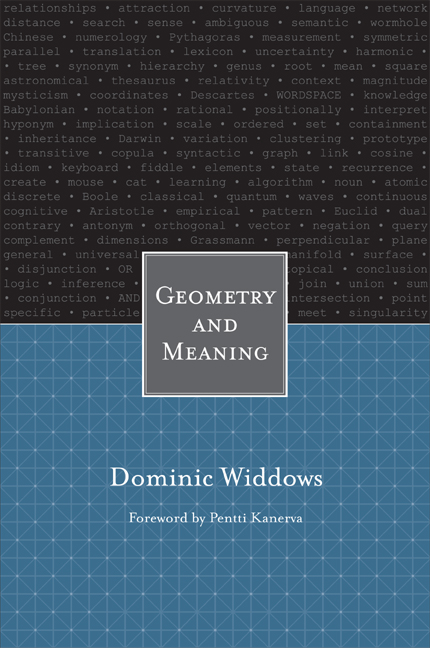
Books: The Geometry of Meaning, Gärdenfors & Geometry and Meaning, Widdows

http://mitpress.mit.edu/books/geometry-meaning
http://www.mitpressjournals.org/doi/pdf/10.1162/coli.2006.32.1.155There are two additions to my library. They are technical in parts and beyond my math and technical abilities, but as background this is essential reading.

The module 1 study, still to be marked provided a prompt to install R and obtain some summary statistics. Widdow's Geometry and Meaning includes details of the software used in the text. See the companion website below. While Gärdenfors' book The Geometry of Meaning is new, Widdow's text is a decade old and so demands some checking of software. I notice there are broken links on the companion site. The book, both in fact are great resources even as they increase the permanence of the geometry upon my furrowed brow...

Dominic Widdows, Geometry and Meaning - Companion website

Related posts:
http://hodges-model.blogspot.co.uk/search/label/conceptual%20spaces

Saturday, 22 March 2014

Over Here 2: Smart Thinking or Who do you think you are?

Of all the things that tend to merge, overlap, then appear discrete only to dissolve again we can see illness, health and well-being. To these we can add - self-help, intelligent self-help, various forms of literacy (3R's, emotional, economic, information, visual, health) and self-care.

I am sure that Hodges' model can help improve health literacy and general reflective abilities. There are some really difficult-to-reach audiences, clients and communities out there. The challenge is not just spreading the word:
A crude but generally accurate definition of what makes a smart thinking book is anything you could easily imagine being the subject of a TED talk. The recipe is to find a leading expert and get him (alas, still more often than her) to write about an idea in his field that is interesting to a wider audience and which he believes - or at least claims - can help us change our lives for the better. It has been called intelligent self-help, but since most potential readers would not appreciate the implied association with the dumber varieties, "smart thinking" has a certain advantage. ... FT Weekend. p.8
- but demonstration too.

My source: Julian Baggini, Wisdom set to work, Life & Arts, Financial Times. March 8-9, 2014, p.8.
Online: http://www.ft.com/cms/s/2/70365226-a3c1-11e3-aa85-00144feab7de.html#axzz2wiUqgpuw

Saturday, 30 November 2013

The Resurgence of - Soul Soil Society - in h2cm

On my travels into Manchester for Drupal NW and other monthly meetings I sometimes have time to call at the Cornerhouse. It's an independent cinema and visual arts venue. The shop is open until about 7pm and amongst many interesting publications I discovered Resurgence which is now Resurgence & ECOLOGIST. It is a great read - as per its banner - on the environment, activism, social justice, arts and ethical living. The great read lies not just in the content, but the fact that it challenges your way of life.

The welcome in the latest issue Nov/Dec 2013 by Satish Kumar the editor-in-chief includes mention of two books, one by Satish Kumar himself: Soul Soil Society.

As technology races ahead and governments chase economic growth through capitalist-based socio-economic systems what stands out is the failure of political systems to keep up.

The question is not how soil is created through a natural process that takes time and is itself a vital variable in a complex ecosystem. The question is how hard can we push soil?

What are the global effects of giant excavators that can move mountains, cut swathes of tarmac through rain forests? What is the natural value of soil, of land for individual farmers against synthetic fertilisers, genetically modified seed, land grabs ...? Why do we call the rainforests - rainforests#? The impacts are local, global and glocal as this issue of Resurgence and others highlights.

Below I've transposed the book's title on to Hodges' model:
INTERPERSONAL : SCIENCES
SOCIOLOGY : POLITICAL

individual
Soul


Soil

Society


What is missing?
group - population

# See also: PHYSICS & THE RAINFOREST, Peter Bunyard, pp.12-14.

Additional book:
Jonathon Porritt, The World We Made

Friday, 4 October 2013

Thursday, 3 October 2013

two books two islands two doctors - beyond a cappuccino

My uncle Doug (I do miss him) mentioned a book to me when I was some time around 1974. I think I found a copy in their bookcase when the whole family used to visit on a Sunday afternoon.
A decade later 1983, the year before I got married I visited Sorrento and during this holiday took a day trip to Capri.

With my fiancé I found myself walking around the Villa San Michele. The book was The Story of San Michele by Axel Munthe. I don’t recall consciously deciding to go to Anacapri, but I found myself there. It really made an impression on the 24 year old. What an amazing place to be, study, to try to be creative if not grandiose.

I’m sure I read the book after this visit, it dawning on me that this was - not just - that place, but the story too.

In between on holiday in Kefalonia in 1995 and read Captain Corelli’s Mandolin while there. Axel Munthe was a doctor and there’s a doctor in de Bernières’ book.

Two islands, two doctors, two books: fact and fiction and the spaces in between.

Thirty years later it was a lovely experience to take the bus to Anacapri this September and spend some time at San Michele.

Now the mix of history and styles is a bit jarring, but it is still, for me at least, an amazing space to be. The views of the Bay of Naples are stunning.

The light, the air, the sky.

Inspirational.

At some point if I could spend some time there, beyond a cappuccino...


The Bay of Naples - Vesuvius from San Michele 4 Sept 2013

literatureandmedicine

Tuesday, 10 September 2013

'Pictures to Share' book titles for people with later stage dementia

Hi
I am contacting you as one of our LinkedIn colleagues working in the field of dementia. One of our 'Pictures to Share' book titles for people with later stage dementia has been shortlisted for the UK 'People's Book Prize'

By winning this award we can help to to raise awareness of the needs of people with dementia, so it would be great if you could take a look at the People's Book Prize website, and consider voting for our book 'Proverbs and Sayings'.

The link is below:

http://www.peoplesbookprize.com/book.php?id=982

Many thanks for your help

Helen Bate and Michelle Forster

http://www.picturestoshare.co.uk/

[I will register and vote Michelle - good luck PJ ]

Friday, 9 August 2013

Papers in progress, book reviews and volcanoes

There are three papers currently in process. There is some good and bad news; plus some similarity with volcanoes. This is in the sense of active, dormant and extinct.

The papers are - with no prizes for guessing the common feature:
  1. The Scope of Nursing and Hodges' model
  2. Case Formulation (Conceptualization), Diagrams and Hodges' model
  3. Recovery and Hodges' model
Two papers are active, that's Case Formulation and Recovery. On the stove is Recovery and it's cookin. I've two co-authors providing invaluable input.

I've just read Terry Marks-Tarlow's Clinical Intuition in Psychotherapy The Neurobiology of Embodied Response and a review will follow my recommending this book right now.

There's a review copy of another book in the post that I believe can inform the recovery paper:

Values-Based Commissioning of Health and Social Care (thanks CUP)

I'm sure the concept of values-based commissioning is a gift to Hodges' model and the recovery paper. A theme to return to on W2tQ. The paper includes the Recovery STAR and relates this to Hodges' model.

The case formulation effort is with my co-author, and after a meeting in Manchester one early evening may incorporate risk formulation too.

The good news is none of these projects are extinct. The first nursing scope paper was rejected. The nursing scope paper is dormant, but is stirring following the symposium on person centredness in nursing early in May 2013.

There are two other books to get to grips with and a project that is in danger of extinction. The sight of Vesuvius next month may help: shift matters.

Monday, 8 July 2013

Four Fields

On my wish list:
In his first book since the acclaimed The Running Sky Tim Dee tells the story of four green fields. Four fields spread around the world: their grasses, their hedges, their birds, their skies, and their natural and human histories. Four real fields - walkable, mappable, man-made, mowable and knowable, but also secretive, mysterious, wild, contested and changing. Four fields - the oldest and simplest and truest measure of what a man needs in life - looked at, thought about, worked in, lived with, written.

Dee's four fields, which he has known for more than twenty years, are the fen field at the bottom of his Cambridgeshire garden, a field in southern Zambia, a prairie field in Little Bighorn, Montana, USA, and a grass meadow in the exclusion zone at Chernobyl, Ukraine. Meditating on these four fields, Dee makes us look anew at where we live and how. He argues that we must attend to what we have made of the wild, to look at and think about the way we have messed things up but also to notice how we have kept going alongside nature, to listen to the conversation we have had with grass and fields.

Four Fields is a profound, lyrical book by one of Britain's very best writers about nature.

Source image and text: Amazon

Monday, 1 July 2013

Hodges' model - DSM V: the Politics of (Well-being (Health [Mental Health])) salience, books and domains

INTERPERSONAL : SCIENCES
SOCIOLOGY : POLITICAL

individual
Diagnostic and Statistical Manual of Mental Disorders (DSM-5)
'salience' 
‘Salience syndrome’ replaces ‘schizophrenia’ in DSM-V and ICD-11: psychiatry’s evidence-based entry into the 21st century? J. Van Os

bereavement
medical, bio-psycho-social, recovery model
self-efficacy
self-stigma

DSM5 and Ethical Relativism

Ultimate terminology: 
self, person, patient, service user, client, 
Mr, Miss .....
Diagnostic process
'Evidence', objectivity, 
repeatability, validity, treatment, drugs
Credit Heidi Cartwright, Wellcome Images
The history of DSM: APA : Wikipedia
stigma
social services
social network (size, quality)
anti-psychiatry
social norms?

Media: Books review - essay;
Stevenson, T. (2013) Mind field, FT Weekend, May 25-26. p.8.
American Psychiatric Association APA

dx revision watch

Opinion - commentary:

DSM-5: Caught between Mental Illness Stigma and Anti-Psychiatry Prejudice

Is Criticism of DSM-5 'Anti-psychiatry'?

Goldacre: Bad Pharma
.... and much more...!

group - population


Image: http://wellcomeimages.org/

Monday, 22 April 2013

A sentence in a word - precarity - and a bad spell of 'whether'

In the past couple of months I've acquired three books to review. One of them is:

Philosophical And Theoretical Perspectives For Advanced Nursing Practic, Cody.

I'm pleased to say that over half the book now has extra notes (in pencil). Within the text and my reflections there are a great many potential posts. In chapter 18 though Doane and Varcoe write:
Subsequently, there has been little discussion about what is required to develop and enact that sensitivity and/or the knowledge, capacities, and skills required for ethical and responsive nursing relationships within the complexities of current health-care milieus. For example, as social inequalities deepen and neoliberal ideologies hold individuals responsible for their own health and well-being regardless of how poverty, disability, remote geographical locations, or other inequalities determine health, notions of obligation, responsibility, accountability, and efficiency are as vital to nursing relationships as are notions of compassion, responsiveness, trust and respect. Thus, nurses require a broader understanding of relationships and their significance to ethical nursing practice. p.204.
The sentence in (my) italics can be summed up in one word - a recently discovered concept for me - that of: precarity.

Here the definition on Wikipedia (c/o the above link):
Precarity is a condition of existence without predictability or security, affecting material or psychological welfare. Specifically, it is applied to the condition of intermittent or underemployment and the resultant precarious existence. The social class defined by this condition has been termed the precariat.
Nursing is bound to be affected by the socio-economic environment. Caution is needed as the weather impacts, puts pressure on nursing's values.

Doane, G.H., Varcoa, C. (2013). Relational Practice and Nursing Obligations. In Philosophical and Theoretical Perspectives for Advanced Nursing Practice (5th ed.), by W. K. Cody (Ed.). (Burlington, MA: Jones and Bartlett.

Thursday, 24 January 2013

Two new books ... to review and a new IPONS website

There are two books in the post for review here which I look forward to receiving. Originally I only enquired about the following:

Philosophical and Theoretical Perspectives for Advanced Nursing Practice, Fifth Edition 

The book will continue to address a need to identify philosophical and a theoretical basis for h2cm.

A phone call from the publisher's rep. Clare McMillan had noted the informatics content here on Welcome to the QUAD W2tQ and would I also be interested in another book?

Yes please, certainly... I appreciate the recognition too.


Nursing Informatics and the Foundation of Knowledge, Second Edition is also to follow and not without a challenge as Clare pointed out. This foundation on informatics is focused on the North American experience. So it is a perspective from Wigan Pier to follow.

Of related interest and with further refinements to follow apparently, the International Philosophy of Nursing Society has a new website.

Wednesday, 31 October 2012

A model, HTML5, games, the normal and the pathological

In the UK the powers that be finally recognise the need to introduce children to computer programming. Our future economic viability depends on no less. So many children are too locked into playing games to consider how games are created. New developments including the Raspberry Pi should help change this.

Here's a possible book intro....
While this book is considered an introduction to building HTML5 care applications with Hodges' model a conceptual framework, it is also intended to be a companion guide to help get you started making, and more importantly, finishing your care applications.
Now I'm not seriously proposing that a care application could be written in HTML5 (am I?). In trying to encourage a teen game player to try game programming, I came across a sentence in Jesse Freeman's short book Introducing HTML5 Game Development which I've revamped above.

The book is about Impact (not open source), a javascript framework. Skimming through the text's potential as a present, you appreciate the potential of games and simulations in health care.

In health care we talk about levels of care. In Impact there is Weltmeister a level editor.

The reader is also encouraged:
"Think of the canvas as an image, that we can bitmap data into." p.8.
There are maps: background and collision. There are Classes, Person is an inevitable example. Admittedly there is also a zombie, but then one of the domains of Hodges' model is frequently described as being populated by zombies (well, look at their movement and the fact that they are non-living).

There's talk of a GDD - a game design document. There is a need for a high concept, plus an asset pipeline, and if the design includes complex levels the likely need for a background, middle ground and foreground. If Life is about sprites running ragged around levels of game play, Death is in there too.

Additional link: Normal and Pathological

Wednesday, 26 September 2012

SF, health, criminality and justice

"The Dehewwoff system of punishing by disease; graded capital punishment; the more serious the crime the more serious the disease the culprit is infected with. For minor crimes a mere fever, loss of livelihood and medical expenses; for more damaging misdeeds a bout of something lasting perhaps months, with pain and long convalescence, bills and no sympathy, sometimes marks to show later on. For really ghastly crimes, infections with diseases rarely survived; near certain death but possible divine intervention and miracle cure. Of course, the lower one's class, the more virulent one's punishment, to allow for the hardier constitution of the toilers. Combinations, and recurring strains, provide sophistications to the basic idea." p.181.

Use of Weapons, Iain M Banks, 1990, Orbit.

Amongst other reading and snorkeling, I read Use of Weapons on holiday. Consider Phlebas was the better read to me. I've come across this disease - justice idea before. As I read the above paragraph in the book you can see the many limitations with this, the physical, psychological and ethical dimensions. This is SF of course, but are the assumptions about the toilers accurate? As a health care professional and thus exposed to more bugs what impact would that have? You also wonder to what extent personalised medicine could physically level the sentencing field? The point about divine intervention seems to suggest a way to gauge - balance that uncertainty element. Is this left to a surface protein or something else? Are the diseases as punishments all to be physical?


My copy (see inside back cover) is now sitting on a shelf in the secondhand book section of the supermarket across from the Zante Park Hotel in Laganas, Zakynthos - the quieter end of the resort. I bought two Camus paperbacks, my book was donated - I suppose you could also say it was shop-dropped - and I'd washed my hands. ;-)

Image source: Goodreads.com

Monday, 26 December 2011

Christmas: Buena Vista Social Club & Multidisciplinary, Interdisciplinary, Interprofessional and Transdisciplinary

A welcome gift for Christmas# was Wim Wenders' and Producer Ry Cooder's film - Buena Vista Social Club. The music, story, sound and images are a real treat. Several of the artists are sadly no longer with us, what is clear is the role that music can give to people in their senior years. The companionship and musical narrative that was rekindled in the late 90s is brilliantly captured and just in time: for the rest of us. The way these musicians and the technicians fuse, improvise, learn together, complement and contrast, and inspire each other is brilliant.

Whilst watching and listening I've realised that for the intro to the conceptual space notes I need to grasp details about the cussed customers - multidisciplinary, interdisciplinary, interprofessional and transdisciplinary.

Checking on current and forthcoming books I'm seeking a review copy to inform my musings:
The sequence in the title is not accidental but roughly equates to the descending frequency of use in health and social care. The most common (multidisciplinary) and least (transdisciplinary) are not dissimilar in needing to be defined and explored. Talk of multidisciplinary in theory, practice and management – notably policy – is so frequent that the meaning of the concept is diminished. On the other hand transdisciplinary is so infrequently used that the meaning is blurred. This is compounded by the noisy signature produced by the proximity of interdisciplinary and interprofessional.
This quartet are like musical disciplines and genres that can potentially grate on the ear and yet also make possible some amazing productions. Maybe that process is what goes into World Music? What in turn needs to go into global health?

#Another much appreciated present is the Steve Jobs biog.

Tuesday, 6 December 2011

The astrolabe, programming and big pictures


The astrolabe was a
mechanical implementation of
an object-orientation
model of the sky. p.47.


Eric Evans, (2009). Domain-Driven Design: Tackling Complexity in the Heart of Software, Model-Driven Design. Addison-Wesley.


Image source: http://planetariubm.wordpress.com/2011/03/01/femei-celebre-in-istoria-astronomiei-1/